Why there’s an audio version
Some readers prefer to read at their own pace. Others (especially when eyesight, energy or health make reading harder) may find listening easier. So I’ve added an audio option—feel free to relax, sit back and listen, or carry on reading—whichever suits you best.
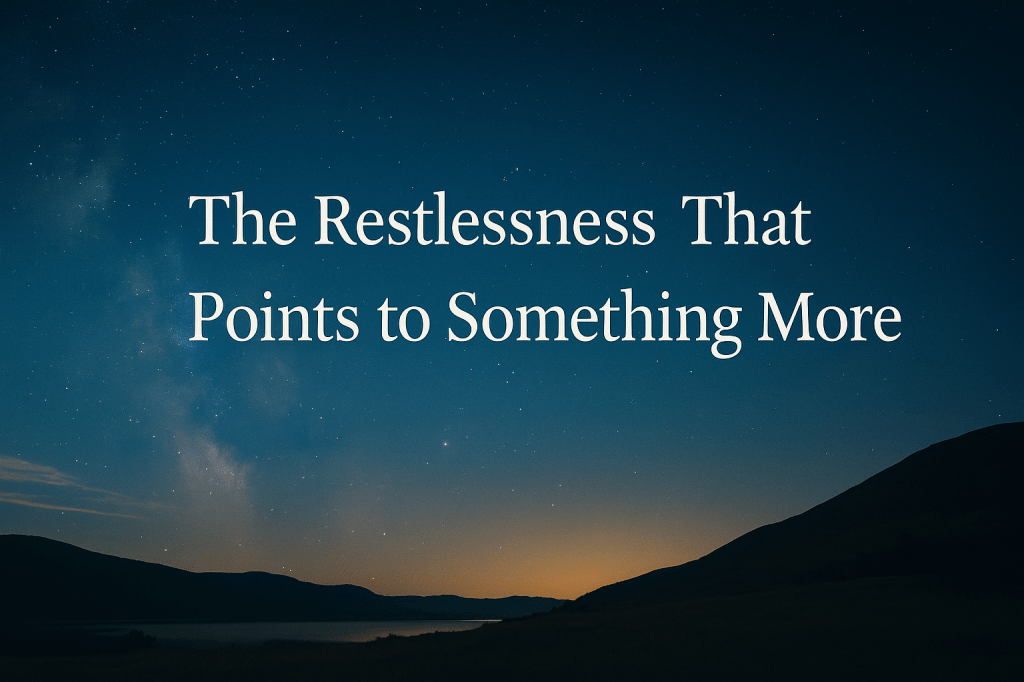
The Restlessness That Points to Something More.
Wonder begins early in life. As children, we asked questions with unguarded honesty—questions that cut beneath the surface of everyday life. We looked at the sky or the rhythm of the seasons and felt instinctively that the world was meaningful. We sensed intention, beauty, and purpose long before we could articulate any of it. The world felt alive.
Yet growing up brings noise. Responsibilities tighten. Modern life hums relentlessly—emails, deadlines, notifications, expectations. Eventually those earlier questions fade into the background. They never truly vanish; they simply sink below the surface. Still, every now and then, something interrupts our pace—a quiet morning, a late-night drive, a moment when the world feels strangely still. And there, in the silence, the old questions rise again, as though patiently waiting to be acknowledged.
These questions are not signs of weakness. They are, in many ways, a map leading us toward a deeper reality.
How We Lost Our Shared Compass.
Only a few generations ago, many in the Western world lived with a shared sense of orientation. Faith, community, tradition, and a belief in a higher purpose sat at the centre of daily life. People disagreed, yes, but most felt connected to something beyond themselves—something more stable than personal preference.
Today that grounding has shifted. We are encouraged to craft our own identity, determine our own truth, and build our own meaning from scratch. The language is empowering, promising unlimited self-expression and total personal freedom. But this freedom comes with a hidden cost: if meaning comes only from within, then we must continually sustain it. We must invent it, protect it, and perform it.
For many, this has not produced confidence but exhaustion. A quiet, unspoken hollowness sits just beneath the surface. The slogans of modern life promise liberation, but they leave us carrying the full weight of our own significance.
The Quiet Experiment of Building Meaning Without God.
Across the last century, something subtle happened. Society began an experiment—one many never consciously agreed to. Faith moved from public life to private life, then from private life to irrelevance. God shifted from the centre to the margins and, eventually, out of the picture altogether.
At first, this shift felt like progress. But without God, the foundations that once supported identity, worth, love, dignity, and moral meaning grew thin. When the human heart loses any reference point beyond the self, everything becomes negotiable. Truth becomes personal. Purpose becomes fluid. Identity becomes fragile.
And when life becomes difficult—as it inevitably does—self-constructed meaning begins to wobble. Hospital corridors, grief, loss, and loneliness often reveal the limitations of carefully curated self-defined purpose. In those moments, many discover an instinctive longing for something solid. Something transcendent. Something real enough to hold the weight of suffering.
Why We Still Feel the Ache.
Despite our technological comfort, our constant entertainment, and our unprecedented convenience, a quiet restlessness lingers in nearly every corner of modern life. Many describe a sense of spiritual depletion they cannot quite name. They change jobs, relationships, locations, habits, and online personas, yet the same unshakable ache returns.
Perhaps that ache is not a malfunction. Perhaps it is a message.
When we remove God from the centre, we inevitably place ourselves there—but the human heart was never built for that role. Most people, even in a secular age, continue to live as though love is real, justice is real, truth is real, beauty is real, and human dignity is real. Yet these realities sit uneasily within a worldview that insists everything is accidental and impersonal. Deep down, we sense that these things point beyond us. They whisper of a source.
Why Our Deepest Questions Still Matter.
We can distract ourselves for years—sometimes for decades—but we cannot outrun the deeper questions that come for us in quiet moments. If suffering exposes the limits of self-invented meaning, and if the ache of restlessness reveals a hunger that comfort cannot satisfy, then perhaps the assumptions of our age need re-examining.
John 14:6 (ESV 2007) speaks with striking clarity:
“Jesus said to him, ‘I am the way, and the truth, and the life. No one comes to the Father except through me.’”
This is not an argument for nostalgia, nor is it a call to return to a past era as though it were golden. Rather, it is an invitation to consider whether removing God from the centre may have unintentionally removed the very foundation on which value, meaning, and hope rest.
An Invitation to Look Again.
You do not need certainty to begin exploring these questions. You do not need to call yourself religious or even know where you stand. You simply need to acknowledge that the stirrings inside you—the longings, doubts, and moments of wonder—may be pointing toward something more substantial than personal feeling.
This is not a verdict on your life or a demand for instant belief. It is a simple invitation: look again. Consider the possibility that the restlessness within you is not an enemy to silence or suppress, but a signal. A signpost toward the One who made you.
If God is real, then seeking Him is not a hobby or a side interest. It is the most important journey any person can take. And that journey often begins not with certainty, but with curiosity.
What if the ache you feel is an echo of the One who calls you?
What if meaning is not something we construct, but something we discover—something already woven into the fabric of reality?
What if those quiet questions are not interruptions, but invitations?
The restlessness may, in the end, be the door.



2 responses to “Blogging Blogging Blogging.”
Good day Jo. I hope you are doing well. I resonated with some of your thougts in this post, especially this one: “New questions arrived before I’d finished answering the previous ones.” I know this experience all too well. Regarding how often to blog, of course that is up to each blogger. Personally, seeing people post every few hours reminds me too much of other social media, like Facebook or Twitter. A lot of people use their blog in the same way, albeit, maybe a little bit deeper as they like to respond to daily prompts, instead of posting about how they overslept, had nothing to eat for breakfast except stale cereal since they had not gone shopping lately. Daily prompts don’t really appeal to me as far as posts for my blog- they just don’t fit what I am trying to do on my blog (even if responding to them drove more traffic.) Considering the type of writing I produce, I don’t think I could keep up a pace of being able to write something new daily.
Anyway, as I was reading your post, an old favorite verse of mine that has given me a lot of hope over the years came to mind. Isaiah 42:16: “And I will bring the blind by a way that they knew not; I will lead them in paths that they have not known: I will make darkness light before them, and crooked things straight. These things will I do unto them, and not forsake them.” I think this verse may fit your situation in conjunction with Isaiah 29:16: “Surely your turning of things upside down shall be esteemed as the potter’s clay: for shall the work say of him that made it, He made me not? or shall the thing framed say of him that framed it, He had no understanding?” Sometimes God allows our world to be turned upside down and we become blind in the sense of where things are going and where He will take us. But as you have shown above, a world turned upside down can still be redeemed and used by God greatly- even more we ever thought before. Never give up on God and let Him use you. Don’t worry about your blog stats but just being faithful. At the end of our days, that is the true measure of success in His eyes. God bless.
Christopher,
Your comment sent me back to Scripture, which is always a good thing. Isaiah 42:16 reminded me that when my world was turned upside down, God is upholding me through it all. He is the One who carries me, strengthens me daily, comforts me, and gently leads me forward into this new season of writing. I’ve always seen myself as clay in the hands of the Potter, our Creator, and these verses confirmed that again. My life, my limits, and this unexpected path are in His hands. And just as the body of Christ has many members with different gifts, we each serve in different ways. You write beautiful poems and reflections that connect with others like me; some write studies, some share stories — but it is the same God who arranges and uses it all. Thank you for sharing those verses and for the encouragement. P.S. If your notifications start pinging every five to seven hours because I’ve posted again, just put my notifications on vibrate :-) — God seems to be setting my schedule these days! God bless you.