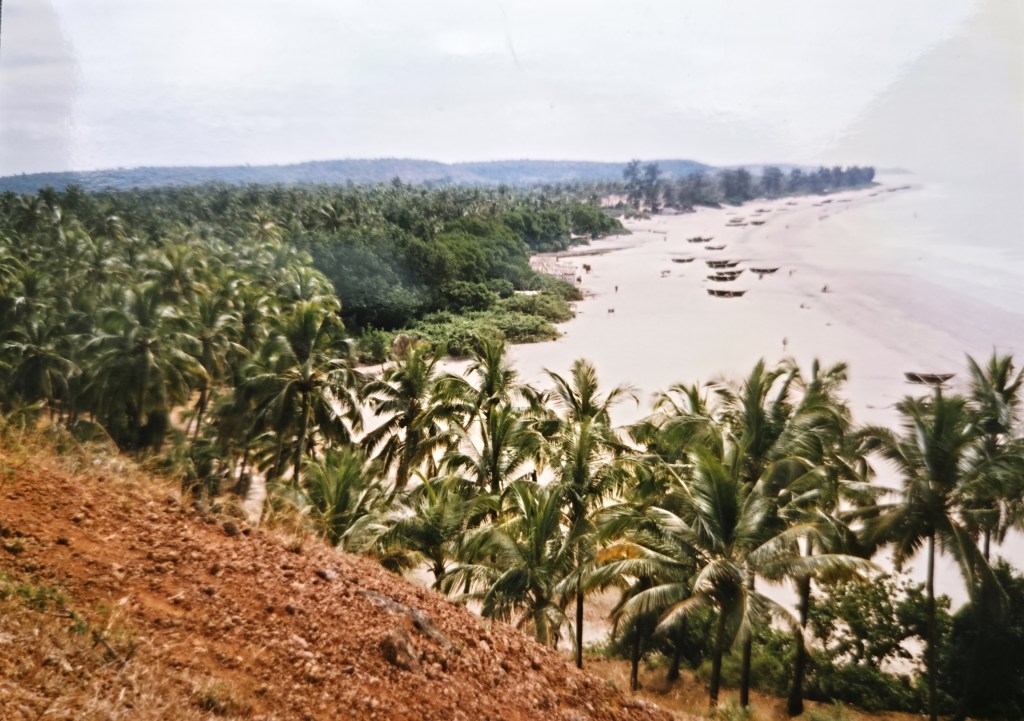
1999 – Decision to Return for the Millennium.
Just before the end of November 1999, I’m with a group of friends from my local area – some I’ve known for decades, others for ten or five years. I’m telling stories about Goa at Christmas from the earlier trips: the shacks, the beaches, the madness, the quiet.
By the end of the evening someone says, “Why don’t we go for the millennium?” That’s it. Decision made. “Let’s do it.”
We each book flights separately. I give people the details of the broker who usually books mine; some go through him; others sort themselves out. Alan and Gemma, a couple in the group, book their own flights. One friend, Lyn, chooses the absolute cheapest route, going via Russia and somewhere else, taking a much more complicated path to Goa.
By this time the Goa airport is built and up and running. Everyone arrives before me. I land about four days later than the rest, bringing a ridiculous amount of duty-free whisky, vodka, and cigars. No stopover in Saudi this time, so nobody confiscates anything.
2000 – Six-Bedroom House and a Changing Village.
For most of my friends, this is their first time in India and in Goa. They haven’t seen Bombay or anywhere else – just straight into this little corner of Goa that I’ve been coming back to for years.
On my first trip in the 1990s I’d gone through Bombay and eaten my first meal in a big hotel that would later be known for a terrorist attack. This time, I leave the airport in a rickshaw with my mate Lance. On the way he casually drops it into the conversation:
“We’ve rented a six-bedroom house.”
I laugh and say, “I didn’t know there were houses like that in Goa.”
Turns out it’s the only one like it in the village. It belongs to a local family I’ve met before over the years. It’s made of brick, with a proper slate roof. There’s an indoor shower and a separate bathroom with a Western toilet. Water is switched on to fill a tank bolted high up on the outside wall, and the whole system runs by gravity.
For Goa, in that little fishing village, this is the West arriving. It feels like the beginning of the end of its old peace and quiet.
Each person gets about a one-minute shower to wash and get ready in the evenings. The routine is simple: you wet the bar of soap, lather your whole body with a tiny bucket – the kind kids use for sandcastles – and then you’ve got one minute under the shower head to rinse off the lot before the water pressure dies. I don’t like it. I preferred the old way, pouring water over my head from the village well, staying closer to the life of the locals.
There are seven of us in total staying there. Alan and Gemma share one room; the rest of us spread out over the others. It’s comfortable, too comfortable. Eventually I decide the rent is too much and move back out into a shack again. The old pattern returns I go back to sleeping in simpler places while the others enjoy the “luxury” house.
Hammock Makers and Undercover Police – Millennium 1999-2000.
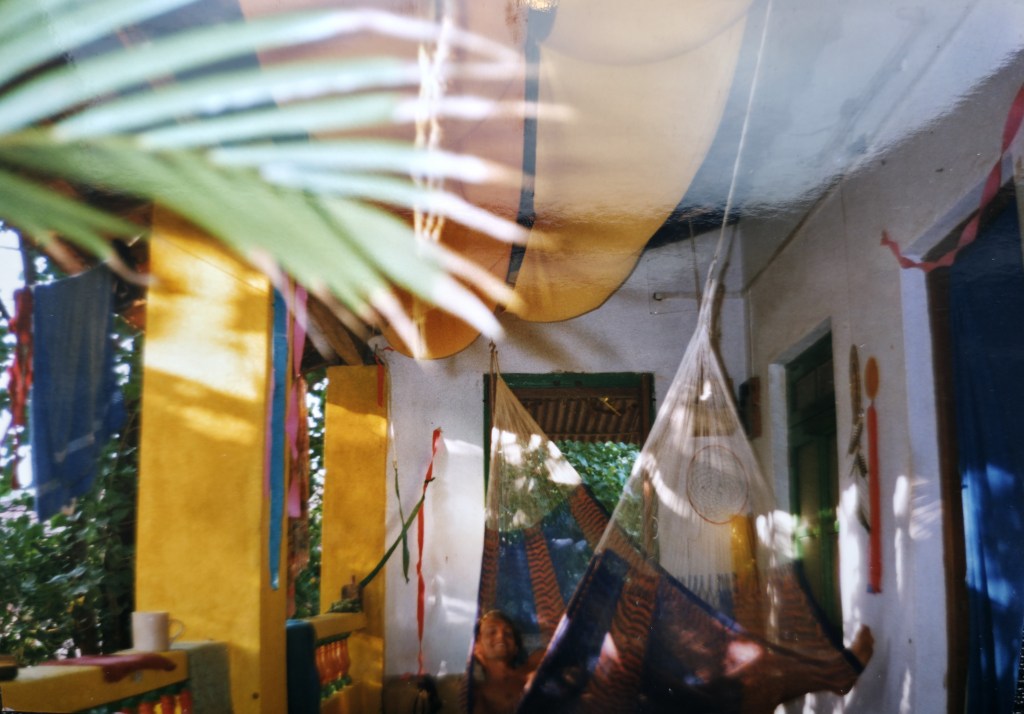
Over the years I become friends with a couple who make and sell very good quality hammocks. They always seem to be in Goa, year in, year out. They know the village, the locals, and the different layers of police – including the plainclothes officers.
They invite me to their place for homemade food; I go often, and one day I invite them down to the beach with the promise of drinks and food on me all day.
By sunset the beach is busy. People are smoking strong cannabis derivatives – “cream,” “gum,” and other forms that are closer to oil and crystal than the usual stuff. It’s powerful and hallucinogenic. Plainclothes police mingle with the tourists.
The hammock-maker’s wife gets up and starts walking around the beach, casually picking up small sticks. Each time she passes a plainclothes officer, she plants a little stick in the sand next to them. After quietly marking them all, she comes back and announces to everyone, “Wherever you see a stick, that’s a policeman.”
Bold, funny, and very accurate.
By this point the game has shifted. It’s no longer just fake “police” trying to extort a bit of money. Now the real police are operating undercover with quotas to hit – a certain number of arrests, a certain amount of bribe money. The money moves up the chain, and everyone takes their cut.
If you’re caught with even a small amount of cannabis, you’re looking at a possible ten-year sentence in an Indian or Goan prison. Many tourists pay bribes to avoid that. If the police are short on their monthly numbers, they sometimes pick people at random on the beach, leading to court cases, jail terms, and people being stripped of their money and sent home in disgrace.

Beach Shack Christmas and the Pig Meal.
On one of my trips back – about two years after the first time in Arambol – I buy an open ticket that lets me stay for up to six months. The shack where my friends and I had spent weeks on my first trip has done so well that the original owner has moved on to other business. His brother has taken it over and tried to “modernise” it with breeze blocks and Western touches.
We don’t like it. It feels wrong. So, we walk further up the beach and find a very basic timber-frame shack run by a young lad in shorts and flip-flops. He’s there every morning when we arrive, serves us beer all day and all night, cooks on a single ring stove behind a curtain, and somehow manages to get us whatever we ask for.
Around Christmas he tells us, “Christmas dinner is on us. You won’t have to pay.”
When the food arrives, it’s a brown broth with bones and no meat – from a village pig. We know what the pigs have been eating. They’re the village waste system, living under the shack toilets and eating human excrement as it falls. Looking into the bowl and seeing mostly bones, none of us can bring ourselves to eat it.
We don’t want to offend them, so we say it’s “too spicy” and ask if we can have something else. They bring vegetarian food. We decide to stick to vegetarian food and fish in India and leave the pig meat alone.
My first close encounter with the pig system had been at about three in the morning after a day and night of laughing and drinking. I was using a shack toilet – a simple hole in the floor – when a large pig’s snout suddenly appeared through it, eating as I continued. I remember joking with the pig and asking if it wanted wine with its meal.

New Year 2000 – Three Days of Parties.
By the time New Year’s Eve 1999 rolls round, the whole group and I have been on a heavy week-long drinking session. On New Year’s Eve itself we head to a party in a bamboo forest. The music is tribal and repetitive. After about three hours, it all sounds the same to me. Everyone is doing the trance-step dance, locked into their own world.
We mostly drink, watch everything, and chat with people.
As usual, a bit of trouble tries to find us when someone starts on one of my friends. I tell the bloke to leave us alone; he does, and that’s that.
Sometime in the early hours I fall asleep at the bamboo party. Instead of taking me home, my brother and friends carry me to another party. I wake up in daylight at a beach party on Day Two. We get some sleep on the beach during the day, then party again through the night.
On Day Three I wake up at yet another party in a completely different place. Everyone I came with has gone back. I have no idea where I am in Goa.
Then I spot one of the African lads I know from Arambol – someone I’ve become friendly with over the years. I walk over, offer him a beer, and ask, “Where are we?” I explain that I started in a bamboo forest three days ago and have been transported from party to party while asleep.
He laughs loudly, tells me where we are, and where the taxis are hiding. I find a taxi, get back “home” to my shack, and sleep there properly for the first time in days. By now I’ve moved out of the expensive house because I think the rent is too high. I sleep off three to five days of near-continuous drinking.
Parties, Israeli Soldiers, and A Broken Man.
By 2000 there are motorbikes everywhere – big 350cc Indian-built versions of old British Enfields. Packs of young Israelis who have finished their national service roar into Goa on them, usually in big groups. They arrive loud, fast, and ready to blow off steam.

I see and hear about far too many casualties. Chemists treat tourists as test subjects for new drugs – acid, ecstasy, all kinds of experimental blends. Some people never fully come back.
One night our group goes down to the beach for a big fire party. I show people how to build a proper beach fire that will last all night: dig a big hole, buy wood from locals over several days, and pack the fire with dry sand so it burns low and isn’t so visible to the police.
A large group of Israeli ex-soldiers sit around the fire with us. One of them gives me a hard, aggressive look, then gets up, walks behind me, and slaps me on the back of the head. I decide to let it go.
Ten minutes later he does it again, harder, on the top of my head.
I stand up and address the rest of the group, asking who he’s with. I tell them they know he’s out of order and it’s on them to control him, so I don’t have to. Then I sit back down.
A short while later, he comes round again and kicks me in the lower back. That’s it. I tell my friends we’re leaving, and we walk about a hundred metres to another shack where people know me from previous years. The same London/Jamaican bar owner is there and tells me that once the Siolim–Chopdem bridge is finished in 2002, he plans to leave because direct road access will turn the beach into a crowded, sunbed-lined circus.
We’re sitting on floor mats in his shack when the same Israeli soldier walks back in with five others. He kicks me in the back again while I’m seated. I jump up. He drops into a martial arts stance. I tell him he’s going to need it. I quickly get him in a throat hold and throw him over two of the little table bays. He lands in the sand, not on anything solid, and his mates drag him out.
A very large American man, who looks ex-military to me, stands up and says, “We don’t want trouble here. Trouble started when you came in.” I tell him I didn’t start it and explain that the soldiers followed us. I say the man is struggling and looks completely gone, probably from too many experimental drugs.
The American says, “I want you out.”
I reply, “If you think you can get me out, you can try.”
The shack owner, the London/Jamaican man, speaks quietly to him, and the American sits back down. The situation deflates.
The next morning the American and I are the first two in the shack. We end up talking, get on really well, and spend two days and nights drinking together and laughing. The aggressive Israeli’s parents fly out to Goa to collect their son. He has become a casualty – mentally and spiritually – and is beyond his friends’ control.
They ask to meet me and thank me for not hurting him. I tell them there’s no need to thank me and wish them well in getting him home safely. They arrange for him to fly back to Israel. Over that period, I see and hear too many horror stories of drug casualties in Goa, people broken in body and mind.
Bible, Seeking Years, and a Later Realisation.
Before I ever became a Christian, I was already a seeker. I always travelled with a Bible – my first Bible, a Good News Bible with an orange cover and simple line drawings. A pastor had once recommended it as a good starter Bible. I can’t remember exactly how young I was when I first got it, but by the time of my Goa years it was worn from use.
Wherever I stayed in Goa – shacks, huts, fishermen’s homes, village houses – that Bible was always next to my roll-out mat. Sometimes the places had no doors or windows, sometimes the doors were left open all night. But the Bible stayed by my mat.
I travelled light. My rucksack held very little apart from that Bible and a few essentials.
By 2000 and earlier, I noticed that everywhere we went locals seemed to recognise the bikes we’d hired. We’d ride little mopeds, 125 Hondas, or Enfields that we’d rented from village families. We’d travel to beaches far away from the main crowd or to places like the Anjuna flea market, and someone would say, “You hired that from my cousin,” then ask how much we paid. We’d laugh about how close-knit the village networks were.
Years later, on 28 November 2025, it hit me: it’s very possible the whole village knew I slept with a Bible by my mat. Goa has Christian communities. Villagers talk about visitors, especially ones who keep coming back year after year. A foreigner who drinks like the rest, lives a simple tourist way, but always has a Bible beside his bed – that would have been noticed, that’s what we witnessed with the locals. It was a part of community safeguarding.
Looking back, I can see those Goa years as part of a long-term “seeking” and God’s call across decades – even though I hadn’t gone there to study religion. I thought I was chasing sun, sea, and parties. Something else was going on.
From Goa to the Gospel.
During one break at Arambol around 2000, after six weeks of sun, sand, sea, and parties, I opened my rucksack and took out my Good News Bible again. I’d seen stone and wooden idols being worshipped. I’d seen the mash-up of Hinduism and Catholic Christianity left over from centuries of Portuguese rule. I’d seen people bowing down to gods they themselves had carved.
Something in me, which had been building for years, refused to accept that the beauty of the world, the universe, and the rare glimpses of real love we see were all an accident. I wanted to search. I wanted to know the truth.
That was the beginning of the journey where Christ found me – lost in a world that worshipped false idols: money, material things, stone gods, wooden gods, even papier-mâché gods paraded at festivals in Bombay.
I’ve travelled through many countries in my life, and everywhere I went I saw the same thing — people worshipping idols. Not carved statues only, but the things we all lift up above God. In India, the idols were literal and handmade, shaped from wood, stone, plaster, or metal. Back home in Britain, the idols weren’t statues at all, but money, status, possessions, comfort, and the need to look successful. Different forms, same root. We all create something to replace the God we don’t want to face. Seeing that contrast so clearly was part of what led me to look deeper into the Gospel.
Back in Blighty, some years later, I watched YouTube videos of Arambol Beach and felt sick. It was unrecognisable. A total freak show. Huge crowds. No fishing boats. Rows of sunbeds like a Spanish resort. One friend of mine kept going out there for six months every year, renting a house or shack, then working six months in metal framework back in the UK. He gave me updates about the changes – the arrival of the Russians, the area nicknamed “Little Russia,” and the rest of it.
For me, after 2000, it was over. I stopped going. The fishing village I’d known had gone.
Coming next: From Goa to the Gospel – Part Three
