Tag: Holy Spirit

  • From Goa to the Gospel: Part One.

    From Goa to the Gospel: Part One.

    These three posts have taken a long time to write, and I wanted to publish them together so the story flows properly from beginning to end. I only scratched the surface of everything that happened. I hope you enjoy reading them as much as I’ve valued writing them.

    1994 – First Trip to Arambol in Goa.

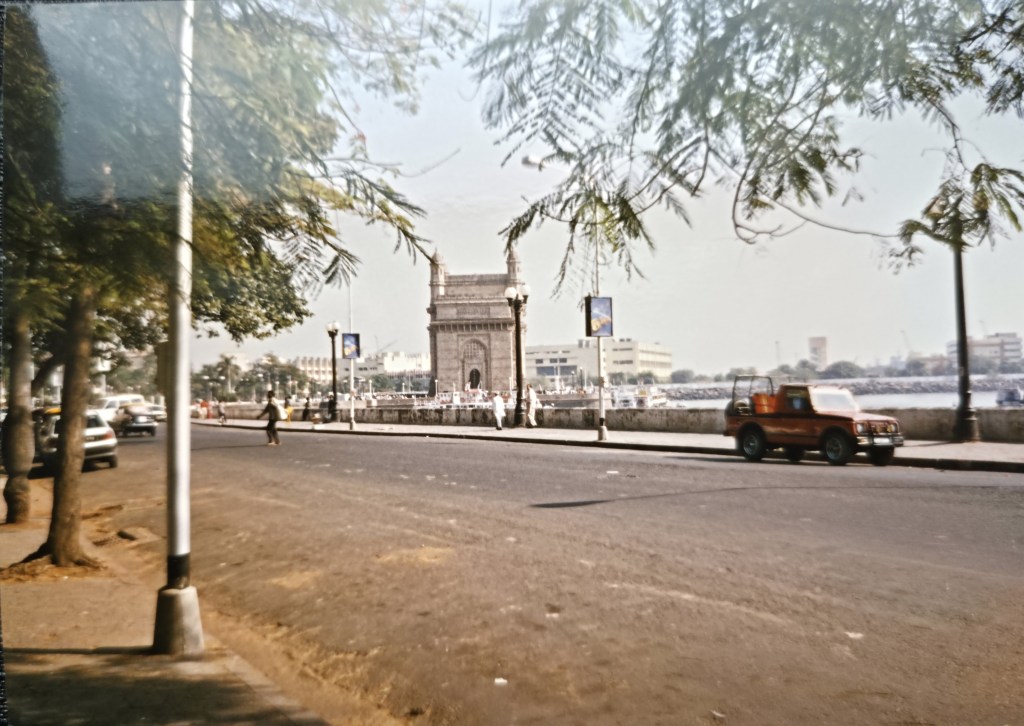
    Travelling to Goa for the first time in the 1990s for about two months with a large group, eventually around fifteen men gathering in Arambol. Our group starts out in the south of Goa, in Calangute, after travelling down from Bombay. Image of the gate of India, Bombay in 1994.
    Calangute is a horrible place to waste time staying. The beaches are awful, and the place the lads stay in is like an insectarium, with insects pouring out of the walls at night. My brother and Jay go straight out for cigarettes and a beer as soon as we arrive, even though we’d just survived an overloaded bus with wooden seats for fourteen hours. It was a cheap and nasty bus trip from Bombay over the most dangerous mountain roads I’d ever seen. There were bus graveyards at the bottom of the cliffs along the route.

    The drivers chew betel quid, a psychoactive mixture of betel leaf, areca nut, slaked lime, and spices like cardamom or cloves. They drive as if they want to die on it. There are only three of us on the bus at this point and we’re the only foreigners. I stand up and ask the bus, “Does everyone want the bus to slow down on these mountain roads?” The whole bus nods instantly.

    The cabin door is locked, so I knock. When no one opens it, I shove it open. There are always three or four drivers taking turns, but to my horror I see a brick on the accelerator and the driver is sitting cross-legged on his seat. All of them have red glazed eyes, red lips, and red teeth. They’re clearly addicted to betel quid and under orders to do the two-way trip as fast as possible.

    I try to remove the brick and keep motioning for them to slow down. A woman shouts something in Hindi, they finally slow—five minutes later they’re back at full speed again. Alton Towers had nothing on this ride.

    A few hours later my brother and Jay return to the room and explain they got into a fight with ex-pat squaddies because the squaddies didn’t like Jay’s dreadlocks. The squaddies lose the fight.

    In the morning, I wake up determined to find these men and make sure they got the message to leave us alone. I follow the main dirt road to a beach shack and see an old school friend with a group of men, one with a busted leg. I sit near them, nodding to the lad from my town, and hear one man saying he’s going to find “those two blokes” and do them in.

    I find him in five minutes. None of his injured friends follow. He gets up and heads towards his Enfield bike. I follow. Before he can mount it, I tell him, “Look no further, I’m who you’re looking for.” He keeps circling the bike, avoiding me. I warn him it won’t end well for him if he causes any more trouble. He runs inside, comes back out with a large knife, and says, “I’m ready now.”

    I slowly walk away down the sand path. He follows on his Enfield but keeps a safe distance, which tells me he doesn’t want a real fight. I lead him to our digs; he waits about fifty feet away. I tell my brother and Jay. We all agree to tell him to meet on the beach at sunset if he wants to sort it out. He agrees. We then throw our rucksacks into a rickshaw and head north to Arambol. I hadn’t gone to India to fight.

    The bridge to Arambol is still being built, so the rickshaw takes us only as far as the ferry. On the other side, we take another rickshaw and arrive in Arambol early evening. I go straight out to eat and see the beach. My brother crashes out, so Jay and I head to the beach.

    On that first night, we see a light in the distance on the beach. We walk towards it, guessing it’s a fire. It is. A small group is gathered around it. Nights can get cold on the beach, so we stay there, talk with strangers, and watch the sunrise. With no electricity around and no pollution like back home, I see the stars properly for the first time. It is incredible. The weight of life falls away. I remember thinking: this was created. That sky, those stars, that scale—no chance accident.

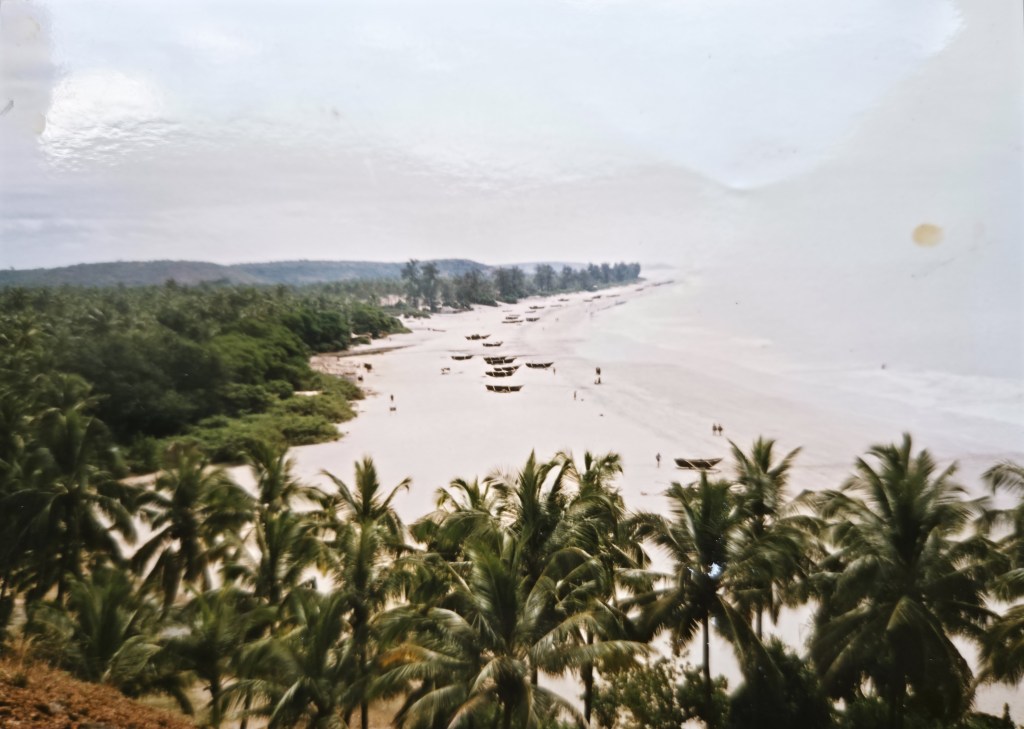
    After a day and night, I realise this beach is the closest to untouched I’ve seen in India. The only thing spoiling it is us being there. The only things on the beach are three fishing boats.

    It doesn’t take long before the rose-tinted glasses slip. The seawater isn’t clear. Sewage from the village runs through an open sandy channel into the ocean. I only notice it after a few days watching locals casually step over it. My perfect beach wasn’t as perfect as it first looked.

    Daily Life and Accommodation in Arambol.

    Most days are spent in a beach shack. Because there are fifteen of us drinking every day, whichever shack we choose ends up doing extremely well financially. Beer is unbelievably cheap—usually 15–17 pence a bottle. One shack is run by a man from London with Jamaican parents who’s been in Arambol for about twenty years, long before many westerners.

    In 1994, £1 buys about 5–6 shack beers. By 1998, the same pound buys seven beers. It’s not because beer got cheaper; it’s the rupee collapsing. Western pocket money suddenly goes a long way, accelerating the tourist influx and changing the village economy.

    I rent a room mainly to store my rucksack—with my first Good News Bible inside—and to have somewhere quiet if needed, but I rarely sleep there. One place has a cockerel perched outside my door that wakes everyone at dawn.

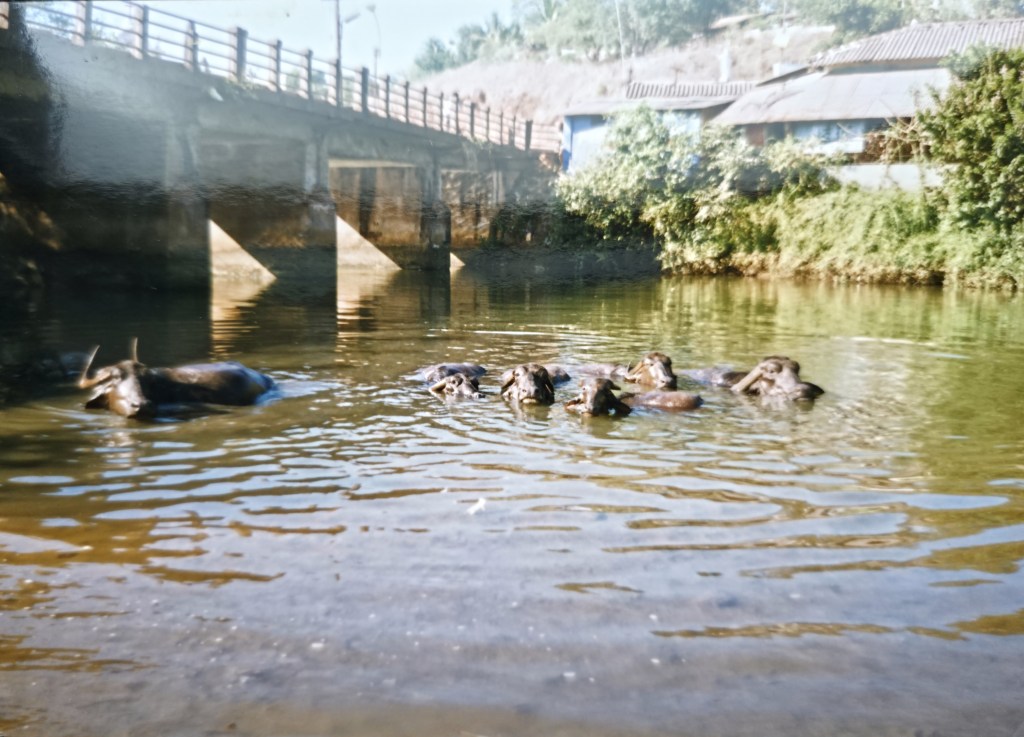
    Mostly I sleep in beach shacks after long nights of drinking. I move regularly between beach and village. I find a local barber with a shack that has no windows, just holes in the walls; he shaves my head and face, places hot towels on me, and I fall asleep in the chair. A large water buffalo often sticks its head through the hole in the wall and wakes me by licking my face. This becomes a ritual—the buffalo, the shave, the hot towels, and me drifting off.
    We also play football with the villagers. They play what I call “killer football.” Rough, aggressive, and fast. They love it when we give back as good as we get.

    Fenny Episode.

    About four weeks in, Jay asks if I’ve tried fenny. I thought it was made from cashews; he says the stuff here is coconut-based. I ask the London/Jamaican bar owner where to get it. He tells me to walk 200 yards up the beach to a closed shack where a man will be asleep.

    I find him sleeping on the floor. I whisper “Fenny.” He gets up silently, dips a clear plastic tube into an old barrel, and offers me a choice: a 2-litre jug or a 5-litre jug. I point to the 5-litre. He fills it. When I ask, “How much?” he shakes his head. I give him about 70 rupees—more than enough. He smiles and goes back to sleep.

    Back at the shack, no one else wants any, so I drink it slowly myself. Sitting, I feel fine. But when I stand to go to the toilet, I realise I’m “drunk from the legs up”—mind clear, legs completely drunk.

    Village Habits and the Dawn Chorus.

    From the shack I notice a morning pattern: villagers coming down to the sea to defecate and urinate. Heavy coughing, spitting, farting, cockerels crowing—the combined noise is like a strange “morning chorus.”
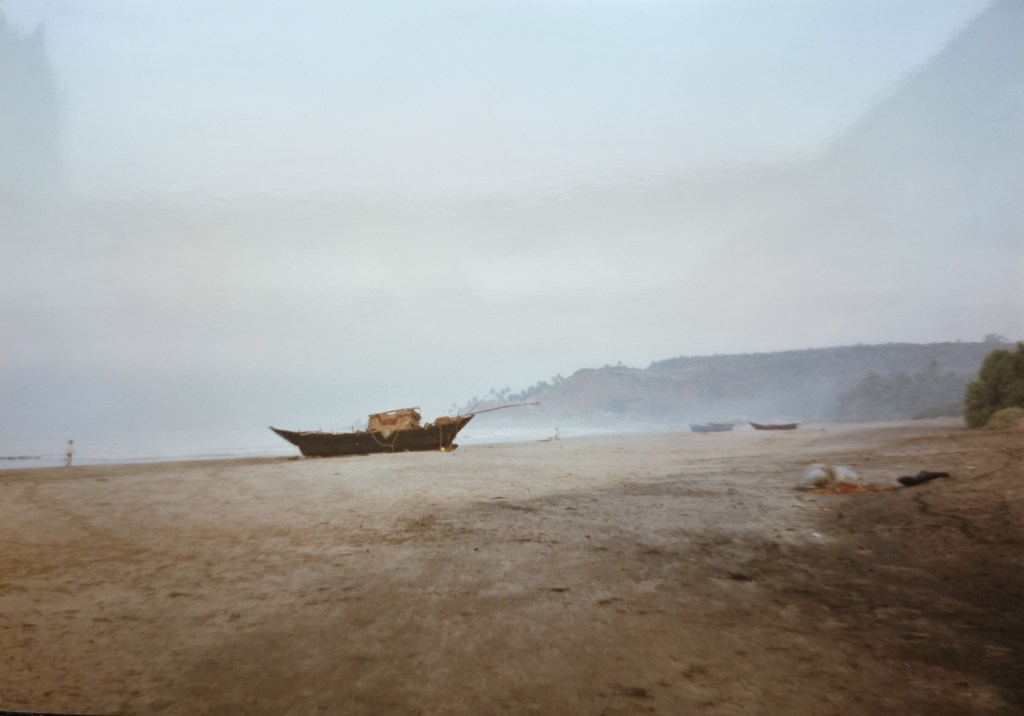
    Fishing With the Village.

    Over time I get to know the fishermen. I help push boats out in the mornings. Eventually they invite me in the boats for the early fishing runs. I love it—deep water, away from the toilet runoff. I never swim in the surf again, only out at sea.

    I become close with one fisherman and his son. I go to their home early; he’s always still asleep. “Goa pace,” he tells me. We fish morning and evening. In the mornings we go far out; the water is slightly cleaner, and I dive into swim even though visibility is terrible. In the evenings we set nets near shore.

    One morning swim nearly ends in disaster. A huge swarm of box jellyfish drifts towards me. The fisherman and his son are shouting and waving urgently. At first, I wave back—then I realise I’m being warned. I swim back to the boat as fast as I can. From inside the boat, I see the swarm glide through where I had been.

    In the evenings villagers gather to pull the nets in and share the catch. I join often and am always given fresh fish.

    Moving to an Unfinished Shack.

    At one point I live with a family—the Gunga family—but the place feels “too nice.” I want something simpler. I find a half-finished shack made of timber poles, palm-leaf thatching, and cow-dung flooring.

    It has no doors, no windows—just holes. Animals can wander in pigs, cows, snakes, dogs. I buy a rope and hook, lift my rucksack into the rafters to keep it off the floor, and sleep on a woven wooden roll-mat with a proper handmade Goa blanket for the cold nights. My companions are geckos on the walls eating mosquitoes. I could watch them for hours.

    Porcupine and Dogs.

    One morning a huge porcupine—about the size of a pig—runs through the village. Villagers kill it right outside my hut, strip the skin, pull the quills, share the meat, and give the dogs the rest.

    By the end of tourist season villagers lure dogs to the beach and cull them. Dogs roam in packs during the season, then disappear. One night a pack of fifteen follows me aggressively. I picked up the biggest branch I can find, swing it, and warn them off.

    The Banyan Tree.

    I meet Jack, an Australian who travels Goa often. He tells me about a giant banyan tree, supposedly the third biggest in the world. We pack bread, water, and bananas and hike through forest and clay pools where we cover ourselves in drying white clay. Monkeys come down for food; we share some.

    At the tree we find sadhus performing rituals around a central fire. I stay three days and nights. They wrap me in blankets and a traditional head scarf. I’m deeply tanned by then—dark as the locals from fishing. When I return down the mountain, my brother thinks I’m a local and nearly doesn’t recognise me. The sadhus give me their pipe to smoke a couple of times over the three days; the whole experience is calm, relaxing, almost otherworldly. I learn to play the didgeridoo there and bring one home from Goa.

    Guitar on the Beach and the Fake Police.

    One night I hear faint guitar music and follow it down the beach. A Swedish man is sitting alone, playing beautifully, a spliff in his mouth. I sit behind him, not wanting to disturb him. He notices, nods, and keeps playing. He tosses me the joint; I take a couple of drags and stub it out in the sand.

    A noise behind us makes me turn. A group of twelve to fifteen Indian men in brightly coloured hand-knitted balaclavas approach—some with eye holes cut in completely the wrong place. They claim to be police. I recognise one as a villager. They accuse us of having hashish.

    I tell them I’ll go get my fifteen friends so we can all pay them together. That ends it. They wander off. The guitarist smiles and keeps playing.

    Photography, Temples, and Weddings.
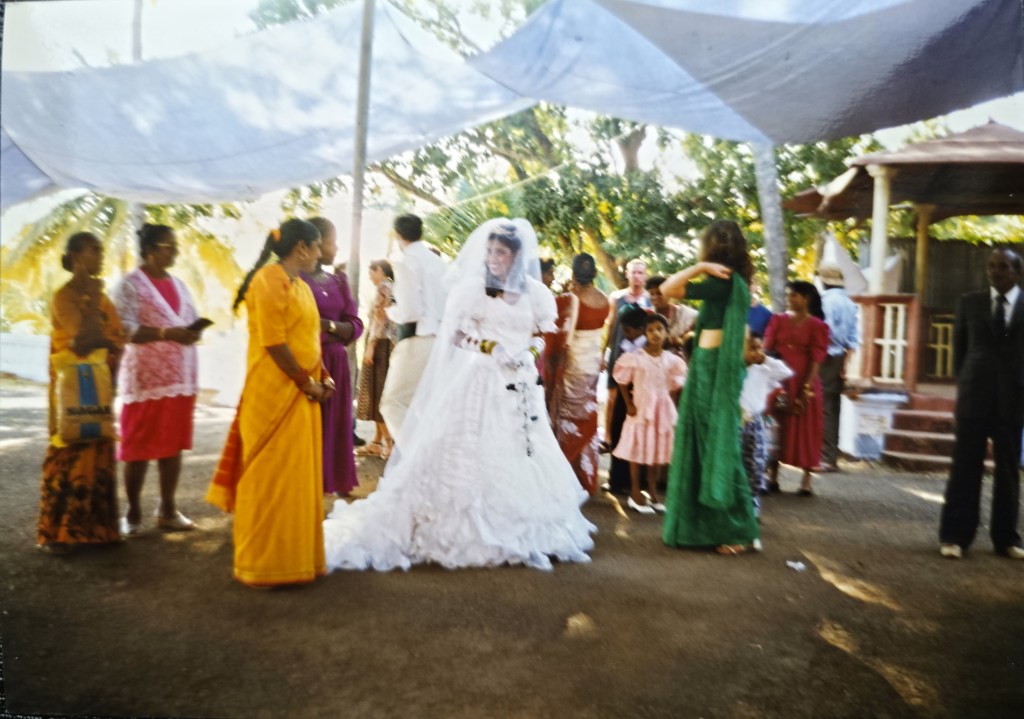
    Back then there are no mobile phones and hardly anyone carries a camera. I bring two disposable Kodaks and only take photos on days I deliberately go out looking for things to capture.

    After six weeks in the village, three of us are invited to two weddings—a Hindu outdoor wedding and a Christian one in a small church. The contrast is obvious. Hindu: loud, vibrant, drums, colour everywhere. Christian: peaceful, restrained, but later everyone dances and sings.

    Villagers ask why I dress like I have nothing yet spend so much in the village. I explain the woman who washes my clothes beats them on a rock with glycerine soap and destroys anything nice. Because of the heat I mostly wear simple Indian clothes and a single pair of jeans I cut down.

    To attend the weddings, we buy new clothes. I keep photos of the Christian church and its Catholic imagery—crucifixion scenes, Mary and the infant Jesus.

    When I get home, I develop the photos and show them to my brother’s friends who live close to North London. They look at them and say, “These are boring. Where are all the partying photos?” I tell them I was interested in capturing the place—not posing for drunken snapshots.

    Continue: Goa to the Gospel, Part-Two
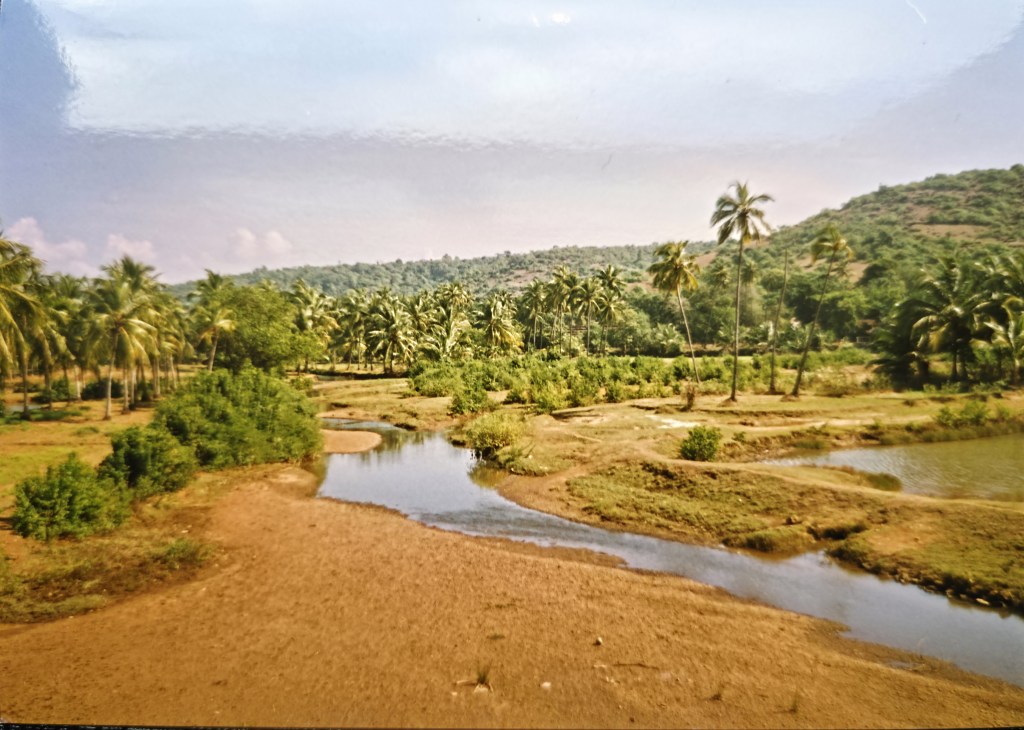
    Leave a comment

    This site uses Akismet to reduce spam. Learn how your comment data is processed.

  • From Goa to the Gospel: Part Three

    From Goa to the Gospel: Part Three

    A Real Conversion.

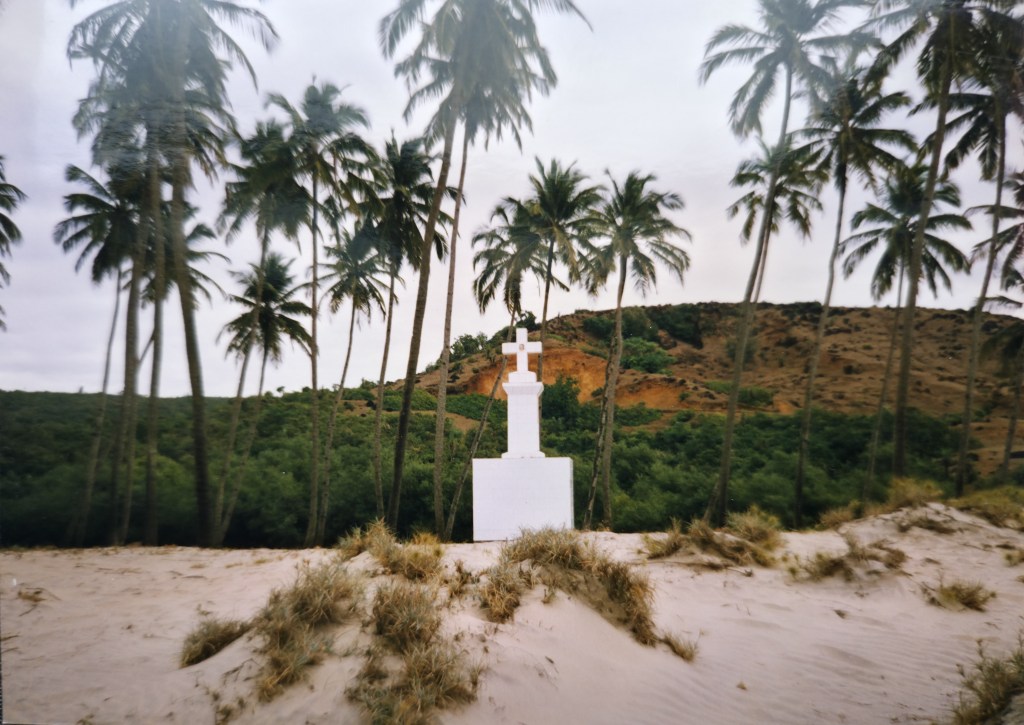
    Image: The hilltop beside the fishing village where the local ekklesia—the called-out ones—gather to worship the Living God. The concrete cross is not an object of worship, but simply a geographical marker where the believers meet.

    My conversion was not a “nice idea” or a gradual drift into church because it seemed respectable. It was the Holy Spirit showing me, for the first time, what I really was. And it broke me.

    I had been down every dead-end street I could find. Goa, parties, travelling, work, friendships – I kept thinking the next thing round the corner would finally make life make sense. But eventually I  hit a wall. I realised that if I walked down one more dead-end, I would have to admit life was pointless. That was the moment another way opened up in front of me: not a wide road with crowds on it, but a small, narrow path.

    The conviction of the Holy Spirit doesn’t flatter you. He doesn’t tell you that you’re “basically a good person who just needs a bit of religion.” He shows you the truth. I saw my own sin, my selfishness, my pride, the way I had lived as if God did not exist. It was like looking in a mirror for the first time. I wasn’t destroyed, but I was in pieces – like a smashed pot on the floor.

    That breaking was not cruelty. It was mercy. The old me had to die. The Bible says we are crucified with Christ and that the old self is put to death. Scripture also says what every honest Christian knows: you still feel that old self hanging around your neck like a dead man you drag behind you. I understood what the Apostle Paul meant – the new heart was real, but the old habits, the old temptations and shadows were still there, trying to pull me back.

    From that point on, everything changed. My heart and mind were different. I didn’t see the world the same way. Things I once shrugged off as “just life” now looked like poison. I wasn’t suddenly standing in the street judging everyone – I could see that I was the problem. But I also knew that certain things had to go. Certain places. Certain patterns. Certain friendships.

    In the end, I lost all my old friends. They didn’t want Christ; they wanted the old version of me. They were happy enough for me to believe in God in private, as long as I left my shoes and my Christianity at the door when I visited. Eventually it was clear to all of us that it couldn’t go on like that. I stopped going round. They treated me differently. They sounded different. We agreed it was for the best, but it still hurt.

    My conversion was not a Pentecost-style experience with shouting, singing, and tongues. There was no choir in the background. It was quieter and more painful than that. It was me on the ground, many times, saying things that are between me and God. It was the Holy Spirit convicting me of sin, breaking me, and then, very slowly, beginning to build me back up again in Christ.

    That is what I mean when I say my journey really did go from Goa to the Gospel. I gave my life to Christ before my baptism – baptism is an outward sign of the inward work of the Holy Spirit. I was baptised on Sunday 8th October 2017.

    Praise God. Amen.

    Leave a comment

    This site uses Akismet to reduce spam. Learn how your comment data is processed.

  • The Master’s Manual: Matthew Part 7 of 7

    The Master’s Manual: Matthew Part 7 of 7

    Introduction

    Every kingdom shapes the lives of its citizens. It forms how they think, act, love, and hope. In the Gospel according to Matthew, Jesus not only announces His Kingdom — He teaches His followers how to live within it. His words are not abstract philosophy; they are a manual for life under His reign. Through long-form teaching, parables, warnings, and promises, Jesus forms a people who live by the power of God rather than their own strength. And as His teaching points ahead, the Holy Spirit would later come to empower this obedience, turning fearful disciples into fearless witnesses

    What Matthew Tells Us

    Jesus begins His great teaching on a mountain (chs. 5–7). He presents a vision of righteousness that flows from the heart, not religious performance. He calls the humble blessed. He honours those who hunger for what is right. He teaches that reconciliation is better than resentment, purity better than hidden indulgence, truth better than empty promises, quiet trust better than anxious striving. His followers give, pray, and fast without drawing attention to themselves, trusting the Father who sees in secret. He closes with a picture of two houses — one collapses, one stands — showing that wisdom is not merely hearing His words but obeying them.

    Jesus then instructs His disciples for mission (ch. 10). He sends them as His representatives into towns and households, calling people to recognise that God’s Kingdom has drawn near. This mission will meet hostility, yet He assures them they will not be abandoned. When they face pressure and accusation, their defence does not rest on human eloquence; the Holy Spirit will speak through them (10:19–20). Allegiance to Jesus will even divide families, yet He promises that losing one’s life for His sake is the way to find true life.

    Through parables (ch. 13), Jesus reveals the hidden strength of God’s Kingdom. It is like seed scattered on various soils — some hearts resist, some receive superficially, but where the Word sinks deep, it bears abundant fruit. The Kingdom grows quietly, like yeast spreading through dough or a tiny mustard seed becoming a tree. It is worth more than everything a person owns; to gain it is to gain treasure beyond price. Yet for now, good, and evil grow together. A final harvest will come, where the King will bring justice and make things right.

    Jesus teaches that life in His Kingdom reshapes the way believers treat one another (ch. 18). Greatness is found not in status but humility. He values the vulnerable, warning His followers never to push them away. When a brother sins, restoration is patiently pursued. Forgiveness is not measured out reluctantly but poured out generously, echoing the grace His Father has shown. Jesus tells of a servant forgiven an impossible debt who then refuses to forgive another. The warning is unmistakable: those who have received mercy must live as people of mercy.

    As Jesus moves toward Jerusalem (chs. 19–20), He teaches about faithfulness in relationships, generosity that reflects God’s heart, and service rather than self-promotion. When some disciples compete for honour, Jesus redirects them. In His Kingdom, greatness comes through serving, because the King Himself came not to be served but to serve and to give His life for many. God’s generosity is not earned by labour; it is given with delight.

    Near the end of His ministry, Jesus prepares His disciples for what lies ahead (chs. 24–25). He tells them not to be alarmed by turmoil; the world will be shaken, but the purposes of God will stand. His people must remain awake, faithful, and expectant. He compares them to servants entrusted with resources. Some remain diligent; others grow careless. When the King returns, He will welcome those who served Him by serving His people — feeding the hungry, welcoming strangers, caring for the sick and imprisoned. He receives such love as if it were shown to Him directly.

    Matthew shows that obedience to Jesus is the solid foundation of kingdom life. But Jesus also knows His disciples cannot walk this path alone. He promises His ongoing presence with them (28:20). After His resurrection and ascension, this promise is fulfilled through the Holy Spirit — poured out at Pentecost as recorded in Acts — who emboldens His followers with power, love, and clarity. The same disciples who once hid in fear now speak boldly, even in many languages, declaring that the risen King reigns. What Jesus began teaching on the mountain is carried forward by His Spirit through His people.

    Why This Matters

    Jesus’ teachings in Matthew reveal the character of life under His rule. They invite us to respond to God from the heart, not merely from habit. They uphold a righteousness deeper than behaviour — a life shaped by love, trust, and humility. His Kingdom challenges our natural instincts: mercy instead of revenge, purity instead of indulgence, generosity instead of grasping, faith instead of fear.

    His commands are not burdens. They describe the beauty of a life aligned with God. The King never demands what He will not supply. He teaches, leads, and gives His very presence. When Jesus promises to be with His people to the end of the age, He is assuring them that obedience is not a lonely endeavour. The same Spirit who empowered Him, who spoke through His disciples, now strengthens His people worldwide.

    Matthew shows the King giving the pattern; the Spirit later gives the power. These are not competing truths but a united story. Jesus forms His disciples through teaching; the Spirit then enables them to live what they have learned. The foundation is the Word; the power is the Spirit; the goal is a people who bear the King’s likeness.

    Hope and Challenge

    Jesus’ teaching comforts and confronts. It comforts by revealing the Father’s care, the Son’s presence, and the Spirit’s help. It confronts by exposing where our allegiance wavers, where anger hardens, where fear rules. His words press us to follow — not half-heartedly, but with trust.

    For believers, this teaching is not an optional layer on top of faith; it is the shape of faith itself. The King calls His people to forgive as they have been forgiven, to serve as they have been served, to hope because He reigns. And He does not leave them powerless. By the Holy Spirit, fearful hearts become bold, anxious minds find peace, and weak hands learn to love.

    For seekers or the curious, Jesus’ teaching is an open invitation. His Kingdom is not for the flawless but for those who recognise their need. Here, the broken are restored, the weary find rest, and those wandering in darkness see light. To follow Jesus is to discover a life deeper than achievement, more enduring than success, more joyful than comfort. This life begins with trusting the King.

    Conclusion

    Matthew reveals Jesus as both King and Teacher. He shows His people how to live under God’s reign — humbly, faithfully, boldly. His teaching gives the pattern; His Spirit gives the power. Those who hear and follow build their lives upon rock. The Master does not send His disciples alone. He teaches them, saves them, dwells with them, and empowers them. This is the life of His Kingdom: shaped by His words, by the Holy Spirit of truth who teaches, comforts, and brings things to remembrance for those born again.

    Leave a comment

    This site uses Akismet to reduce spam. Learn how your comment data is processed.

  • The Royal Mandate, Matthew Part 6 of 7

    The Royal Mandate, Matthew Part 6 of 7

    The Royal Mandate

    Welcome back to The King and His Kingdom. We have journeyed from Jesus’ royal identity to His fulfilment of Scripture, His global rescue, His formation of a new family, and His unfailing presence with His people. Each part has carried us forward — not toward an ending, but toward a beginning.

    Now we arrive at the sixth movement: the risen King sends His people. Matthew closes his Gospel with a royal command that defines the church’s identity and purpose. The King does not only call people into His Kingdom — He sends them into the world under His authority.

    This is the heart of Part 6: the church is sent — making disciples is our mission and purpose.

    What Matthew Teaches

    Matthew shows that the risen Jesus gathers His disciples on a mountain — a familiar place where God reveals His purposes. The One who once walked to the cross now stands alive. His authority spans heaven and earth. Nothing lies outside His rule.

    On that foundation, He gives His disciples their task. They are to go, baptise, and teach — not merely spreading ideas but forming disciples who live under His commands. This is not a suggestion. It is a royal commission.

    To baptise in the name of the Father, the Son, and the Holy Spirit is to bring people into a new identity. Their lives now belong to God Himself. They are drawn into the life of the Trinity — welcomed into fellowship with the Father through the work of the Son and sealed by the Holy Spirit.

    To teach them to obey everything Jesus commanded is to nurture a new way of life. Discipleship is not momentary; it is lifelong. It forms whole lives under the gracious rule of the King.

    This mission is global. The disciples are sent to “all nations.” Jesus does not limit the scope to one people or place. The grace of the King extends across every boundary. Matthew began his Gospel by naming Jesus as the One who would save His people from their sins. He ends it by sending His followers with that same message into the world.

    Matthew notes that some of the disciples worshipped while others hesitated. Their uncertainty did not disqualify them. Jesus did not send them away or replace them. Instead, He grounded them in His authority and entrusted His mission to them. The weight of the mission does not rest on their inner strength; it rests on Him.

    At the heart of this mission lies a great promise: Jesus will be with His people until the end of the age. The command and the promise belong together. The church goes because the King leads. The church speaks because the King empowers. His authority sends, and His presence sustains.

    The Spirit Who Enables

    Matthew shows that the mission Jesus entrusts to His people is not carried out in human power alone. Earlier, when He first sent His disciples out, He told them they need not worry about what to say when they were brought before authorities. In that moment, what they needed would be given to them. They would speak yet not speak alone. The Spirit of their Father would speak through them (Matthew 10:19–20).

    This reveals something vital. The King who commands His people to go also gives them divine help. The Holy Spirit upholds their mission. The disciples are not left to invent strategies to make their words effective. The Holy Spirit Himself enables their witness. False confidence is emptied; God supplies what is needed.

    When Jesus later commands baptism in the name of the Father, the Son, and the Holy Spirit, He makes this truth unmistakable. The mission is rooted in the life of God. The Spirit’s work is not an optional influence but God’s gracious provision. He strengthens, guides, and gives courage to fearful hearts so that they may bear witness with truth and love.

    The King sends, and the Spirit enables.

    Why This Matters

    Matthew teaches that discipleship is not private. The risen King does not call His people into a quiet corner to reflect privately on what He has done. He sends them into the world to make disciples — beginning in their homes and cities and stretching to every land.

    This outward movement is not driven by guilt or pressure, but by the authority of Jesus and the enabling power of the Spirit. The One who commands is the One who remains. His rule is not distant; His presence is active.

    This matters because it aligns us with God’s purpose. From the opening chapters, Matthew has shown that Jesus came to save. Now, at the end, Jesus sends His followers to share that salvation. The church’s mission arises not from human creativity but from the King Himself.

    Discipleship touches every part of life. To be baptised is to belong to God. To be taught to obey is to live under the King. Jesus’ commands are not burdensome; they reveal the way of life we were made for. Discipleship is not simply learning about Jesus but learning to walk with Him.

    This mission also matters because it is global. The Gospel carries dignity across cultures. It does not erase them but welcomes them into the Kingdom. Every person is invited; no nation is too distant.

    The promise of Jesus’ presence gives unshakable hope. He does not send His people alone. He walks with them, opening hearts as they speak. Their confidence does not rest on what they can accomplish but on who He is. Even when opposition arises, the Spirit of the Father speaks through His people. He enables what He commands.

    This truth frees us from self-reliance. The mission is not carried by human charisma, planning, or strength. It is carried by the King and empowered by His Spirit. Our role is obedience; His presence gives power.

    Hope and Challenge

    The Great Commission lifts our eyes beyond ourselves. For believers, it brings dignity and clarity. Whether speaking to a neighbour, encouraging another believer, or quietly serving, every act offered to Christ participates in this mission. Nothing is wasted.

    The challenge is real. Some feel hesitant or fearful. Yet Matthew records that even among those who bowed in worship, some doubted. Jesus sent them anyway — and promised to be with them. Our frailty does not cancel His calling.

    For seekers, this is an invitation. The King who sends His people is the same King who invites all to follow Him. To become a disciple is to receive forgiveness, to learn His ways, and to walk with Him. The Spirit does not simply help those already strong; He strengthens those who come weak.

    The mission is vast, but no one is sent alone. The King goes with His people. The Spirit speaks through them. The Father holds them fast.

    Conclusion

    Matthew does not end with a farewell. He ends with a command and a promise. The risen Jesus, with all authority, sends His followers to make disciples among all nations, baptising in the name of the Father, the Son, and the Holy Spirit, and teaching them to live under His gracious instruction.

    The church is therefore not merely gathered — it is sent. Its mission is not rooted in human cleverness but in the authority of the King. Its power does not rise from within but from the Spirit of the Father who speaks through His people. Its hope does not rest on circumstance but on the promise of Jesus’ unshakeable presence.

    The mission is global.
    The power is divine.
    The King is with His people — always.

    Leave a comment

    This site uses Akismet to reduce spam. Learn how your comment data is processed.