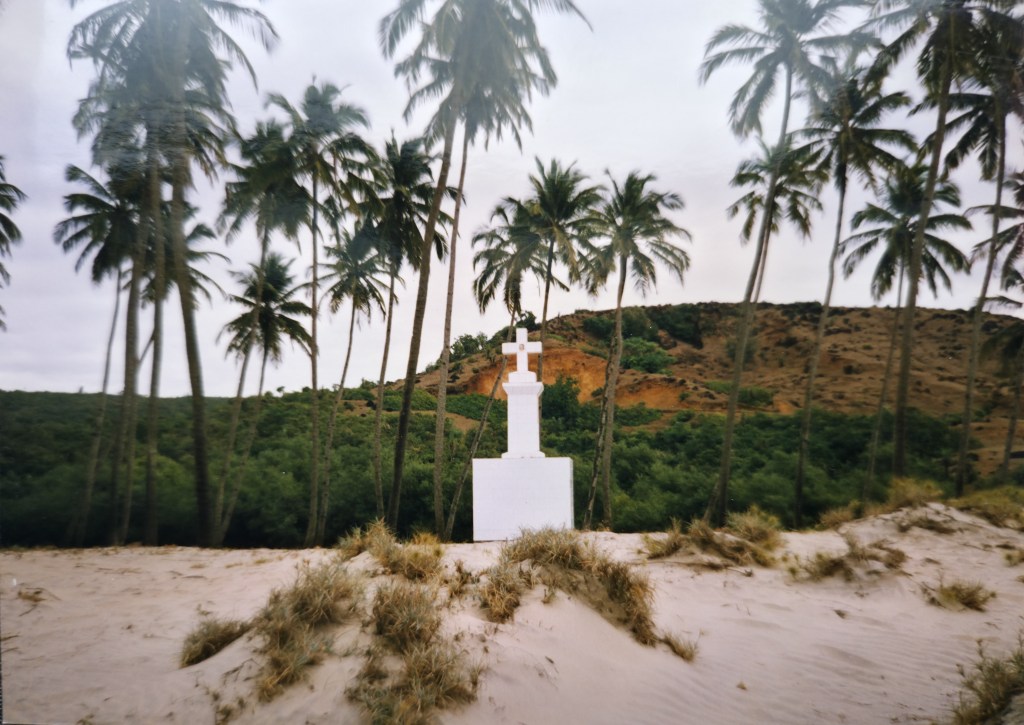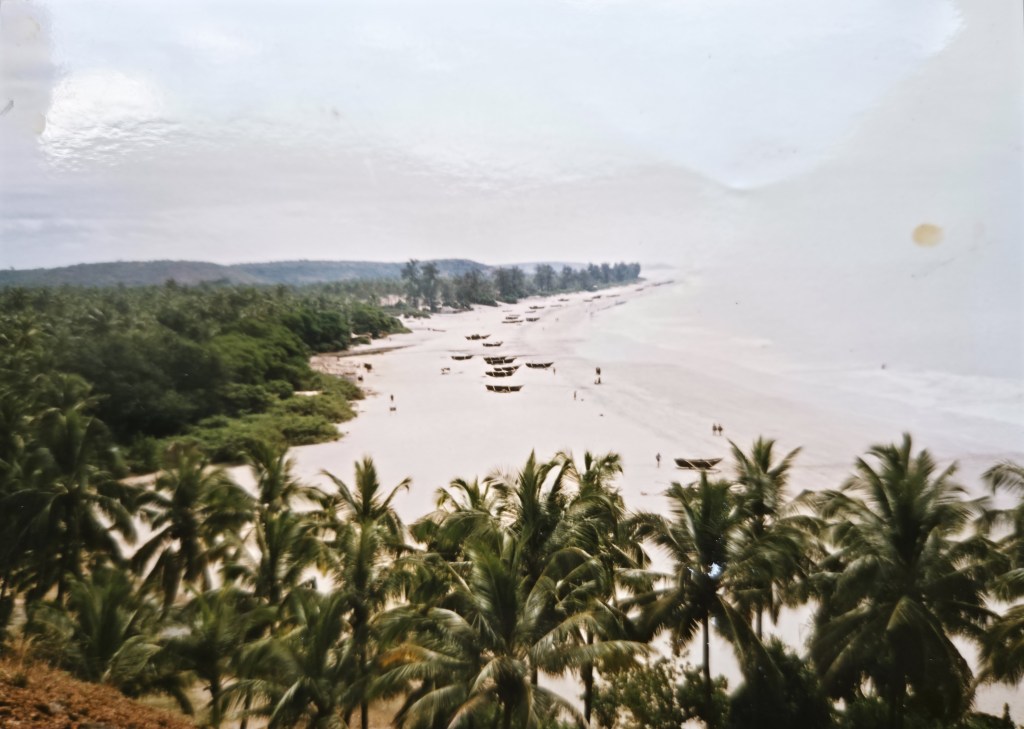
These three posts have taken a long time to write, and I wanted to publish them together so the story flows properly from beginning to end. I only scratched the surface of everything that happened. I hope you enjoy reading them as much as I’ve valued writing them.
1994 – First Trip to Arambol in Goa.
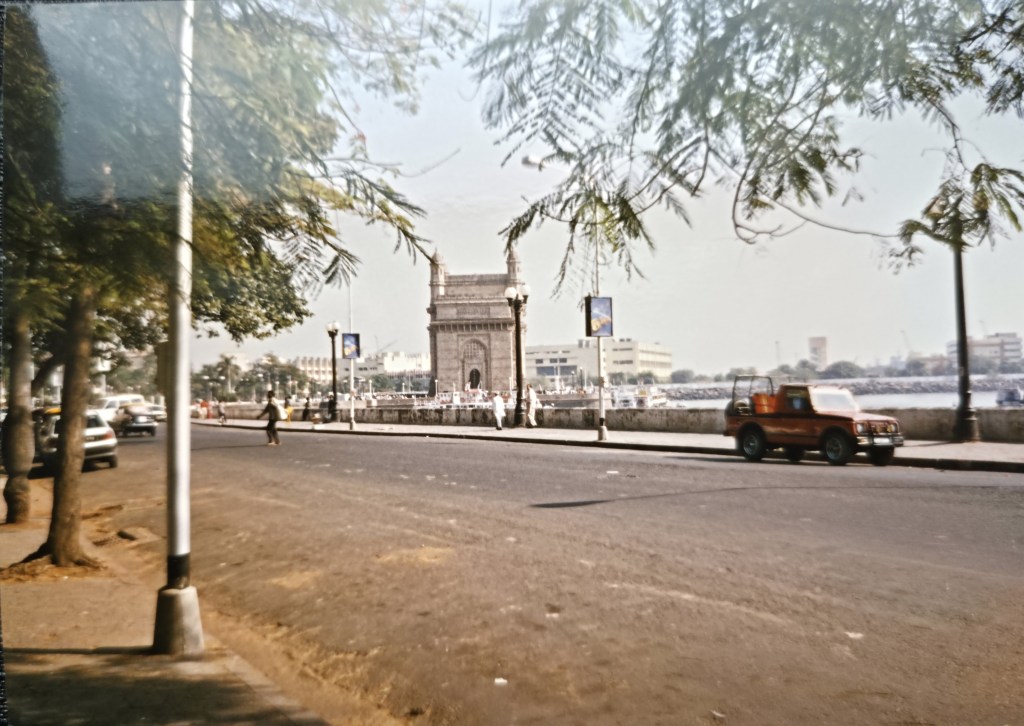
Travelling to Goa for the first time in the 1990s for about two months with a large group, eventually around fifteen men gathering in Arambol. Our group starts out in the south of Goa, in Calangute, after travelling down from Bombay. Image of the gate of India, Bombay in 1994.
Calangute is a horrible place to waste time staying. The beaches are awful, and the place the lads stay in is like an insectarium, with insects pouring out of the walls at night. My brother and Jay go straight out for cigarettes and a beer as soon as we arrive, even though we’d just survived an overloaded bus with wooden seats for fourteen hours. It was a cheap and nasty bus trip from Bombay over the most dangerous mountain roads I’d ever seen. There were bus graveyards at the bottom of the cliffs along the route.
The drivers chew betel quid, a psychoactive mixture of betel leaf, areca nut, slaked lime, and spices like cardamom or cloves. They drive as if they want to die on it. There are only three of us on the bus at this point and we’re the only foreigners. I stand up and ask the bus, “Does everyone want the bus to slow down on these mountain roads?” The whole bus nods instantly.
The cabin door is locked, so I knock. When no one opens it, I shove it open. There are always three or four drivers taking turns, but to my horror I see a brick on the accelerator and the driver is sitting cross-legged on his seat. All of them have red glazed eyes, red lips, and red teeth. They’re clearly addicted to betel quid and under orders to do the two-way trip as fast as possible.
I try to remove the brick and keep motioning for them to slow down. A woman shouts something in Hindi, they finally slow—five minutes later they’re back at full speed again. Alton Towers had nothing on this ride.
A few hours later my brother and Jay return to the room and explain they got into a fight with ex-pat squaddies because the squaddies didn’t like Jay’s dreadlocks. The squaddies lose the fight.
In the morning, I wake up determined to find these men and make sure they got the message to leave us alone. I follow the main dirt road to a beach shack and see an old school friend with a group of men, one with a busted leg. I sit near them, nodding to the lad from my town, and hear one man saying he’s going to find “those two blokes” and do them in.
I find him in five minutes. None of his injured friends follow. He gets up and heads towards his Enfield bike. I follow. Before he can mount it, I tell him, “Look no further, I’m who you’re looking for.” He keeps circling the bike, avoiding me. I warn him it won’t end well for him if he causes any more trouble. He runs inside, comes back out with a large knife, and says, “I’m ready now.”
I slowly walk away down the sand path. He follows on his Enfield but keeps a safe distance, which tells me he doesn’t want a real fight. I lead him to our digs; he waits about fifty feet away. I tell my brother and Jay. We all agree to tell him to meet on the beach at sunset if he wants to sort it out. He agrees. We then throw our rucksacks into a rickshaw and head north to Arambol. I hadn’t gone to India to fight.
The bridge to Arambol is still being built, so the rickshaw takes us only as far as the ferry. On the other side, we take another rickshaw and arrive in Arambol early evening. I go straight out to eat and see the beach. My brother crashes out, so Jay and I head to the beach.

On that first night, we see a light in the distance on the beach. We walk towards it, guessing it’s a fire. It is. A small group is gathered around it. Nights can get cold on the beach, so we stay there, talk with strangers, and watch the sunrise. With no electricity around and no pollution like back home, I see the stars properly for the first time. It is incredible. The weight of life falls away. I remember thinking: this was created. That sky, those stars, that scale—no chance accident.
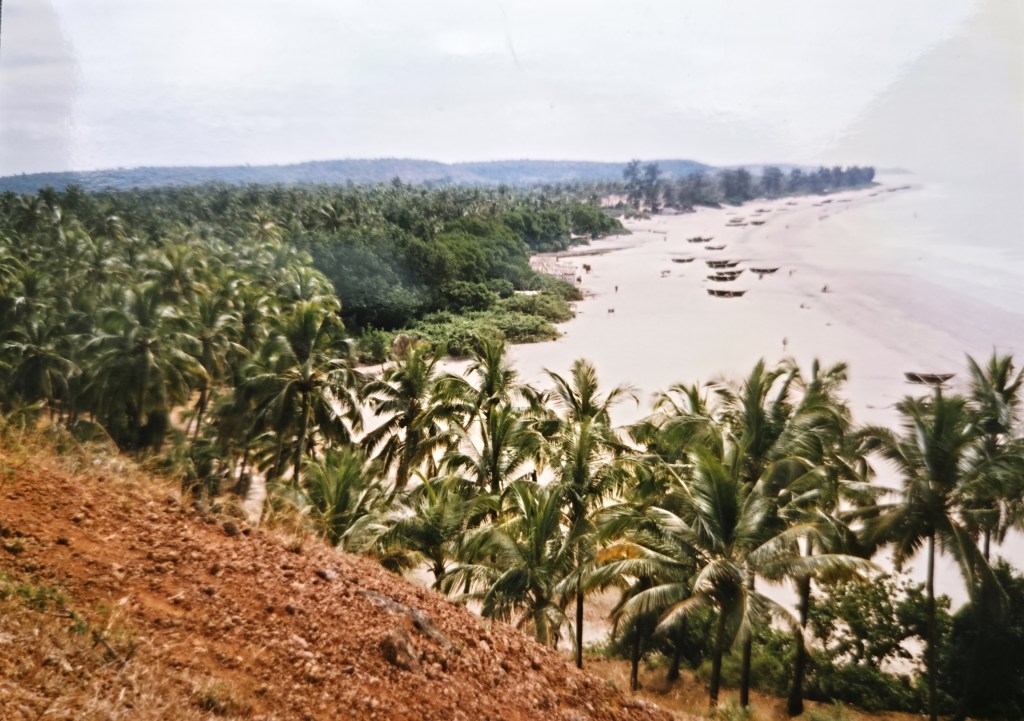
After a day and night, I realise this beach is the closest to untouched I’ve seen in India. The only thing spoiling it is us being there. The only things on the beach are three fishing boats.
It doesn’t take long before the rose-tinted glasses slip. The seawater isn’t clear. Sewage from the village runs through an open sandy channel into the ocean. I only notice it after a few days watching locals casually step over it. My perfect beach wasn’t as perfect as it first looked.
Daily Life and Accommodation in Arambol.
Most days are spent in a beach shack. Because there are fifteen of us drinking every day, whichever shack we choose ends up doing extremely well financially. Beer is unbelievably cheap—usually 15–17 pence a bottle. One shack is run by a man from London with Jamaican parents who’s been in Arambol for about twenty years, long before many westerners.
In 1994, £1 buys about 5–6 shack beers. By 1998, the same pound buys seven beers. It’s not because beer got cheaper; it’s the rupee collapsing. Western pocket money suddenly goes a long way, accelerating the tourist influx and changing the village economy.
I rent a room mainly to store my rucksack—with my first Good News Bible inside—and to have somewhere quiet if needed, but I rarely sleep there. One place has a cockerel perched outside my door that wakes everyone at dawn.
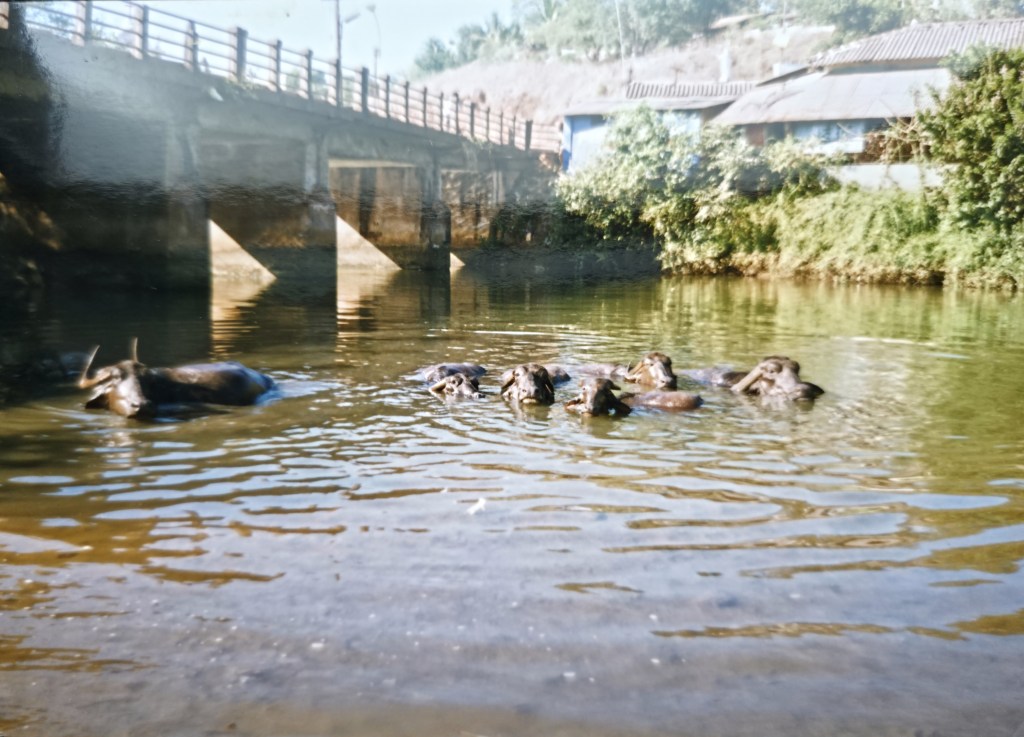
Mostly I sleep in beach shacks after long nights of drinking. I move regularly between beach and village. I find a local barber with a shack that has no windows, just holes in the walls; he shaves my head and face, places hot towels on me, and I fall asleep in the chair. A large water buffalo often sticks its head through the hole in the wall and wakes me by licking my face. This becomes a ritual—the buffalo, the shave, the hot towels, and me drifting off.
We also play football with the villagers. They play what I call “killer football.” Rough, aggressive, and fast. They love it when we give back as good as we get.
Fenny Episode.
About four weeks in, Jay asks if I’ve tried fenny. I thought it was made from cashews; he says the stuff here is coconut-based. I ask the London/Jamaican bar owner where to get it. He tells me to walk 200 yards up the beach to a closed shack where a man will be asleep.
I find him sleeping on the floor. I whisper “Fenny.” He gets up silently, dips a clear plastic tube into an old barrel, and offers me a choice: a 2-litre jug or a 5-litre jug. I point to the 5-litre. He fills it. When I ask, “How much?” he shakes his head. I give him about 70 rupees—more than enough. He smiles and goes back to sleep.
Back at the shack, no one else wants any, so I drink it slowly myself. Sitting, I feel fine. But when I stand to go to the toilet, I realise I’m “drunk from the legs up”—mind clear, legs completely drunk.
Village Habits and the Dawn Chorus.
From the shack I notice a morning pattern: villagers coming down to the sea to defecate and urinate. Heavy coughing, spitting, farting, cockerels crowing—the combined noise is like a strange “morning chorus.”
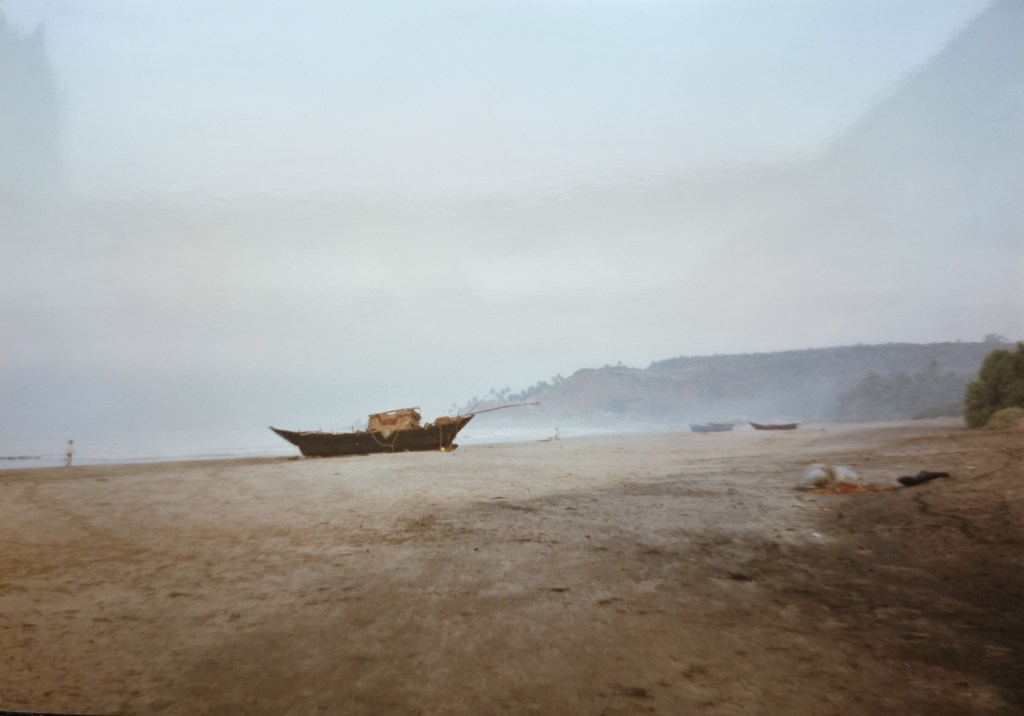
Fishing With the Village.
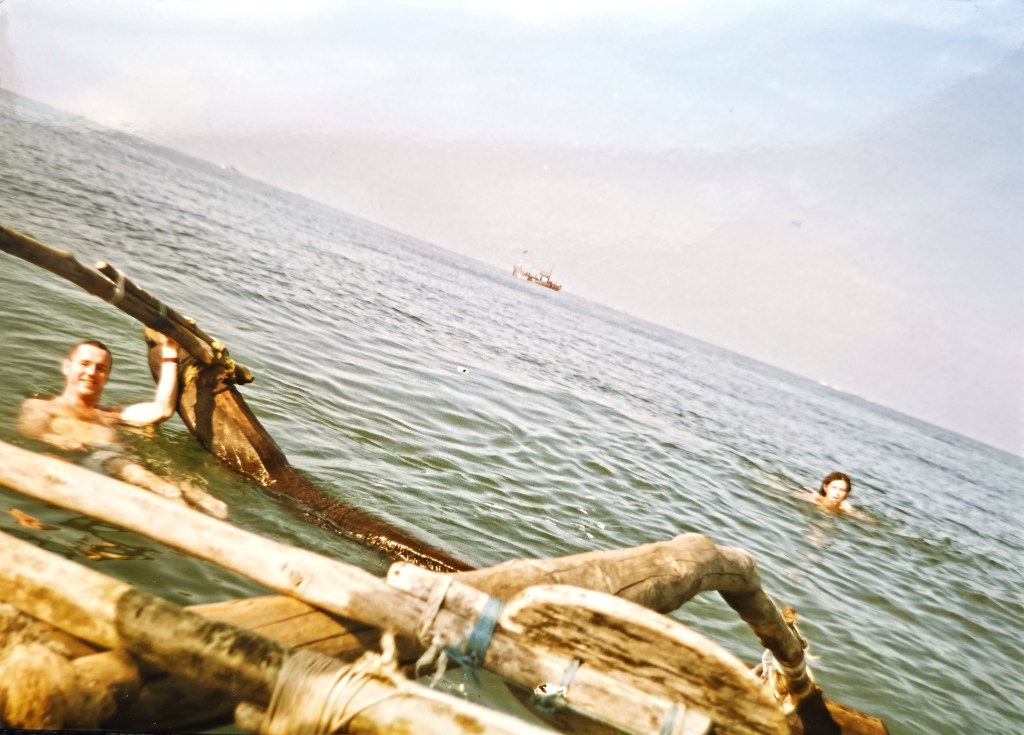
Over time I get to know the fishermen. I help push boats out in the mornings. Eventually they invite me in the boats for the early fishing runs. I love it—deep water, away from the toilet runoff. I never swim in the surf again, only out at sea.
I become close with one fisherman and his son. I go to their home early; he’s always still asleep. “Goa pace,” he tells me. We fish morning and evening. In the mornings we go far out; the water is slightly cleaner, and I dive into swim even though visibility is terrible. In the evenings we set nets near shore.
One morning swim nearly ends in disaster. A huge swarm of box jellyfish drifts towards me. The fisherman and his son are shouting and waving urgently. At first, I wave back—then I realise I’m being warned. I swim back to the boat as fast as I can. From inside the boat, I see the swarm glide through where I had been.

In the evenings villagers gather to pull the nets in and share the catch. I join often and am always given fresh fish.
Moving to an Unfinished Shack.
At one point I live with a family—the Gunga family—but the place feels “too nice.” I want something simpler. I find a half-finished shack made of timber poles, palm-leaf thatching, and cow-dung flooring.
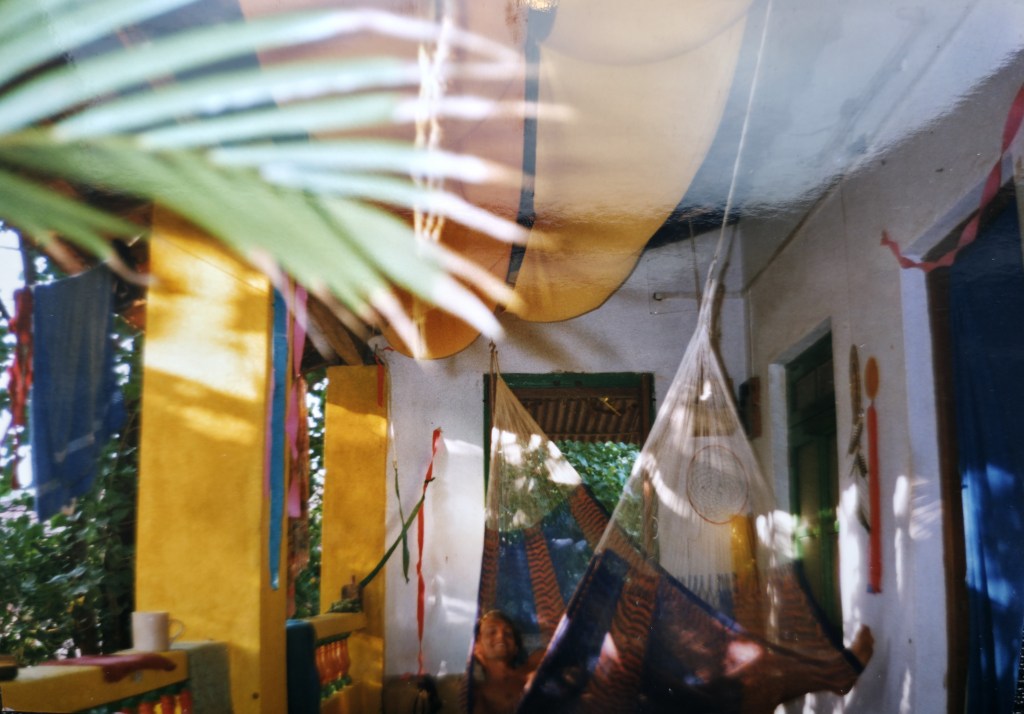
It has no doors, no windows—just holes. Animals can wander in pigs, cows, snakes, dogs. I buy a rope and hook, lift my rucksack into the rafters to keep it off the floor, and sleep on a woven wooden roll-mat with a proper handmade Goa blanket for the cold nights. My companions are geckos on the walls eating mosquitoes. I could watch them for hours.

Porcupine and Dogs.
One morning a huge porcupine—about the size of a pig—runs through the village. Villagers kill it right outside my hut, strip the skin, pull the quills, share the meat, and give the dogs the rest.
By the end of tourist season villagers lure dogs to the beach and cull them. Dogs roam in packs during the season, then disappear. One night a pack of fifteen follows me aggressively. I picked up the biggest branch I can find, swing it, and warn them off.
The Banyan Tree.
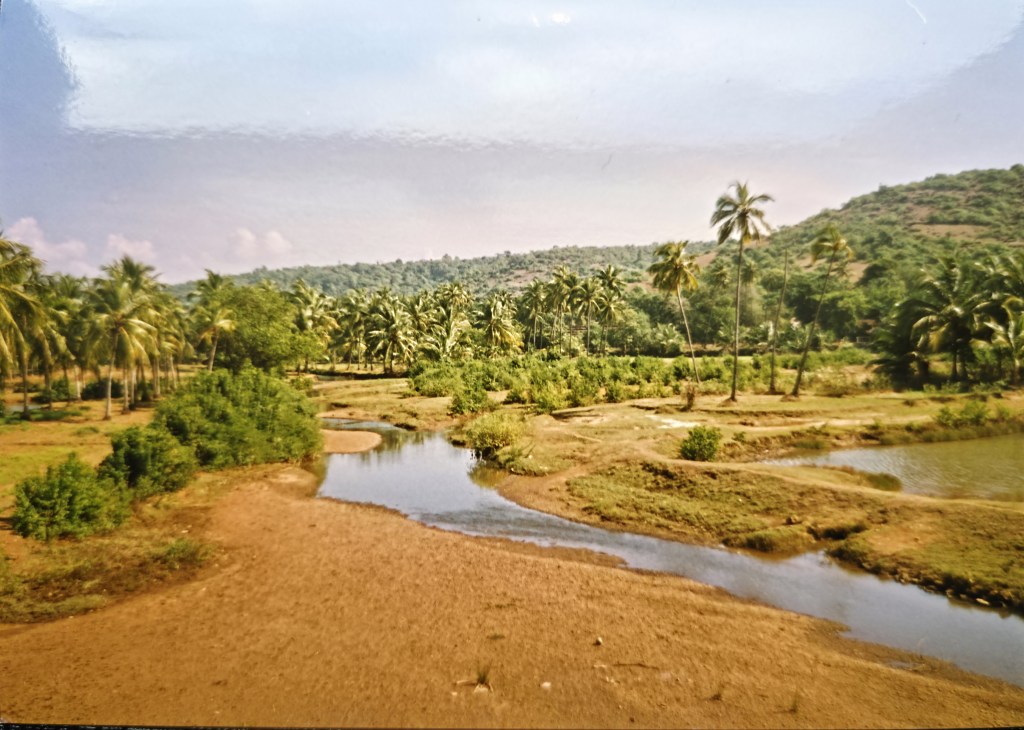
I meet Jack, an Australian who travels Goa often. He tells me about a giant banyan tree, supposedly the third biggest in the world. We pack bread, water, and bananas and hike through forest and clay pools where we cover ourselves in drying white clay. Monkeys come down for food; we share some.
At the tree we find sadhus performing rituals around a central fire. I stay three days and nights. They wrap me in blankets and a traditional head scarf. I’m deeply tanned by then—dark as the locals from fishing. When I return down the mountain, my brother thinks I’m a local and nearly doesn’t recognise me. The sadhus give me their pipe to smoke a couple of times over the three days; the whole experience is calm, relaxing, almost otherworldly. I learn to play the didgeridoo there and bring one home from Goa.
Guitar on the Beach and the Fake Police.
One night I hear faint guitar music and follow it down the beach. A Swedish man is sitting alone, playing beautifully, a spliff in his mouth. I sit behind him, not wanting to disturb him. He notices, nods, and keeps playing. He tosses me the joint; I take a couple of drags and stub it out in the sand.
A noise behind us makes me turn. A group of twelve to fifteen Indian men in brightly coloured hand-knitted balaclavas approach—some with eye holes cut in completely the wrong place. They claim to be police. I recognise one as a villager. They accuse us of having hashish.
I tell them I’ll go get my fifteen friends so we can all pay them together. That ends it. They wander off. The guitarist smiles and keeps playing.
Photography, Temples, and Weddings.
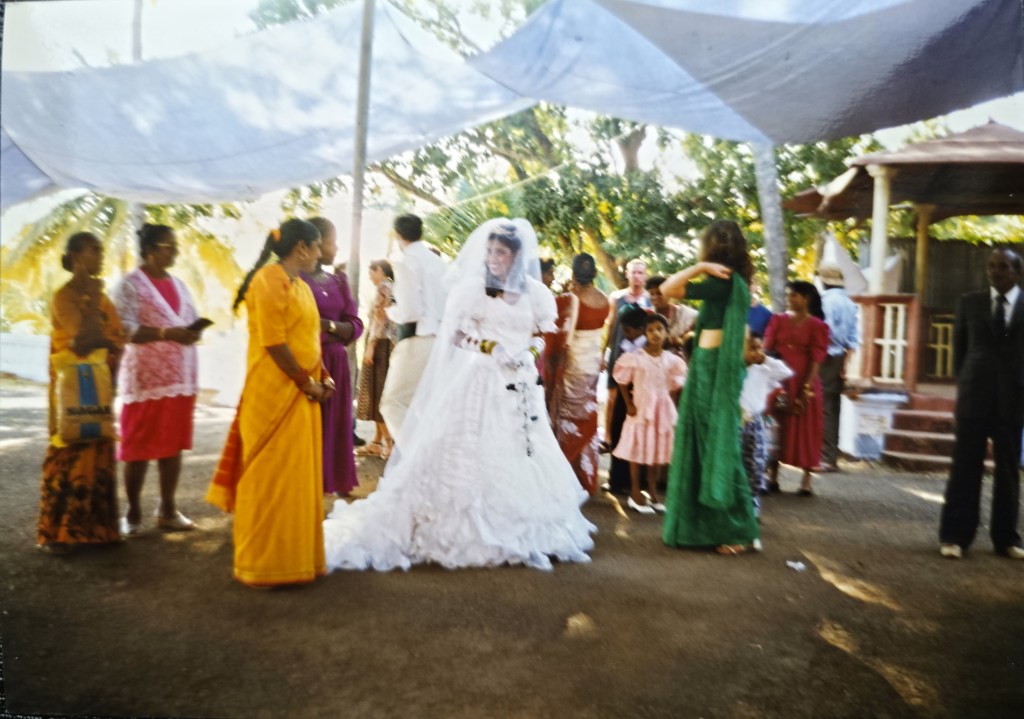
Back then there are no mobile phones and hardly anyone carries a camera. I bring two disposable Kodaks and only take photos on days I deliberately go out looking for things to capture.
After six weeks in the village, three of us are invited to two weddings—a Hindu outdoor wedding and a Christian one in a small church. The contrast is obvious. Hindu: loud, vibrant, drums, colour everywhere. Christian: peaceful, restrained, but later everyone dances and sings.
Villagers ask why I dress like I have nothing yet spend so much in the village. I explain the woman who washes my clothes beats them on a rock with glycerine soap and destroys anything nice. Because of the heat I mostly wear simple Indian clothes and a single pair of jeans I cut down.
To attend the weddings, we buy new clothes. I keep photos of the Christian church and its Catholic imagery—crucifixion scenes, Mary and the infant Jesus.
When I get home, I develop the photos and show them to my brother’s friends who live close to North London. They look at them and say, “These are boring. Where are all the partying photos?” I tell them I was interested in capturing the place—not posing for drunken snapshots.
Continue: Goa to the Gospel, Part-Two