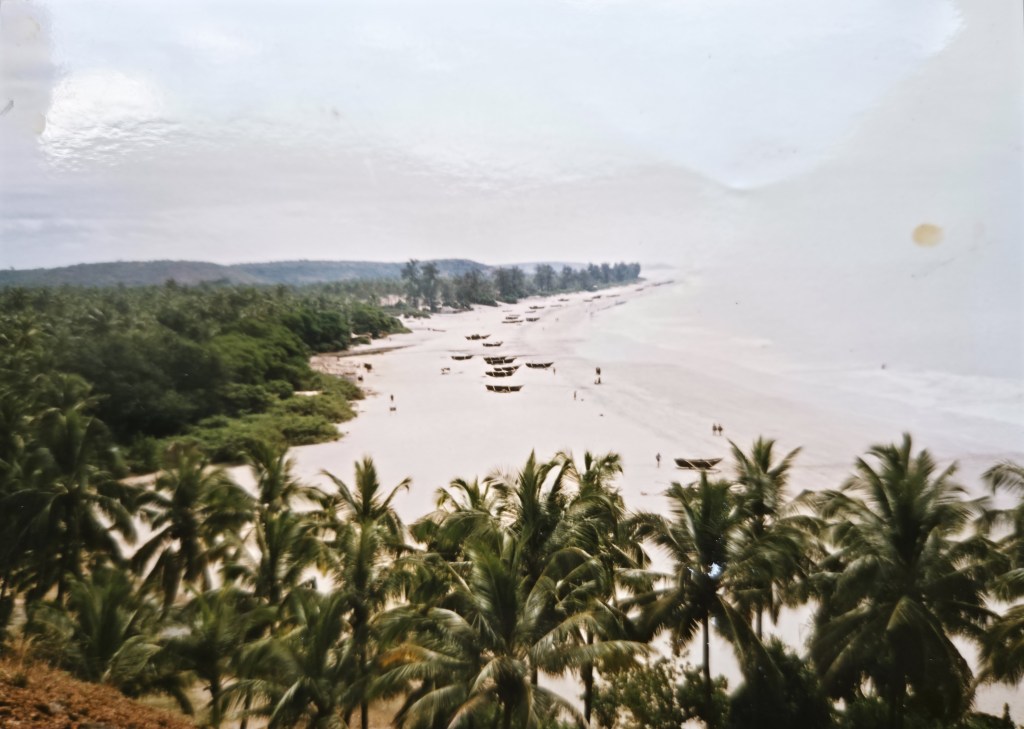
Tag: blogging

  • From Goa to the Gospel: Part One.

    From Goa to the Gospel: Part One.

    These three posts have taken a long time to write, and I wanted to publish them together so the story flows properly from beginning to end. I only scratched the surface of everything that happened. I hope you enjoy reading them as much as I’ve valued writing them.

    1994 – First Trip to Arambol in Goa.

    Travelling to Goa for the first time in the 1990s for about two months with a large group, eventually around fifteen men gathering in Arambol. Our group starts out in the south of Goa, in Calangute, after travelling down from Bombay. Image of the gate of India, Bombay in 1994.
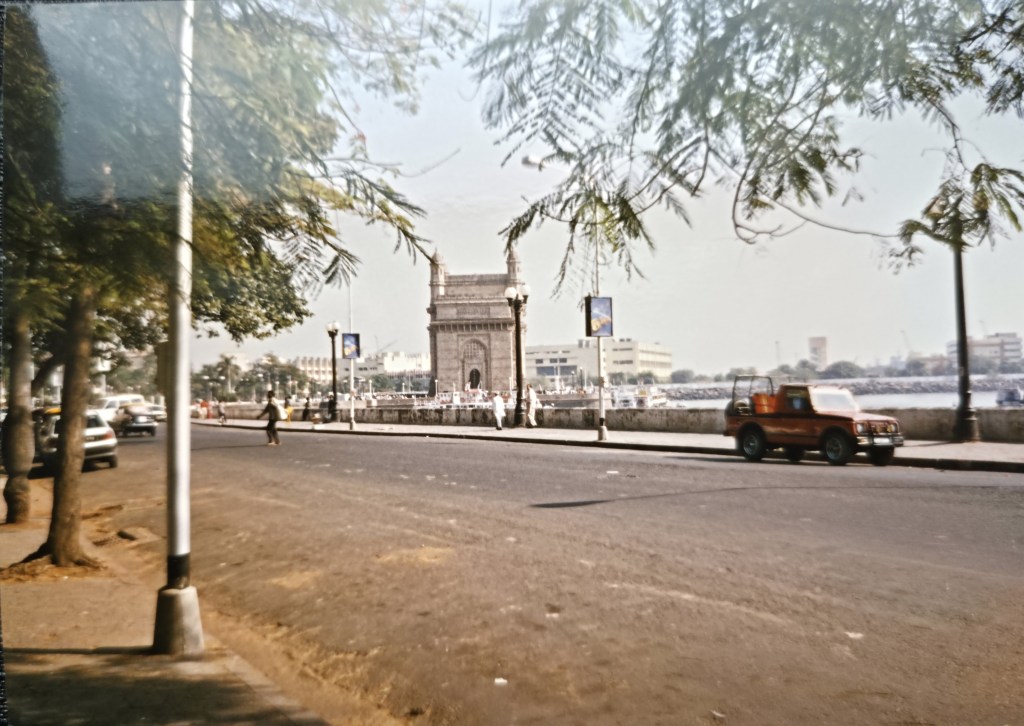
    Calangute is a horrible place to waste time staying. The beaches are awful, and the place the lads stay in is like an insectarium, with insects pouring out of the walls at night. My brother and Jay go straight out for cigarettes and a beer as soon as we arrive, even though we’d just survived an overloaded bus with wooden seats for fourteen hours. It was a cheap and nasty bus trip from Bombay over the most dangerous mountain roads I’d ever seen. There were bus graveyards at the bottom of the cliffs along the route.

    The drivers chew betel quid, a psychoactive mixture of betel leaf, areca nut, slaked lime, and spices like cardamom or cloves. They drive as if they want to die on it. There are only three of us on the bus at this point and we’re the only foreigners. I stand up and ask the bus, “Does everyone want the bus to slow down on these mountain roads?” The whole bus nods instantly.

    The cabin door is locked, so I knock. When no one opens it, I shove it open. There are always three or four drivers taking turns, but to my horror I see a brick on the accelerator and the driver is sitting cross-legged on his seat. All of them have red glazed eyes, red lips, and red teeth. They’re clearly addicted to betel quid and under orders to do the two-way trip as fast as possible.

    I try to remove the brick and keep motioning for them to slow down. A woman shouts something in Hindi, they finally slow—five minutes later they’re back at full speed again. Alton Towers had nothing on this ride.

    A few hours later my brother and Jay return to the room and explain they got into a fight with ex-pat squaddies because the squaddies didn’t like Jay’s dreadlocks. The squaddies lose the fight.

    In the morning, I wake up determined to find these men and make sure they got the message to leave us alone. I follow the main dirt road to a beach shack and see an old school friend with a group of men, one with a busted leg. I sit near them, nodding to the lad from my town, and hear one man saying he’s going to find “those two blokes” and do them in.

    I find him in five minutes. None of his injured friends follow. He gets up and heads towards his Enfield bike. I follow. Before he can mount it, I tell him, “Look no further, I’m who you’re looking for.” He keeps circling the bike, avoiding me. I warn him it won’t end well for him if he causes any more trouble. He runs inside, comes back out with a large knife, and says, “I’m ready now.”

    I slowly walk away down the sand path. He follows on his Enfield but keeps a safe distance, which tells me he doesn’t want a real fight. I lead him to our digs; he waits about fifty feet away. I tell my brother and Jay. We all agree to tell him to meet on the beach at sunset if he wants to sort it out. He agrees. We then throw our rucksacks into a rickshaw and head north to Arambol. I hadn’t gone to India to fight.

    The bridge to Arambol is still being built, so the rickshaw takes us only as far as the ferry. On the other side, we take another rickshaw and arrive in Arambol early evening. I go straight out to eat and see the beach. My brother crashes out, so Jay and I head to the beach.

    On that first night, we see a light in the distance on the beach. We walk towards it, guessing it’s a fire. It is. A small group is gathered around it. Nights can get cold on the beach, so we stay there, talk with strangers, and watch the sunrise. With no electricity around and no pollution like back home, I see the stars properly for the first time. It is incredible. The weight of life falls away. I remember thinking: this was created. That sky, those stars, that scale—no chance accident.

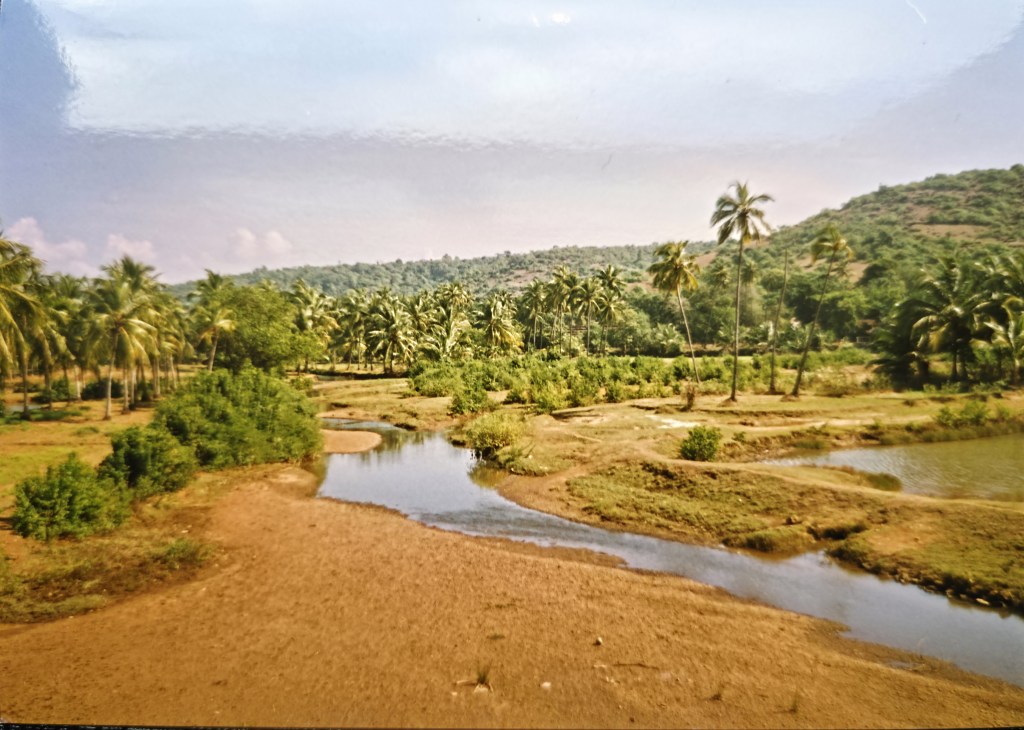
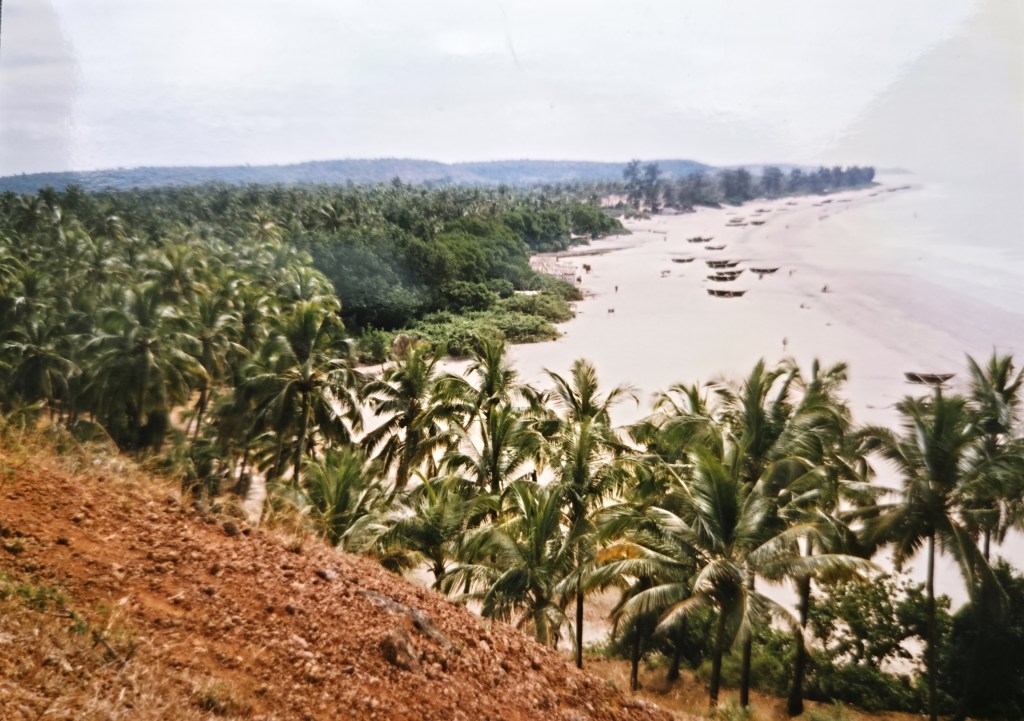
    After a day and night, I realise this beach is the closest to untouched I’ve seen in India. The only thing spoiling it is us being there. The only things on the beach are three fishing boats.

    It doesn’t take long before the rose-tinted glasses slip. The seawater isn’t clear. Sewage from the village runs through an open sandy channel into the ocean. I only notice it after a few days watching locals casually step over it. My perfect beach wasn’t as perfect as it first looked.

    Daily Life and Accommodation in Arambol.

    Most days are spent in a beach shack. Because there are fifteen of us drinking every day, whichever shack we choose ends up doing extremely well financially. Beer is unbelievably cheap—usually 15–17 pence a bottle. One shack is run by a man from London with Jamaican parents who’s been in Arambol for about twenty years, long before many westerners.

    In 1994, £1 buys about 5–6 shack beers. By 1998, the same pound buys seven beers. It’s not because beer got cheaper; it’s the rupee collapsing. Western pocket money suddenly goes a long way, accelerating the tourist influx and changing the village economy.

    I rent a room mainly to store my rucksack—with my first Good News Bible inside—and to have somewhere quiet if needed, but I rarely sleep there. One place has a cockerel perched outside my door that wakes everyone at dawn.

    Mostly I sleep in beach shacks after long nights of drinking. I move regularly between beach and village. I find a local barber with a shack that has no windows, just holes in the walls; he shaves my head and face, places hot towels on me, and I fall asleep in the chair. A large water buffalo often sticks its head through the hole in the wall and wakes me by licking my face. This becomes a ritual—the buffalo, the shave, the hot towels, and me drifting off.
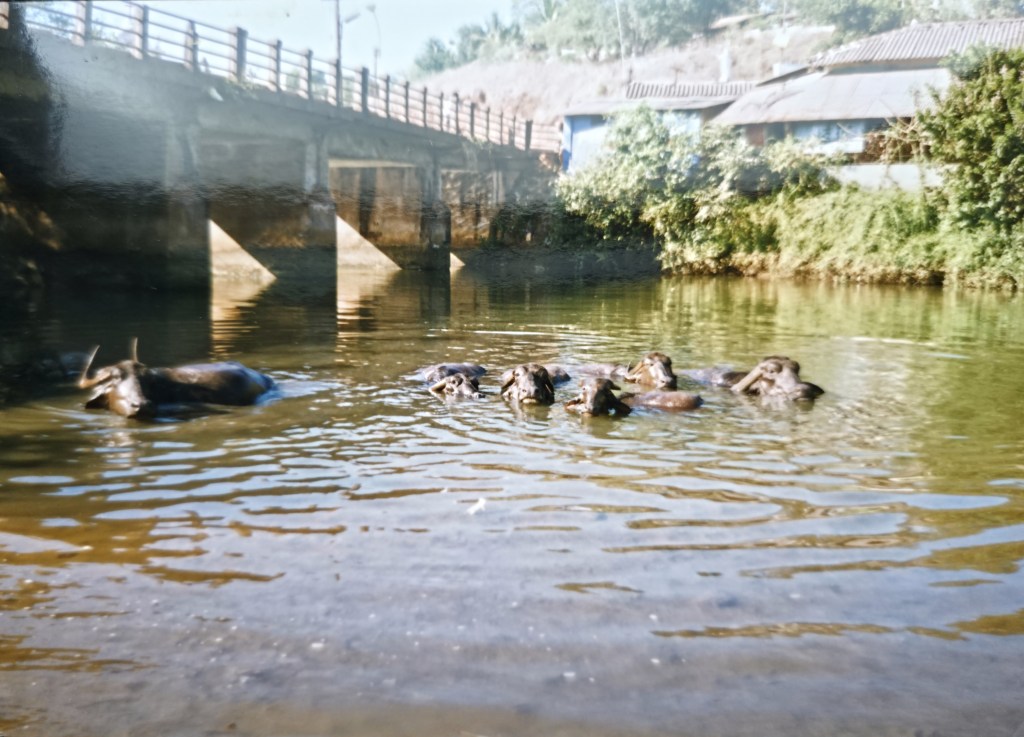
    We also play football with the villagers. They play what I call “killer football.” Rough, aggressive, and fast. They love it when we give back as good as we get.

    Fenny Episode.

    About four weeks in, Jay asks if I’ve tried fenny. I thought it was made from cashews; he says the stuff here is coconut-based. I ask the London/Jamaican bar owner where to get it. He tells me to walk 200 yards up the beach to a closed shack where a man will be asleep.

    I find him sleeping on the floor. I whisper “Fenny.” He gets up silently, dips a clear plastic tube into an old barrel, and offers me a choice: a 2-litre jug or a 5-litre jug. I point to the 5-litre. He fills it. When I ask, “How much?” he shakes his head. I give him about 70 rupees—more than enough. He smiles and goes back to sleep.

    Back at the shack, no one else wants any, so I drink it slowly myself. Sitting, I feel fine. But when I stand to go to the toilet, I realise I’m “drunk from the legs up”—mind clear, legs completely drunk.

    Village Habits and the Dawn Chorus.

    From the shack I notice a morning pattern: villagers coming down to the sea to defecate and urinate. Heavy coughing, spitting, farting, cockerels crowing—the combined noise is like a strange “morning chorus.”
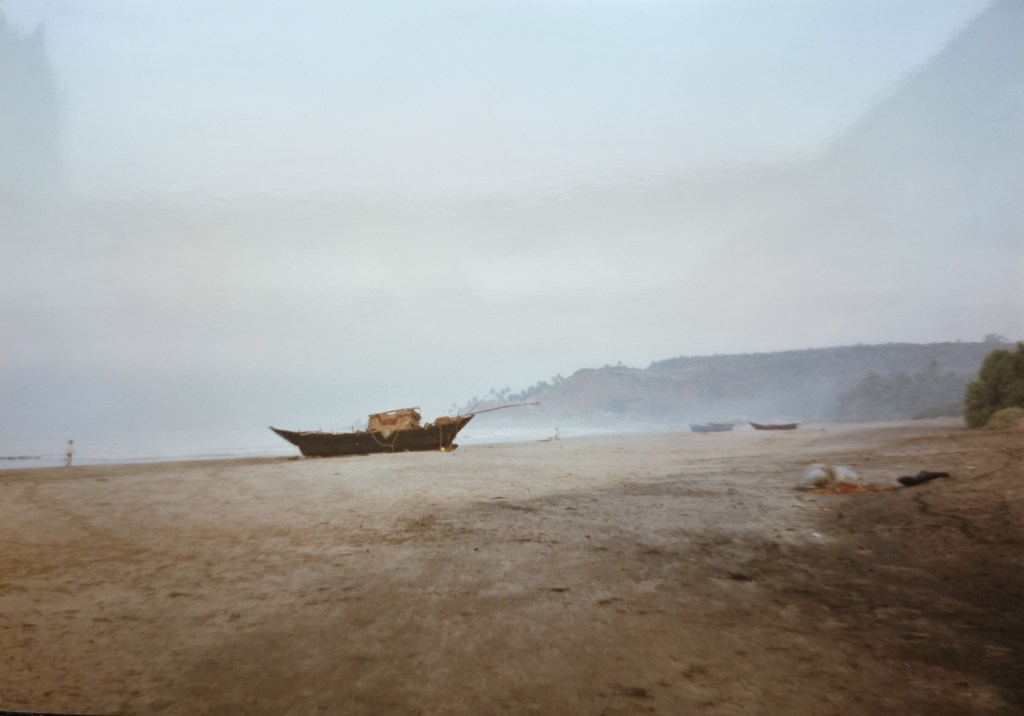
    Fishing With the Village.

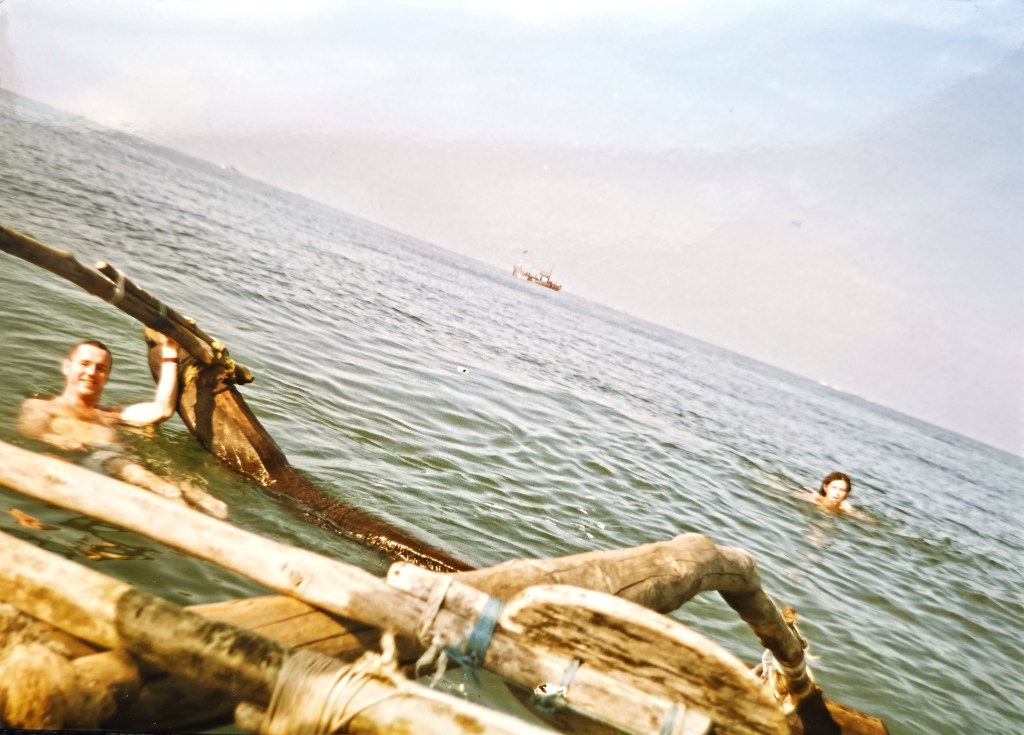
    Over time I get to know the fishermen. I help push boats out in the mornings. Eventually they invite me in the boats for the early fishing runs. I love it—deep water, away from the toilet runoff. I never swim in the surf again, only out at sea.

    I become close with one fisherman and his son. I go to their home early; he’s always still asleep. “Goa pace,” he tells me. We fish morning and evening. In the mornings we go far out; the water is slightly cleaner, and I dive into swim even though visibility is terrible. In the evenings we set nets near shore.

    One morning swim nearly ends in disaster. A huge swarm of box jellyfish drifts towards me. The fisherman and his son are shouting and waving urgently. At first, I wave back—then I realise I’m being warned. I swim back to the boat as fast as I can. From inside the boat, I see the swarm glide through where I had been.

    In the evenings villagers gather to pull the nets in and share the catch. I join often and am always given fresh fish.

    Moving to an Unfinished Shack.

    At one point I live with a family—the Gunga family—but the place feels “too nice.” I want something simpler. I find a half-finished shack made of timber poles, palm-leaf thatching, and cow-dung flooring.

    It has no doors, no windows—just holes. Animals can wander in pigs, cows, snakes, dogs. I buy a rope and hook, lift my rucksack into the rafters to keep it off the floor, and sleep on a woven wooden roll-mat with a proper handmade Goa blanket for the cold nights. My companions are geckos on the walls eating mosquitoes. I could watch them for hours.

    Porcupine and Dogs.

    One morning a huge porcupine—about the size of a pig—runs through the village. Villagers kill it right outside my hut, strip the skin, pull the quills, share the meat, and give the dogs the rest.

    By the end of tourist season villagers lure dogs to the beach and cull them. Dogs roam in packs during the season, then disappear. One night a pack of fifteen follows me aggressively. I picked up the biggest branch I can find, swing it, and warn them off.

    The Banyan Tree.

    I meet Jack, an Australian who travels Goa often. He tells me about a giant banyan tree, supposedly the third biggest in the world. We pack bread, water, and bananas and hike through forest and clay pools where we cover ourselves in drying white clay. Monkeys come down for food; we share some.

    At the tree we find sadhus performing rituals around a central fire. I stay three days and nights. They wrap me in blankets and a traditional head scarf. I’m deeply tanned by then—dark as the locals from fishing. When I return down the mountain, my brother thinks I’m a local and nearly doesn’t recognise me. The sadhus give me their pipe to smoke a couple of times over the three days; the whole experience is calm, relaxing, almost otherworldly. I learn to play the didgeridoo there and bring one home from Goa.

    Guitar on the Beach and the Fake Police.

    One night I hear faint guitar music and follow it down the beach. A Swedish man is sitting alone, playing beautifully, a spliff in his mouth. I sit behind him, not wanting to disturb him. He notices, nods, and keeps playing. He tosses me the joint; I take a couple of drags and stub it out in the sand.

    A noise behind us makes me turn. A group of twelve to fifteen Indian men in brightly coloured hand-knitted balaclavas approach—some with eye holes cut in completely the wrong place. They claim to be police. I recognise one as a villager. They accuse us of having hashish.

    I tell them I’ll go get my fifteen friends so we can all pay them together. That ends it. They wander off. The guitarist smiles and keeps playing.

    Photography, Temples, and Weddings.
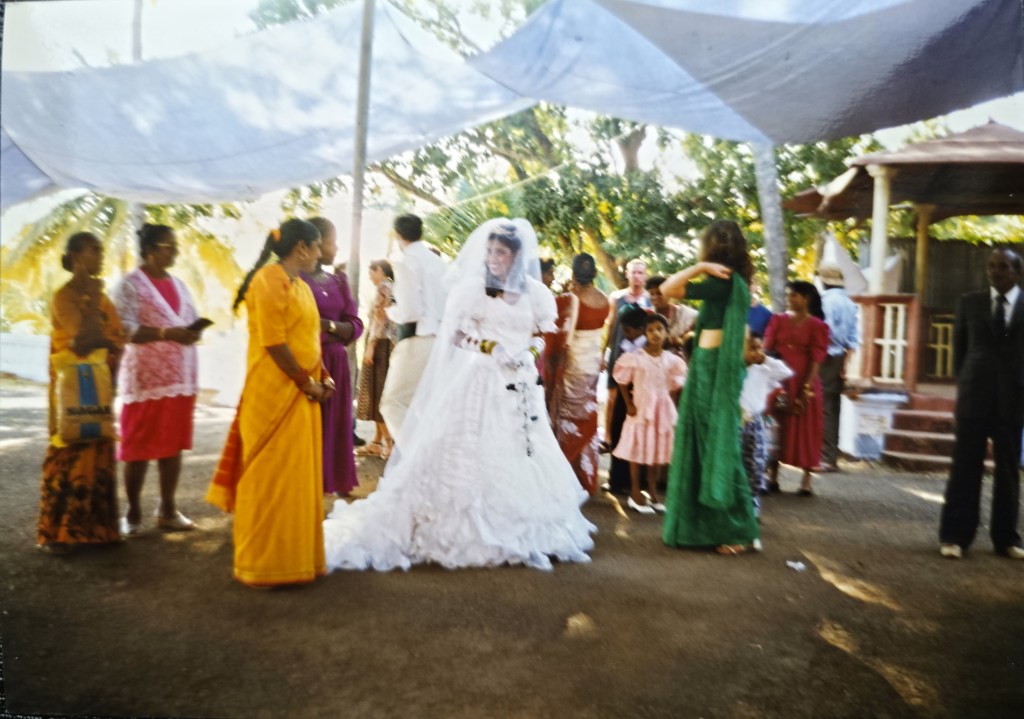
    Back then there are no mobile phones and hardly anyone carries a camera. I bring two disposable Kodaks and only take photos on days I deliberately go out looking for things to capture.

    After six weeks in the village, three of us are invited to two weddings—a Hindu outdoor wedding and a Christian one in a small church. The contrast is obvious. Hindu: loud, vibrant, drums, colour everywhere. Christian: peaceful, restrained, but later everyone dances and sings.

    Villagers ask why I dress like I have nothing yet spend so much in the village. I explain the woman who washes my clothes beats them on a rock with glycerine soap and destroys anything nice. Because of the heat I mostly wear simple Indian clothes and a single pair of jeans I cut down.

    To attend the weddings, we buy new clothes. I keep photos of the Christian church and its Catholic imagery—crucifixion scenes, Mary and the infant Jesus.

    When I get home, I develop the photos and show them to my brother’s friends who live close to North London. They look at them and say, “These are boring. Where are all the partying photos?” I tell them I was interested in capturing the place—not posing for drunken snapshots.

    Continue: Goa to the Gospel, Part-Two
    Leave a comment

    This site uses Akismet to reduce spam. Learn how your comment data is processed.

  • From Goa to the Gospel: Part Two.

    From Goa to the Gospel: Part Two.

    1999 – Decision to Return for the Millennium.

    Just before the end of November 1999, I’m with a group of friends from my local area – some I’ve known for decades, others for ten or five years. I’m telling stories about Goa at Christmas from the earlier trips: the shacks, the beaches, the madness, the quiet.

    By the end of the evening someone says, “Why don’t we go for the millennium?” That’s it. Decision made. “Let’s do it.”

    We each book flights separately. I give people the details of the broker who usually books mine; some go through him; others sort themselves out. Alan and Gemma, a couple in the group, book their own flights. One friend, Lyn, chooses the absolute cheapest route, going via Russia and somewhere else, taking a much more complicated path to Goa.

    By this time the Goa airport is built and up and running. Everyone arrives before me. I land about four days later than the rest, bringing a ridiculous amount of duty-free whisky, vodka, and cigars. No stopover in Saudi this time, so nobody confiscates anything.

    2000 – Six-Bedroom House and a Changing Village.

    For most of my friends, this is their first time in India and in Goa. They haven’t seen Bombay or anywhere else – just straight into this little corner of Goa that I’ve been coming back to for years.

    On my first trip in the 1990s I’d gone through Bombay and eaten my first meal in a big hotel that would later be known for a terrorist attack. This time, I leave the airport in a rickshaw with my mate Lance. On the way he casually drops it into the conversation:

    “We’ve rented a six-bedroom house.”

    I laugh and say, “I didn’t know there were houses like that in Goa.”

    Turns out it’s the only one like it in the village. It belongs to a local family I’ve met before over the years. It’s made of brick, with a proper slate roof. There’s an indoor shower and a separate bathroom with a Western toilet. Water is switched on to fill a tank bolted high up on the outside wall, and the whole system runs by gravity.

    For Goa, in that little fishing village, this is the West arriving. It feels like the beginning of the end of its old peace and quiet.

    Each person gets about a one-minute shower to wash and get ready in the evenings. The routine is simple: you wet the bar of soap, lather your whole body with a tiny bucket – the kind kids use for sandcastles – and then you’ve got one minute under the shower head to rinse off the lot before the water pressure dies. I don’t like it. I preferred the old way, pouring water over my head from the village well, staying closer to the life of the locals.

    There are seven of us in total staying there. Alan and Gemma share one room; the rest of us spread out over the others. It’s comfortable, too comfortable. Eventually I decide the rent is too much and move back out into a shack again. The old pattern returns I go back to sleeping in simpler places while the others enjoy the “luxury” house.

    Hammock Makers and Undercover Police – Millennium 1999-2000.

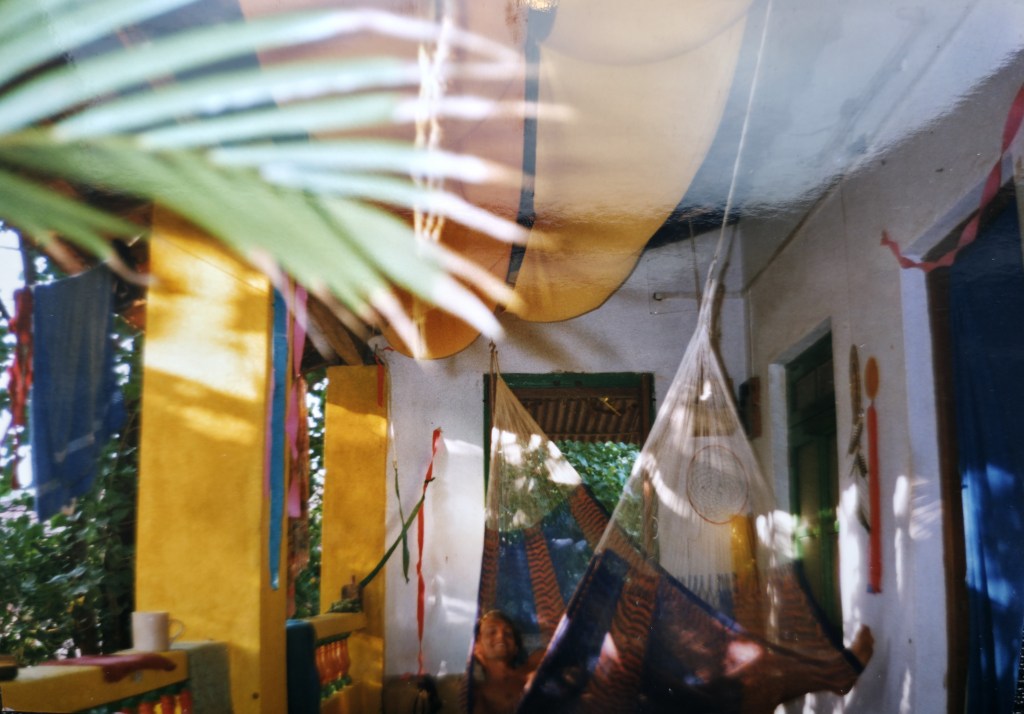
    Over the years I become friends with a couple who make and sell very good quality hammocks. They always seem to be in Goa, year in, year out. They know the village, the locals, and the different layers of police – including the plainclothes officers.

    They invite me to their place for homemade food; I go often, and one day I invite them down to the beach with the promise of drinks and food on me all day.

    By sunset the beach is busy. People are smoking strong cannabis derivatives – “cream,” “gum,” and other forms that are closer to oil and crystal than the usual stuff. It’s powerful and hallucinogenic. Plainclothes police mingle with the tourists.

    The hammock-maker’s wife gets up and starts walking around the beach, casually picking up small sticks. Each time she passes a plainclothes officer, she plants a little stick in the sand next to them. After quietly marking them all, she comes back and announces to everyone, “Wherever you see a stick, that’s a policeman.”

    Bold, funny, and very accurate.

    By this point the game has shifted. It’s no longer just fake “police” trying to extort a bit of money. Now the real police are operating undercover with quotas to hit – a certain number of arrests, a certain amount of bribe money. The money moves up the chain, and everyone takes their cut.

    If you’re caught with even a small amount of cannabis, you’re looking at a possible ten-year sentence in an Indian or Goan prison. Many tourists pay bribes to avoid that. If the police are short on their monthly numbers, they sometimes pick people at random on the beach, leading to court cases, jail terms, and people being stripped of their money and sent home in disgrace.

    Beach Shack Christmas and the Pig Meal.

    On one of my trips back – about two years after the first time in Arambol – I buy an open ticket that lets me stay for up to six months. The shack where my friends and I had spent weeks on my first trip has done so well that the original owner has moved on to other business. His brother has taken it over and tried to “modernise” it with breeze blocks and Western touches.

    We don’t like it. It feels wrong. So, we walk further up the beach and find a very basic timber-frame shack run by a young lad in shorts and flip-flops. He’s there every morning when we arrive, serves us beer all day and all night, cooks on a single ring stove behind a curtain, and somehow manages to get us whatever we ask for.

    Around Christmas he tells us, “Christmas dinner is on us. You won’t have to pay.”

    When the food arrives, it’s a brown broth with bones and no meat – from a village pig. We know what the pigs have been eating. They’re the village waste system, living under the shack toilets and eating human excrement as it falls. Looking into the bowl and seeing mostly bones, none of us can bring ourselves to eat it.

    We don’t want to offend them, so we say it’s “too spicy” and ask if we can have something else. They bring vegetarian food. We decide to stick to vegetarian food and fish in India and leave the pig meat alone.

    My first close encounter with the pig system had been at about three in the morning after a day and night of laughing and drinking. I was using a shack toilet – a simple hole in the floor – when a large pig’s snout suddenly appeared through it, eating as I continued. I remember joking with the pig and asking if it wanted wine with its meal.

    New Year 2000 – Three Days of Parties.

    By the time New Year’s Eve 1999 rolls round, the whole group and I have been on a heavy week-long drinking session. On New Year’s Eve itself we head to a party in a bamboo forest. The music is tribal and repetitive. After about three hours, it all sounds the same to me. Everyone is doing the trance-step dance, locked into their own world.

    We mostly drink, watch everything, and chat with people.

    As usual, a bit of trouble tries to find us when someone starts on one of my friends. I tell the bloke to leave us alone; he does, and that’s that.

    Sometime in the early hours I fall asleep at the bamboo party. Instead of taking me home, my brother and friends carry me to another party. I wake up in daylight at a beach party on Day Two. We get some sleep on the beach during the day, then party again through the night.

    On Day Three I wake up at yet another party in a completely different place. Everyone I came with has gone back. I have no idea where I am in Goa.

    Then I spot one of the African lads I know from Arambol – someone I’ve become friendly with over the years. I walk over, offer him a beer, and ask, “Where are we?” I explain that I started in a bamboo forest three days ago and have been transported from party to party while asleep.

    He laughs loudly, tells me where we are, and where the taxis are hiding. I find a taxi, get back “home” to my shack, and sleep there properly for the first time in days. By now I’ve moved out of the expensive house because I think the rent is too high. I sleep off three to five days of near-continuous drinking.

    Parties, Israeli Soldiers, and A Broken Man.

    By 2000 there are motorbikes everywhere – big 350cc Indian-built versions of old British Enfields. Packs of young Israelis who have finished their national service roar into Goa on them, usually in big groups. They arrive loud, fast, and ready to blow off steam.

    I see and hear about far too many casualties. Chemists treat tourists as test subjects for new drugs – acid, ecstasy, all kinds of experimental blends. Some people never fully come back.

    One night our group goes down to the beach for a big fire party. I show people how to build a proper beach fire that will last all night: dig a big hole, buy wood from locals over several days, and pack the fire with dry sand so it burns low and isn’t so visible to the police.

    A large group of Israeli ex-soldiers sit around the fire with us. One of them gives me a hard, aggressive look, then gets up, walks behind me, and slaps me on the back of the head. I decide to let it go.

    Ten minutes later he does it again, harder, on the top of my head.

    I stand up and address the rest of the group, asking who he’s with. I tell them they know he’s out of order and it’s on them to control him, so I don’t have to. Then I sit back down.

    A short while later, he comes round again and kicks me in the lower back. That’s it. I tell my friends we’re leaving, and we walk about a hundred metres to another shack where people know me from previous years. The same London/Jamaican bar owner is there and tells me that once the Siolim–Chopdem bridge is finished in 2002, he plans to leave because direct road access will turn the beach into a crowded, sunbed-lined circus.

    We’re sitting on floor mats in his shack when the same Israeli soldier walks back in with five others. He kicks me in the back again while I’m seated. I jump up. He drops into a martial arts stance. I tell him he’s going to need it. I quickly get him in a throat hold and throw him over two of the little table bays. He lands in the sand, not on anything solid, and his mates drag him out.

    A very large American man, who looks ex-military to me, stands up and says, “We don’t want trouble here. Trouble started when you came in.” I tell him I didn’t start it and explain that the soldiers followed us. I say the man is struggling and looks completely gone, probably from too many experimental drugs.

    The American says, “I want you out.”

    I reply, “If you think you can get me out, you can try.”

    The shack owner, the London/Jamaican man, speaks quietly to him, and the American sits back down. The situation deflates.

    The next morning the American and I are the first two in the shack. We end up talking, get on really well, and spend two days and nights drinking together and laughing. The aggressive Israeli’s parents fly out to Goa to collect their son. He has become a casualty – mentally and spiritually – and is beyond his friends’ control.

    They ask to meet me and thank me for not hurting him. I tell them there’s no need to thank me and wish them well in getting him home safely. They arrange for him to fly back to Israel. Over that period, I see and hear too many horror stories of drug casualties in Goa, people broken in body and mind.

    Bible, Seeking Years, and a Later Realisation.

    Before I ever became a Christian, I was already a seeker. I always travelled with a Bible – my first Bible, a Good News Bible with an orange cover and simple line drawings. A pastor had once recommended it as a good starter Bible. I can’t remember exactly how young I was when I first got it, but by the time of my Goa years it was worn from use.

    Wherever I stayed in Goa – shacks, huts, fishermen’s homes, village houses – that Bible was always next to my roll-out mat. Sometimes the places had no doors or windows, sometimes the doors were left open all night. But the Bible stayed by my mat.

    I travelled light. My rucksack held very little apart from that Bible and a few essentials.

    By 2000 and earlier, I noticed that everywhere we went locals seemed to recognise the bikes we’d hired. We’d ride little mopeds, 125 Hondas, or Enfields that we’d rented from village families. We’d travel to beaches far away from the main crowd or to places like the Anjuna flea market, and someone would say, “You hired that from my cousin,” then ask how much we paid. We’d laugh about how close-knit the village networks were.

    Years later, on 28 November 2025, it hit me: it’s very possible the whole village knew I slept with a Bible by my mat. Goa has Christian communities. Villagers talk about visitors, especially ones who keep coming back year after year. A foreigner who drinks like the rest, lives a simple tourist way, but always has a Bible beside his bed – that would have been noticed, that’s what we witnessed with the locals. It was a part of community safeguarding.

    Looking back, I can see those Goa years as part of a long-term “seeking” and God’s call across decades – even though I hadn’t gone there to study religion. I thought I was chasing sun, sea, and parties. Something else was going on.

    From Goa to the Gospel.

    During one break at Arambol around 2000, after six weeks of sun, sand, sea, and parties, I opened my rucksack and took out my Good News Bible again. I’d seen stone and wooden idols being worshipped. I’d seen the mash-up of Hinduism and Catholic Christianity left over from centuries of Portuguese rule. I’d seen people bowing down to gods they themselves had carved.

    Something in me, which had been building for years, refused to accept that the beauty of the world, the universe, and the rare glimpses of real love we see were all an accident. I wanted to search. I wanted to know the truth.

    That was the beginning of the journey where Christ found me – lost in a world that worshipped false idols: money, material things, stone gods, wooden gods, even papier-mâché gods paraded at festivals in Bombay.

    I’ve travelled through many countries in my life, and everywhere I went I saw the same thing — people worshipping idols. Not carved statues only, but the things we all lift up above God. In India, the idols were literal and handmade, shaped from wood, stone, plaster, or metal. Back home in Britain, the idols weren’t statues at all, but money, status, possessions, comfort, and the need to look successful. Different forms, same root. We all create something to replace the God we don’t want to face. Seeing that contrast so clearly was part of what led me to look deeper into the Gospel.

    Back in Blighty, some years later, I watched YouTube videos of Arambol Beach and felt sick. It was unrecognisable. A total freak show. Huge crowds. No fishing boats. Rows of sunbeds like a Spanish resort. One friend of mine kept going out there for six months every year, renting a house or shack, then working six months in metal framework back in the UK. He gave me updates about the changes – the arrival of the Russians, the area nicknamed “Little Russia,” and the rest of it.

    For me, after 2000, it was over. I stopped going. The fishing village I’d known had gone.

    Coming next: From Goa to the Gospel – Part Three

    Leave a comment

    This site uses Akismet to reduce spam. Learn how your comment data is processed.

  • From Goa to the Gospel: Part Three

    From Goa to the Gospel: Part Three

    A Real Conversion.

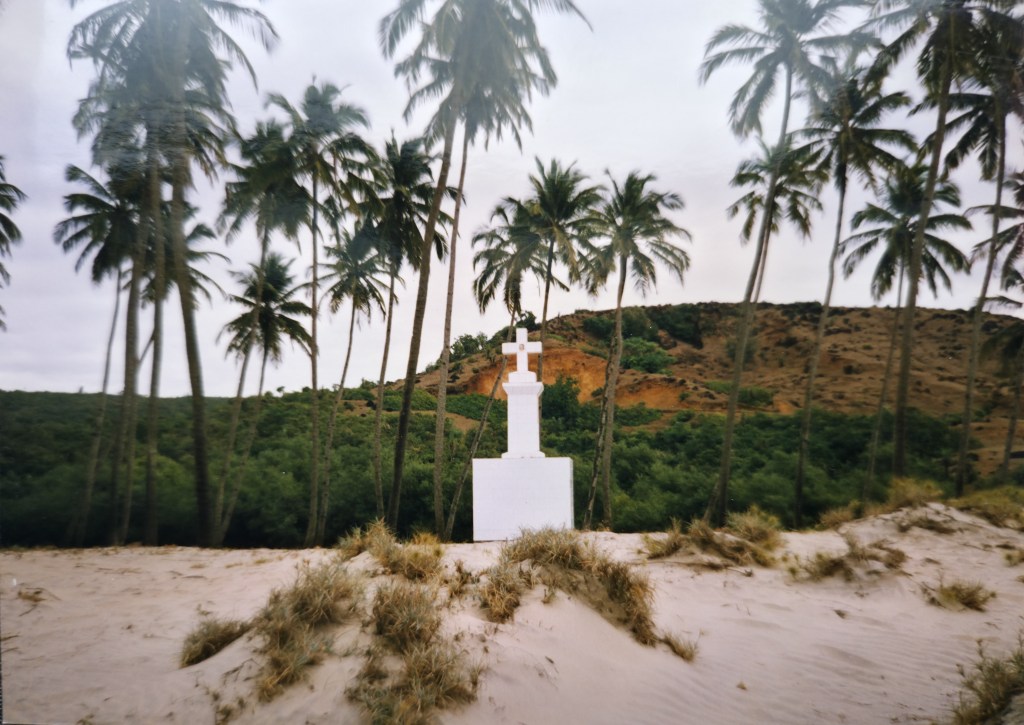
    Image: The hilltop beside the fishing village where the local ekklesia—the called-out ones—gather to worship the Living God. The concrete cross is not an object of worship, but simply a geographical marker where the believers meet.

    My conversion was not a “nice idea” or a gradual drift into church because it seemed respectable. It was the Holy Spirit showing me, for the first time, what I really was. And it broke me.

    I had been down every dead-end street I could find. Goa, parties, travelling, work, friendships – I kept thinking the next thing round the corner would finally make life make sense. But eventually I  hit a wall. I realised that if I walked down one more dead-end, I would have to admit life was pointless. That was the moment another way opened up in front of me: not a wide road with crowds on it, but a small, narrow path.

    The conviction of the Holy Spirit doesn’t flatter you. He doesn’t tell you that you’re “basically a good person who just needs a bit of religion.” He shows you the truth. I saw my own sin, my selfishness, my pride, the way I had lived as if God did not exist. It was like looking in a mirror for the first time. I wasn’t destroyed, but I was in pieces – like a smashed pot on the floor.

    That breaking was not cruelty. It was mercy. The old me had to die. The Bible says we are crucified with Christ and that the old self is put to death. Scripture also says what every honest Christian knows: you still feel that old self hanging around your neck like a dead man you drag behind you. I understood what the Apostle Paul meant – the new heart was real, but the old habits, the old temptations and shadows were still there, trying to pull me back.

    From that point on, everything changed. My heart and mind were different. I didn’t see the world the same way. Things I once shrugged off as “just life” now looked like poison. I wasn’t suddenly standing in the street judging everyone – I could see that I was the problem. But I also knew that certain things had to go. Certain places. Certain patterns. Certain friendships.

    In the end, I lost all my old friends. They didn’t want Christ; they wanted the old version of me. They were happy enough for me to believe in God in private, as long as I left my shoes and my Christianity at the door when I visited. Eventually it was clear to all of us that it couldn’t go on like that. I stopped going round. They treated me differently. They sounded different. We agreed it was for the best, but it still hurt.

    My conversion was not a Pentecost-style experience with shouting, singing, and tongues. There was no choir in the background. It was quieter and more painful than that. It was me on the ground, many times, saying things that are between me and God. It was the Holy Spirit convicting me of sin, breaking me, and then, very slowly, beginning to build me back up again in Christ.

    That is what I mean when I say my journey really did go from Goa to the Gospel. I gave my life to Christ before my baptism – baptism is an outward sign of the inward work of the Holy Spirit. I was baptised on Sunday 8th October 2017.

    Praise God. Amen.

    Leave a comment

    This site uses Akismet to reduce spam. Learn how your comment data is processed.

  • Ecclesiastes Chapter 4

    Ecclesiastes Chapter 4

    The Vanity of Life and the Need for One Another.

    Introduction

    There are moments in Ecclesiastes when the Preacher takes us from philosophical reflection straight into the raw edges of human experience. Chapter 4 is one of those moments. It opens with a scene that is painfully recognisable in every generation: people crushed by those who hold power over them. From there, the chapter moves through the motives that drive our work, the loneliness that often lies beneath outward success, the strength found in companionship, and the fragile nature of human fame. What emerges is an unfiltered look at life in a world that refuses to be fixed by human hands. Through it all, the chapter presses us to consider what actually gives life substance and how we should live when so much around us proves empty.

    Oppression, Envy, and the Burden of Toil.

    The chapter begins with the Preacher observing the tears of those who are oppressed. They have no comfort, while their oppressors hold all the authority. It is a bleak picture: a world where the vulnerable are left without protection and where suffering goes unanswered. The Preacher does not soften what he sees. He goes as far as to say that the dead are better off than the living, and better still are those who have never been born to witness such injustice. It is not cynicism. It is the honest acknowledgement that life under the sun can be brutal, and that power, when misused, crushes those who cannot defend themselves.

    From there the Preacher turns to another uncomfortable truth: much of our work and skill is fuelled by envy. Instead of labour flowing from purpose, love, or service, it often springs from the desire to outdo someone else. We push ourselves not because the work itself is meaningful, but because we are watching our neighbour, comparing, competing, and trying to get ahead. But this too is a chasing after wind. It wears us out and gives nothing lasting in return.

    Idleness, however, offers no escape. The one who simply folds his hands and refuses to work ends up consuming himself. Laziness becomes its own form of destruction. The Preacher is not advocating extremes. He is exposing them. On one side is frantic striving driven by envy. On the other is the self-ruin of refusing to work at all. Between the two lies a better way: a small amount, accompanied by quietness and peace, is far better than overflowing hands gained through endless toil. Contentment, not competition, is where rest is found.

    The chapter then presents the image of a solitary worker. He has no family beside him, yet he works endlessly. His wealth increases, but his heart is never satisfied. He never pauses long enough to ask why he is labouring so hard or who will benefit from his sacrifices. His life becomes a treadmill of accumulation without joy, meaning, or relationship. This too is declared to be vanity—an unhappy business that leaves a person exhausted and alone.

    The Strength of Companionship.

    Against the emptiness of isolation, the Preacher turns to the value of companionship. Two people working together accomplish more than one person working alone. When one falls, the other can lift him up. The solitary person, however, has no one to help when trouble comes. It is a simple picture, yet deeply human. Life is unpredictable, and even the strongest among us will stumble. To have another beside you in those moments is a gift.

    The image continues: two people lying together can share warmth, something one cannot achieve alone. And in conflict, two standing together can withstand an opponent who would overpower them individually. A threefold cord—a partnership strengthened by a third strand—is even harder to break. The point is not mathematical. It is relational. Strength multiplies when people walk together. Isolation may seem easier, but it leaves a person vulnerable, tired, and spiritually cold.

    These lines cut through the modern illusion of self-sufficiency. The chapter insists that human beings were not designed to carry life’s burdens by themselves. Companionship does not remove all hardship, but it provides resilience in a world where hardship is unavoidable. Where envy isolates, generosity binds. Where rivalry exhausts, shared purpose strengthens. In a world full of pressure and uncertainty, the presence of another human being becomes one of God’s simple and profound mercies.

    Wisdom, Status, and the Fragility of Human Praise.

    The chapter closes with a picture of dramatic reversal. A young person, poor but wise, is considered better than an older ruler who has hardened his heart and refuses counsel. The wisdom of the youth lifts him from obscurity—he rises from prison to the throne. Crowds gather around him, celebrating his insight and leadership. But even this moment of triumph is fleeting. Those who come later will not rejoice in him. His popularity, which once seemed unstoppable, fades as quickly as it arrived.

    This final scene exposes the instability of human status. Power rises and falls. Admiration swells and then disappears. Even the most remarkable success cannot secure lasting remembrance. The Preacher’s verdict remains the same: this too is vanity and a striving after wind. The point is clear. We cannot anchor our identity in the approval of others. The praise of crowds is a tide that turns without warning. What looks like glory today becomes dust tomorrow.

    Wisdom is still better than folly. Humility is still better than stubborn pride. But Ecclesiastes warns us not to build our hope on human recognition. Life under the sun is unstable, and the Preacher forces us to face that reality with clear eyes.

    Encouragement for Believers and an Invitation for Seekers.

    For believers, this chapter is an honest reminder that life in a fallen world can be deeply painful. Oppression still wounds, envy still corrodes the heart, and loneliness still weighs heavily on the soul. Yet the chapter also holds out simple, grounded wisdom. Seek contentment over comparison. Choose companionship over isolation. Walk in humility, knowing that God sees even when others do not. He is not blind to the tears of the oppressed or the exhaustion of those who labour without recognition.

    In the body of Christ, the call to companionship becomes practical. We lift one another when we fall. We warm one another’s hearts when the world grows cold. We stand together against pressures that would overwhelm us alone. These are not small things. They are signs of God’s care expressed through His people.

    For those exploring faith, the honesty of Ecclesiastes may feel surprising. The Bible does not pretend the world is safe or fair. It does not offer shallow comfort. Instead, it speaks plainly about the injustice, frustration, and loneliness that everyone feels at some point. Yet it also points to the reality that we are made for relationship—with God and with others. The longings stirred by this chapter are not illusions. They are hints of something deeper, urging us to look beyond the weariness of life under the sun and consider whether there is a God who sees, who cares, and who invites us to walk with Him.

    Conclusion.

    Ecclesiastes 4 gives us a sobering view of life: oppression that goes unanswered, toil driven by comparison, isolation that drains the soul, and success that soon fades from memory. Yet woven through its realism is a thread of hope. Companionship matters. Humility matters. Contentment matters. And the God who stands above all things is not indifferent to what happens under the sun. As we live with open eyes and honest hearts, may we hold fast to what endures and walk with those God has placed beside us, finding strength for the journey in His care.

    Leave a comment

    This site uses Akismet to reduce spam. Learn how your comment data is processed.

  • Ecclesiastes, Chapter 3.

    Ecclesiastes, Chapter 3.

    Why there’s an audio version
    Some readers prefer to read at their own pace. Others (especially when eyesight, energy or health make reading harder) may find listening easier. So, I’ve added an audio option—feel free to relax, sit back and listen, or carry on reading—whichever suits you best.

    A Time for Everything: Learning to Live in God’s Seasons.

    Ecclesiastes 3 is one of those passages that seems to belong to everyone. Even people who have never opened a Bible recognise the cadence: “a time to be born, and a time to die… a time to weep, and a time to laugh… a time for war, and a time for peace.” It’s been quoted in songs, at funerals, at weddings and in films.

    But the writer of Ecclesiastes – often called “the Preacher” – is doing far more than offering a comforting poem about life. In chapters 1 and 2 he has already dismantled our illusions about what will finally satisfy us. Life “under the sun” (life as we see it, limited to this world) runs in weary circles. Pleasure, success, projects, even human wisdom cannot bear the weight of ultimate meaning. And at the end of it all, death levels us all.

    So, when we reach chapter 3, a deeper question surfaces: if life is this brief and fragile, if I cannot control outcomes, if even wisdom and hard work cannot outrun death – how am I meant to live? Ecclesiastes 3 answers with something both humbling and strangely comforting: God rules the times and seasons. Our calling is not to master time, but to trust the One who does.

    A Time for Everything: Life’s Contrasts on the Page.

    The chapter opens: “For everything there is a season, and a time for every matter under heaven” (Ecclesiastes 3:1). What follows is a beautifully balanced poem: fourteen pairs of opposites that sweep across the whole range of human experience – birth and death, planting and uprooting, weeping, and laughing, mourning, and dancing, silence and speech, love and hate, war, and peace.

    This is not a sentimental calendar quote. It is a painfully honest description of real life. We have days of joy and days of heartbreak. There are moments when we must tear things down and other moments when we slowly build again. There are times when speaking up is courageous and right, and times when silence is the wisest, kindest choice we can make.

    The Preacher is not saying that everything on his list is morally equal. “A time to kill” is not a free pass for murder; it reflects that in a fallen world there are God-ordained moments of judgement and just defence, as opposed to unlawful violence. “A time to hate” is not a nod to pettiness or prejudice, but to a right hatred of evil that destroys what God loves.

    Nor is this poem inviting us to do whatever we like whenever we feel like it. The real point is much more unsettling: real life includes all these experiences, and we are not in charge of when they arrive. We did not choose our birth. Few of us choose the moment of our death. We cannot schedule sorrow or predict when unexpected joy will break in.

    In chapter 1, the Preacher watched the cycles of nature – sun, wind, rivers – circling under God’s hand. Here, in chapter 3, he shows human life moving to the same unseen rhythm. There is a pattern to our days that we did not write.

    What Gain Has the Worker? The Question That Lingers.

    After the poem, the old question returns: “What gain has the worker from his toil?” (Ecclesiastes 3:9). We have already heard this question in chapters 1 and 2, as he wrestles with whether anything truly “profits” in the end. Now the question is asked again, but inside a world where God appoints times and seasons.

    You can work hard and create something beautiful, only to see it broken down in a later season. You can pour yourself into relationships, and then a time of distance, disappointment or loss arrives. You can enjoy a season of laughter and lightness, and then without consulting you, life moves into a time of weeping.

    The Preacher says, “I have seen the business that God has given to the children of man to be busy with” (Ecclesiastes 3:10). He is not saying that work is pointless. He is saying that work is not ultimate. We do not stand outside time, managing it. We live inside it, subject to it. That realisation will either drag us into despair or drive us into trust.

    Eternity in Our Hearts: Beauty in Its Time.

    Then we reach the beating heart of the chapter: “He has made everything beautiful in its time. Also, he has put eternity into man’s heart, yet so that he cannot find out what God has done from the beginning to the end” (Ecclesiastes 3:11).

    Here are two massive truths held together.

    First, God “has made everything beautiful in its time.” Not everything is beautiful in itself. Illness, injustice, grief, and war are truly evil. Yet God is so wise and so sovereign that he can weave even painful seasons into a larger pattern of beauty in his time. You and I see a handful of tangled threads. God sees the whole tapestry. The timing belongs to him, not to us.

    Second, God “has put eternity into man’s heart.” Deep down, we know we were made for more than “birth → work → death.” We long for permanence. We ache for justice that is not postponed or buried. We feel, sometimes almost physically, that death is wrong and life is too short. That ache is not a glitch in the system or a psychological trick. Ecclesiastes says it is something God himself has planted in us.

    And yet, the verse continues, we “cannot find out what God has done from the beginning to the end.” We are big enough to sense that there is a story larger than our own, but we are small enough that we cannot fully grasp that story while we are inside it. We want the full blueprint; God gives us enough light for the next step.

    So how do we live inside that tension? The Preacher says: “I perceived that there is nothing better for them than to be joyful and to do good as long as they live; also, that everyone should eat and drink and take pleasure in all his toil—this is God’s gift to man” (Ecclesiastes 3:12–13).

    This is not shallow escapism. It is an invitation to receive the ordinary gifts of life – food, drink, work, friendship, rest – as gifts from God’s hand, not as little gods in themselves. Enjoy your meals as gifts, not as your comfort saviour. Enjoy your work as service, not as your identity. Enjoy your relationships as blessings, not as foundations that must never crack. Real joy in God’s gifts is part of trusting him, not a distraction from it.

    The God Whose Work Endures Forever.

    The next verses shift our eyes from our fragile activity to God’s enduring work: “I perceived that whatever God does endures for ever; nothing can be added to it, nor anything taken from it. God has done it, so that people fear before him” (Ecclesiastes 3:14).

    Our plans are temporary and easily interrupted. God’s purposes stand. We cannot “improve” his wisdom or undermine his final design. That is not meant to crush us, but to humble us into reverent trust. If we could see and control everything, we would forget him entirely. Because we cannot, we are invited to bow before him.

    Verse 15 echoes the sense of repetition from earlier in the book: “That which is, already has been that which is to be, already has been and God seeks what has been driven away.” The cycles of history are not random. The “I’ve seen this before” moments of life unfold under a God whose purposes are consistent, even when his timing puzzles us.

    When Justice Fails and Death Looms.

    Just when we might be tempted to turn this into a neat “everything is beautiful, so everything is fine” message, Ecclesiastes drags us back to hard reality. “In the place of justice, even there was wickedness, and in the place of righteousness, even there was wickedness” (Ecclesiastes 3:16). Courts can be corrupt. Safe places can be dangerous. People who should do right often do wrong.

    What then? The Preacher answers in two ways. First, there will be a time of judgement: “God will judge the righteous and the wicked, for there is a time for every matter and for every work” (Ecclesiastes 3:17). Justice delayed is not justice abandoned. The God who orders times for birth and death also has his own time for putting things right. If judgement fell instantly every time we sinned, there would be no room for repentance, faith, or growth.

    Second, God uses the delay to expose what we really are. He is “testing” the children of man so that they may see they are “but beasts” (Ecclesiastes 3:18). Physically, we share the mortality of animals; we breathe, weaken, and return to dust. And if we live as if this world is all there is, with no God, no eternity, no final justice, then in the end we have no lasting advantage over the beasts.

    He even asks, “Who knows whether the spirit of man goes upward and the spirit of the beast goes down into the earth?” (Ecclesiastes 3:21). He is not denying the difference; by the end of the book, he will clearly say that “the spirit returns to God who gave it.” But inside the cycle of life and death, from our limited vantage point, we see so little. Ecclesiastes wants us to feel that smallness, not to mock us, but to loosen our grip on self-sufficiency.

    Rejoicing in Your Lot Today.

    The chapter closes very practically: “So I saw that there is nothing better than that a man should rejoice in his work, for that is his lot” (Ecclesiastes 3:22). Work is not your god, and it is not your curse. It is your portion – part of the daily calling God has entrusted to you.

    You and I do not know how long our work will last. We cannot see “what will be after” us. We have no idea how God might use what we do beyond our own lifetime. But we do know this: today has been given to us. The tasks in front of us are not accidents. The ability to enjoy them, even in small ways, is a gift. The right response is not anxious control, but thankful faithfulness.

    Learning to Trust the Lord of Time.

    Ecclesiastes 3 does not offer a shortcut around pain. Instead, it gives us a way to live honestly and hopefully in a world we do not control. You do not manage the seasons of your life; God does. Your deep longing for “something more” than this short, fragile existence is not madness; it is eternity written on your heart.

    For Christians, this chapter also points us towards Jesus Christ, the One who stepped into our times and seasons. The New Testament says, “when the fullness of time had come, God sent forth his Son, born of woman, born under the law” (Galatians 4:4). In Jesus, God entered our “under the sun” world to bear our sin, taste our death, and open up eternal life beyond the cycle.

    If you are a believer, Ecclesiastes 3 invites you to loosen your grip on control and receive today as a gift from a Father whose wisdom outlasts you. If you are exploring or sceptical, it gently asks why your heart insists that life should be more just, more permanent, more meaningful than it often feels. That ache may be God’s way of drawing you towards the One who makes “everything beautiful in its time” and who promises a world where time itself is healed.

    You do not need the full map. You have today’s portion: today’s work, today’s relationships, today’s opportunities to do good and to rejoice. Walk faithfully in that and dare to ask whether the God who holds your times in his hands might also be holding out his hand to you.

    Leave a comment

    This site uses Akismet to reduce spam. Learn how your comment data is processed.