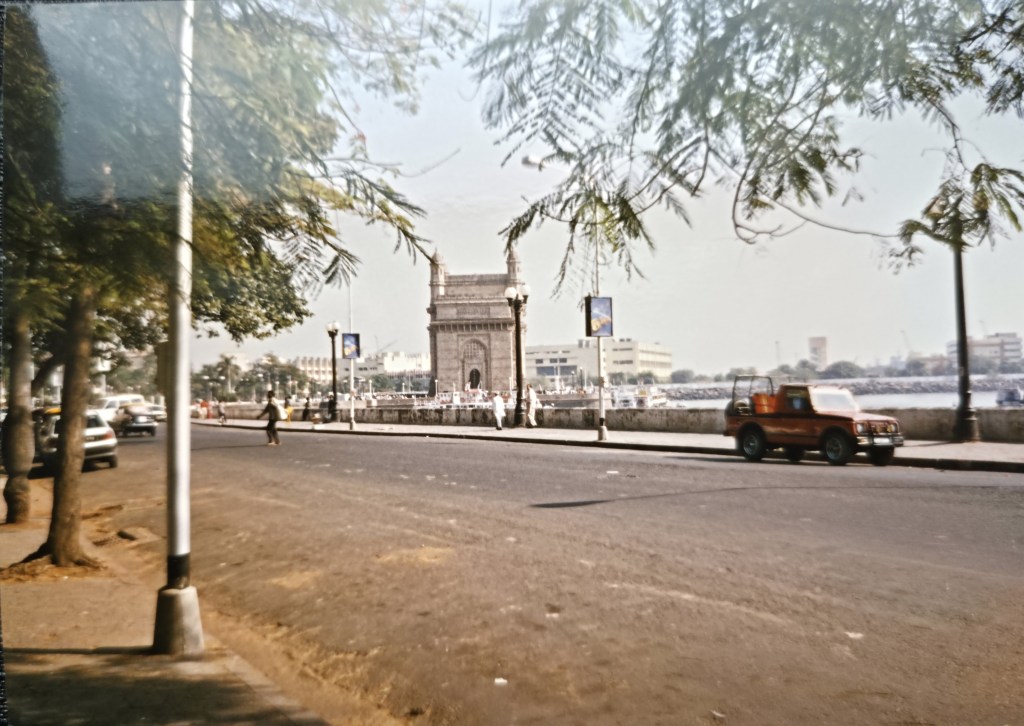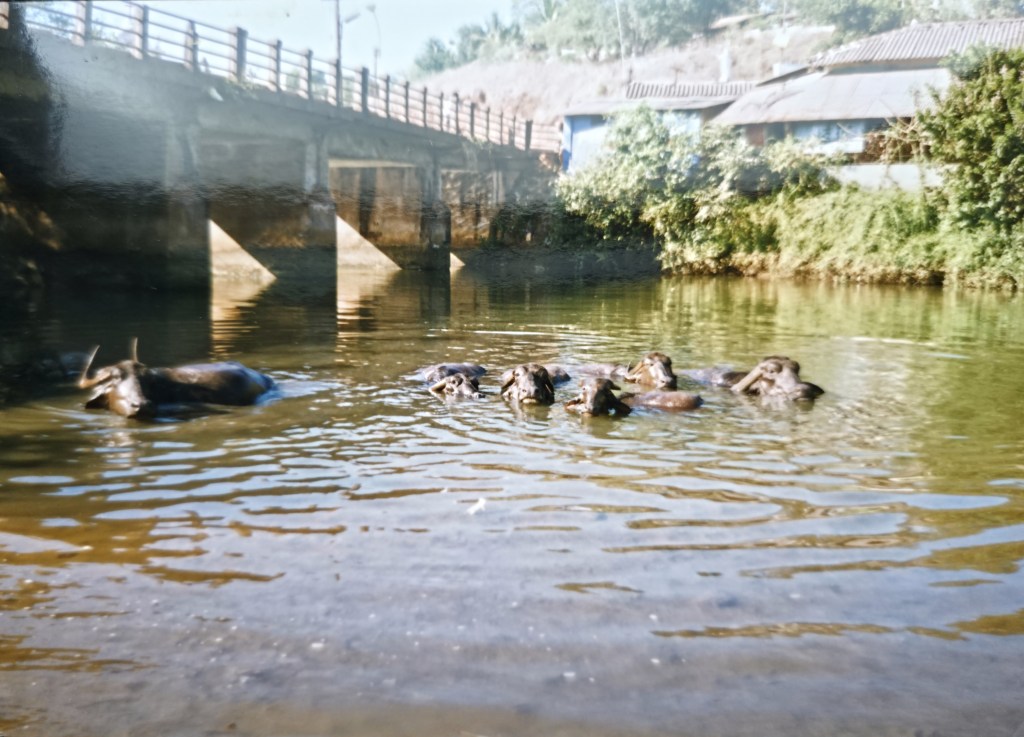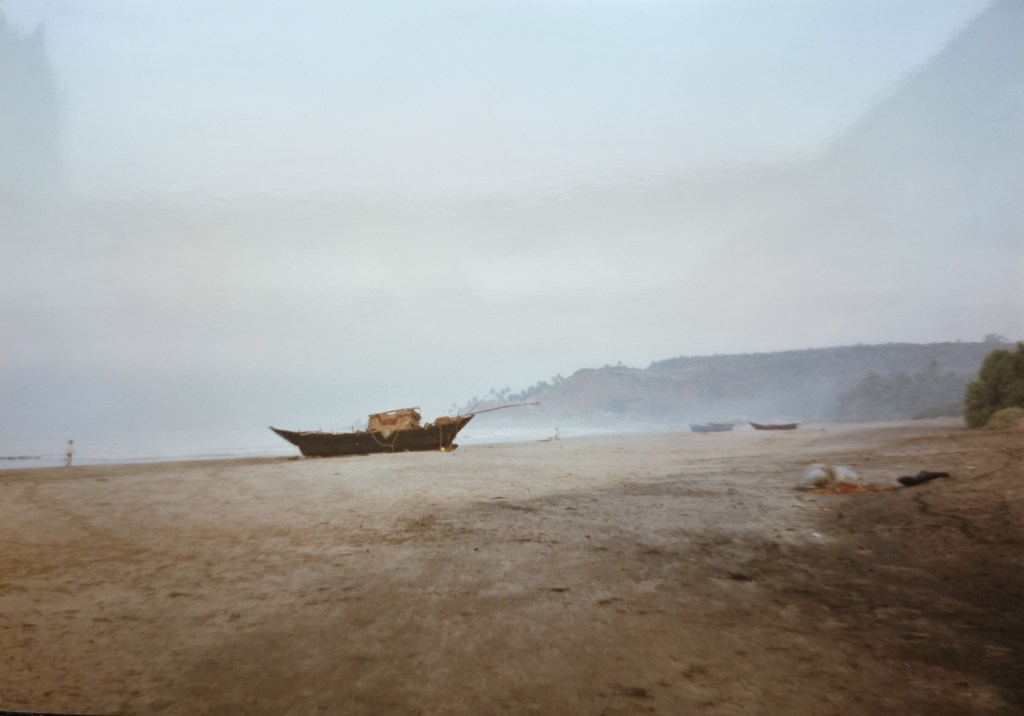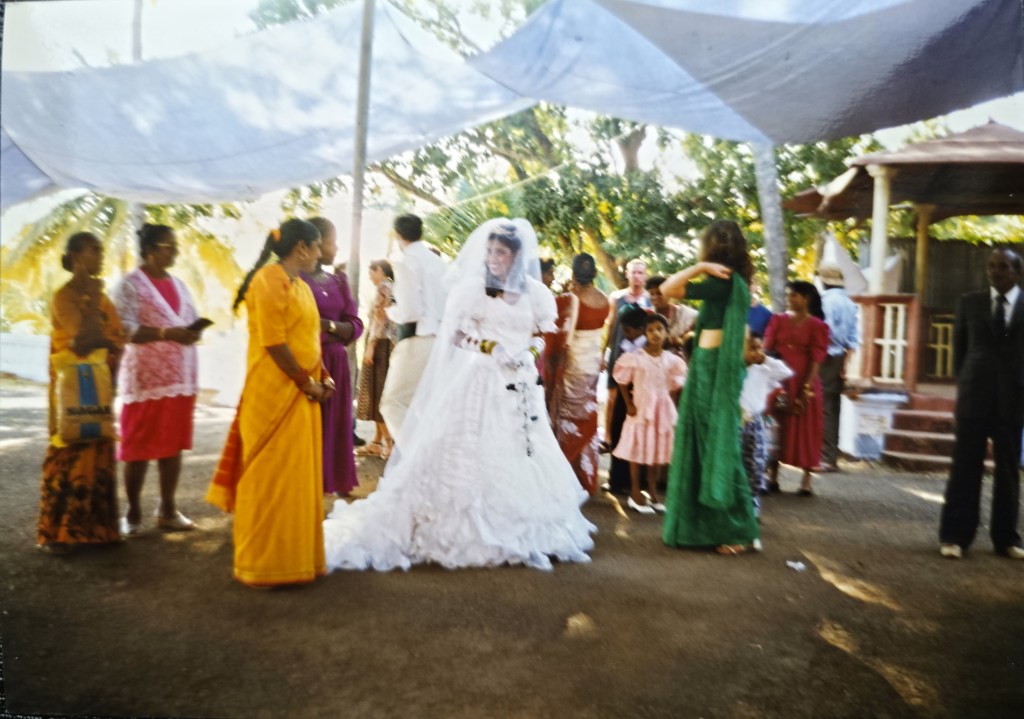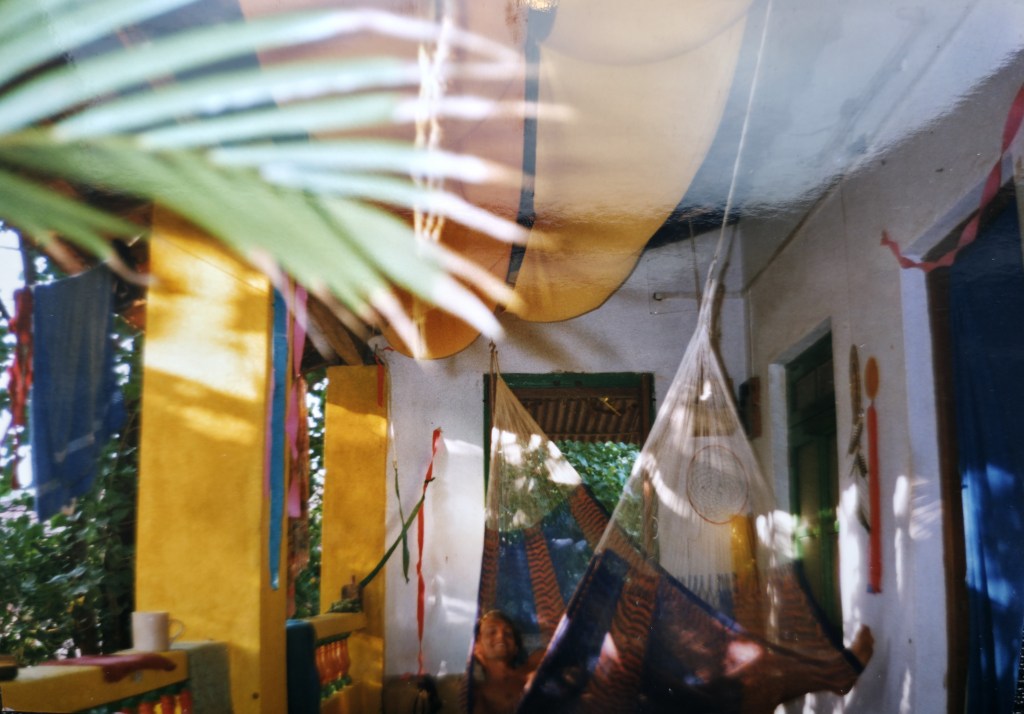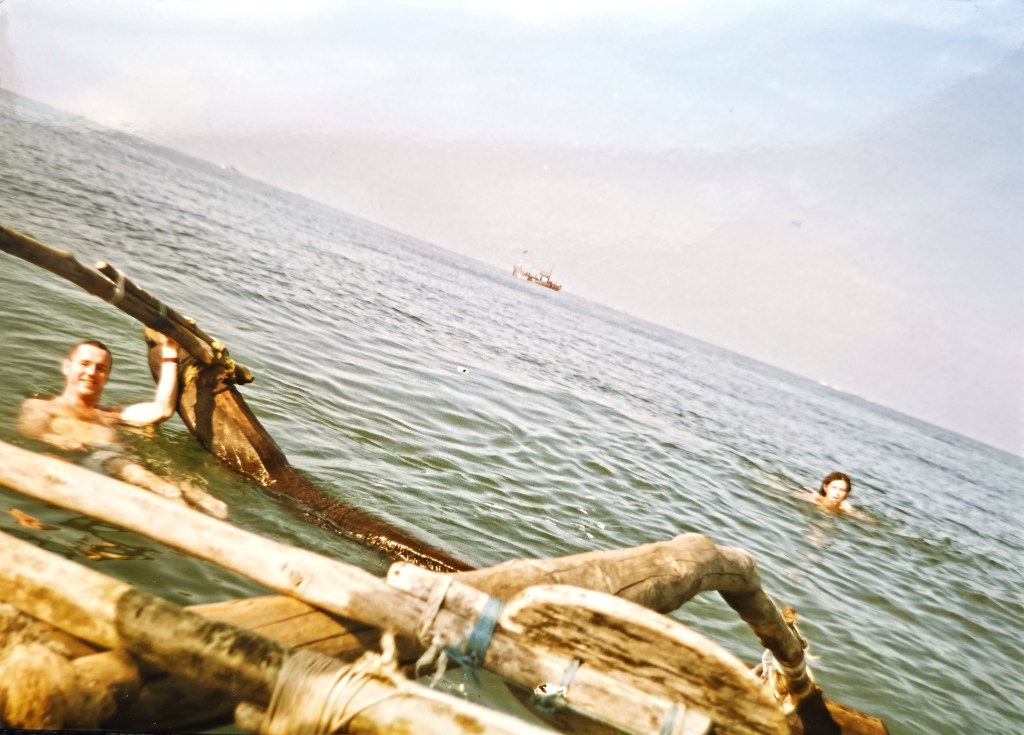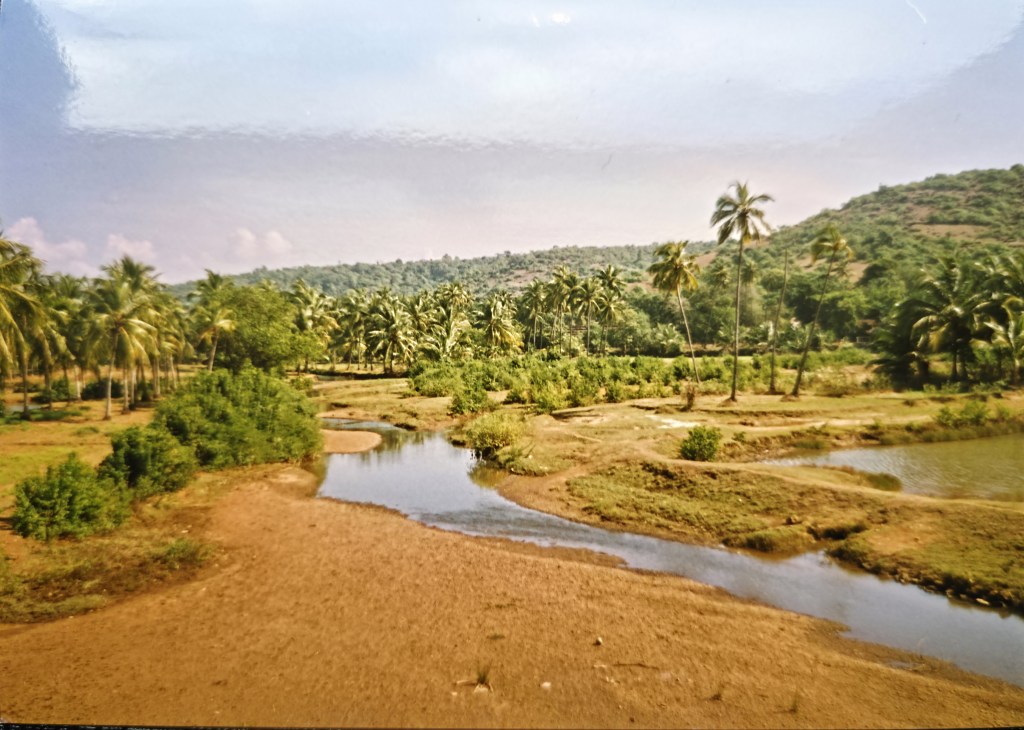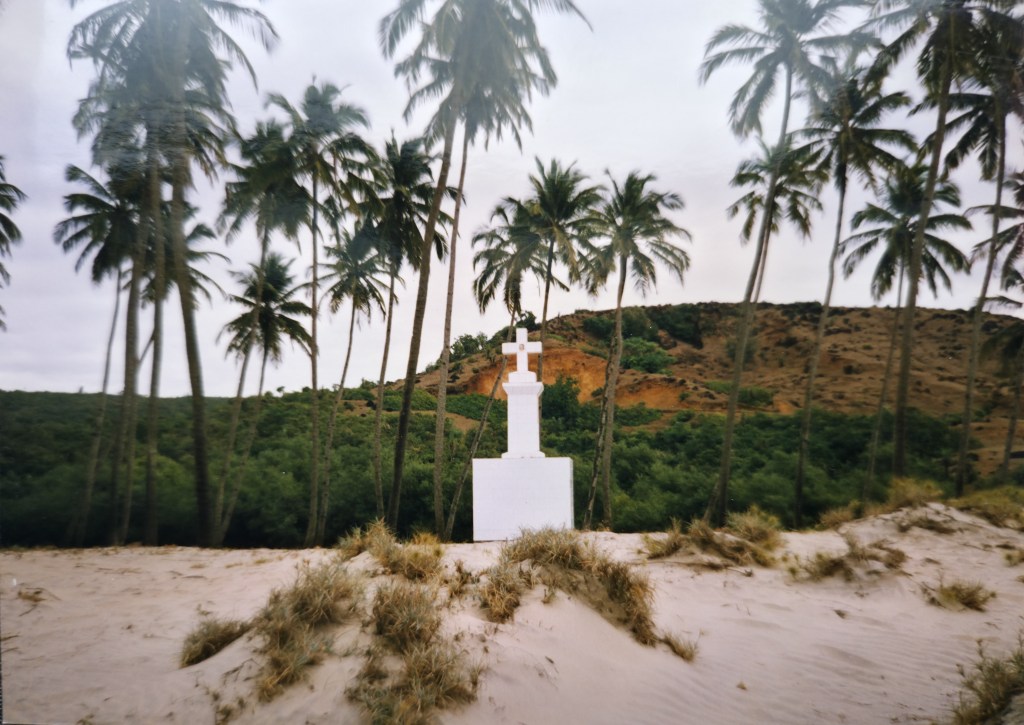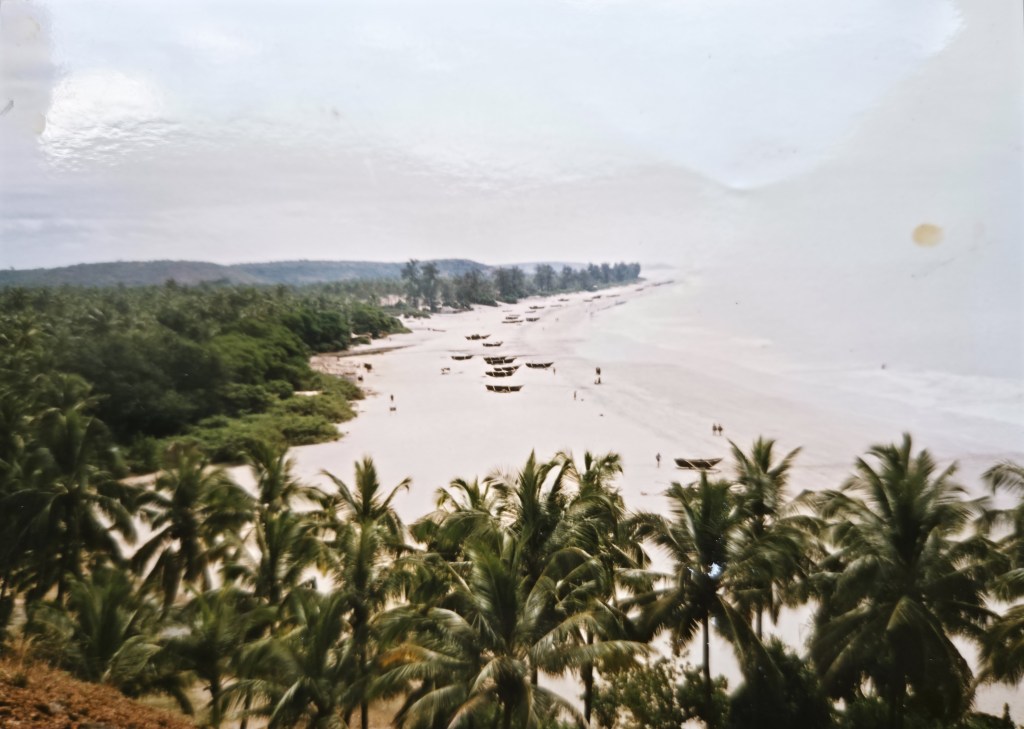
Image: The hilltop beside the fishing village where the local ekklesia—the called-out ones—gather to worship the Living God. The concrete cross is not an object of worship, but simply a geographical marker where the believers meet.
My conversion was not a “nice idea” or a gradual drift into church because it seemed respectable. It was the Holy Spirit showing me, for the first time, what I really was. And it broke me.
I had been down every dead-end street I could find. Goa, parties, travelling, work, friendships – I kept thinking the next thing round the corner would finally make life make sense. But eventually I hit a wall. I realised that if I walked down one more dead-end, I would have to admit life was pointless. That was the moment another way opened up in front of me: not a wide road with crowds on it, but a small, narrow path.
The conviction of the Holy Spirit doesn’t flatter you. He doesn’t tell you that you’re “basically a good person who just needs a bit of religion.” He shows you the truth. I saw my own sin, my selfishness, my pride, the way I had lived as if God did not exist. It was like looking in a mirror for the first time. I wasn’t destroyed, but I was in pieces – like a smashed pot on the floor.
That breaking was not cruelty. It was mercy. The old me had to die. The Bible says we are crucified with Christ and that the old self is put to death. Scripture also says what every honest Christian knows: you still feel that old self hanging around your neck like a dead man you drag behind you. I understood what the Apostle Paul meant – the new heart was real, but the old habits, the old temptations and shadows were still there, trying to pull me back.
From that point on, everything changed. My heart and mind were different. I didn’t see the world the same way. Things I once shrugged off as “just life” now looked like poison. I wasn’t suddenly standing in the street judging everyone – I could see that I was the problem. But I also knew that certain things had to go. Certain places. Certain patterns. Certain friendships.
In the end, I lost all my old friends. They didn’t want Christ; they wanted the old version of me. They were happy enough for me to believe in God in private, as long as I left my shoes and my Christianity at the door when I visited. Eventually it was clear to all of us that it couldn’t go on like that. I stopped going round. They treated me differently. They sounded different. We agreed it was for the best, but it still hurt.
My conversion was not a Pentecost-style experience with shouting, singing, and tongues. There was no choir in the background. It was quieter and more painful than that. It was me on the ground, many times, saying things that are between me and God. It was the Holy Spirit convicting me of sin, breaking me, and then, very slowly, beginning to build me back up again in Christ.
That is what I mean when I say my journey really did go from Goa to the Gospel. I gave my life to Christ before my baptism – baptism is an outward sign of the inward work of the Holy Spirit. I was baptised on Sunday 8th October 2017.
There are moments in Ecclesiastes when the Preacher takes us from philosophical reflection straight into the raw edges of human experience. Chapter 4 is one of those moments. It opens with a scene that is painfully recognisable in every generation: people crushed by those who hold power over them. From there, the chapter moves through the motives that drive our work, the loneliness that often lies beneath outward success, the strength found in companionship, and the fragile nature of human fame. What emerges is an unfiltered look at life in a world that refuses to be fixed by human hands. Through it all, the chapter presses us to consider what actually gives life substance and how we should live when so much around us proves empty.
Oppression, Envy, and the Burden of Toil.
The chapter begins with the Preacher observing the tears of those who are oppressed. They have no comfort, while their oppressors hold all the authority. It is a bleak picture: a world where the vulnerable are left without protection and where suffering goes unanswered. The Preacher does not soften what he sees. He goes as far as to say that the dead are better off than the living, and better still are those who have never been born to witness such injustice. It is not cynicism. It is the honest acknowledgement that life under the sun can be brutal, and that power, when misused, crushes those who cannot defend themselves.
From there the Preacher turns to another uncomfortable truth: much of our work and skill is fuelled by envy. Instead of labour flowing from purpose, love, or service, it often springs from the desire to outdo someone else. We push ourselves not because the work itself is meaningful, but because we are watching our neighbour, comparing, competing, and trying to get ahead. But this too is a chasing after wind. It wears us out and gives nothing lasting in return.
Idleness, however, offers no escape. The one who simply folds his hands and refuses to work ends up consuming himself. Laziness becomes its own form of destruction. The Preacher is not advocating extremes. He is exposing them. On one side is frantic striving driven by envy. On the other is the self-ruin of refusing to work at all. Between the two lies a better way: a small amount, accompanied by quietness and peace, is far better than overflowing hands gained through endless toil. Contentment, not competition, is where rest is found.
The chapter then presents the image of a solitary worker. He has no family beside him, yet he works endlessly. His wealth increases, but his heart is never satisfied. He never pauses long enough to ask why he is labouring so hard or who will benefit from his sacrifices. His life becomes a treadmill of accumulation without joy, meaning, or relationship. This too is declared to be vanity—an unhappy business that leaves a person exhausted and alone.
The Strength of Companionship.
Against the emptiness of isolation, the Preacher turns to the value of companionship. Two people working together accomplish more than one person working alone. When one falls, the other can lift him up. The solitary person, however, has no one to help when trouble comes. It is a simple picture, yet deeply human. Life is unpredictable, and even the strongest among us will stumble. To have another beside you in those moments is a gift.
The image continues: two people lying together can share warmth, something one cannot achieve alone. And in conflict, two standing together can withstand an opponent who would overpower them individually. A threefold cord—a partnership strengthened by a third strand—is even harder to break. The point is not mathematical. It is relational. Strength multiplies when people walk together. Isolation may seem easier, but it leaves a person vulnerable, tired, and spiritually cold.
These lines cut through the modern illusion of self-sufficiency. The chapter insists that human beings were not designed to carry life’s burdens by themselves. Companionship does not remove all hardship, but it provides resilience in a world where hardship is unavoidable. Where envy isolates, generosity binds. Where rivalry exhausts, shared purpose strengthens. In a world full of pressure and uncertainty, the presence of another human being becomes one of God’s simple and profound mercies.
Wisdom, Status, and the Fragility of Human Praise.
The chapter closes with a picture of dramatic reversal. A young person, poor but wise, is considered better than an older ruler who has hardened his heart and refuses counsel. The wisdom of the youth lifts him from obscurity—he rises from prison to the throne. Crowds gather around him, celebrating his insight and leadership. But even this moment of triumph is fleeting. Those who come later will not rejoice in him. His popularity, which once seemed unstoppable, fades as quickly as it arrived.
This final scene exposes the instability of human status. Power rises and falls. Admiration swells and then disappears. Even the most remarkable success cannot secure lasting remembrance. The Preacher’s verdict remains the same: this too is vanity and a striving after wind. The point is clear. We cannot anchor our identity in the approval of others. The praise of crowds is a tide that turns without warning. What looks like glory today becomes dust tomorrow.
Wisdom is still better than folly. Humility is still better than stubborn pride. But Ecclesiastes warns us not to build our hope on human recognition. Life under the sun is unstable, and the Preacher forces us to face that reality with clear eyes.
Encouragement for Believers and an Invitation for Seekers.
For believers, this chapter is an honest reminder that life in a fallen world can be deeply painful. Oppression still wounds, envy still corrodes the heart, and loneliness still weighs heavily on the soul. Yet the chapter also holds out simple, grounded wisdom. Seek contentment over comparison. Choose companionship over isolation. Walk in humility, knowing that God sees even when others do not. He is not blind to the tears of the oppressed or the exhaustion of those who labour without recognition.
In the body of Christ, the call to companionship becomes practical. We lift one another when we fall. We warm one another’s hearts when the world grows cold. We stand together against pressures that would overwhelm us alone. These are not small things. They are signs of God’s care expressed through His people.
For those exploring faith, the honesty of Ecclesiastes may feel surprising. The Bible does not pretend the world is safe or fair. It does not offer shallow comfort. Instead, it speaks plainly about the injustice, frustration, and loneliness that everyone feels at some point. Yet it also points to the reality that we are made for relationship—with God and with others. The longings stirred by this chapter are not illusions. They are hints of something deeper, urging us to look beyond the weariness of life under the sun and consider whether there is a God who sees, who cares, and who invites us to walk with Him.
Conclusion.
Ecclesiastes 4 gives us a sobering view of life: oppression that goes unanswered, toil driven by comparison, isolation that drains the soul, and success that soon fades from memory. Yet woven through its realism is a thread of hope. Companionship matters. Humility matters. Contentment matters. And the God who stands above all things is not indifferent to what happens under the sun. As we live with open eyes and honest hearts, may we hold fast to what endures and walk with those God has placed beside us, finding strength for the journey in His care.
Why there’s an audio version Some readers prefer to read at their own pace. Others (especially when eyesight, energy or health make reading harder) may find listening easier. So, I’ve added an audio option—feel free to relax, sit back and listen, or carry on reading—whichever suits you best.
A Time for Everything: Learning to Live in God’s Seasons.
Ecclesiastes 3 is one of those passages that seems to belong to everyone. Even people who have never opened a Bible recognise the cadence: “a time to be born, and a time to die… a time to weep, and a time to laugh… a time for war, and a time for peace.” It’s been quoted in songs, at funerals, at weddings and in films.
But the writer of Ecclesiastes – often called “the Preacher” – is doing far more than offering a comforting poem about life. In chapters 1 and 2 he has already dismantled our illusions about what will finally satisfy us. Life “under the sun” (life as we see it, limited to this world) runs in weary circles. Pleasure, success, projects, even human wisdom cannot bear the weight of ultimate meaning. And at the end of it all, death levels us all.
So, when we reach chapter 3, a deeper question surfaces: if life is this brief and fragile, if I cannot control outcomes, if even wisdom and hard work cannot outrun death – how am I meant to live? Ecclesiastes 3 answers with something both humbling and strangely comforting: God rules the times and seasons. Our calling is not to master time, but to trust the One who does.
A Time for Everything: Life’s Contrasts on the Page.
The chapter opens: “For everything there is a season, and a time for every matter under heaven” (Ecclesiastes 3:1). What follows is a beautifully balanced poem: fourteen pairs of opposites that sweep across the whole range of human experience – birth and death, planting and uprooting, weeping, and laughing, mourning, and dancing, silence and speech, love and hate, war, and peace.
This is not a sentimental calendar quote. It is a painfully honest description of real life. We have days of joy and days of heartbreak. There are moments when we must tear things down and other moments when we slowly build again. There are times when speaking up is courageous and right, and times when silence is the wisest, kindest choice we can make.
The Preacher is not saying that everything on his list is morally equal. “A time to kill” is not a free pass for murder; it reflects that in a fallen world there are God-ordained moments of judgement and just defence, as opposed to unlawful violence. “A time to hate” is not a nod to pettiness or prejudice, but to a right hatred of evil that destroys what God loves.
Nor is this poem inviting us to do whatever we like whenever we feel like it. The real point is much more unsettling: real life includes all these experiences, and we are not in charge of when they arrive. We did not choose our birth. Few of us choose the moment of our death. We cannot schedule sorrow or predict when unexpected joy will break in.
In chapter 1, the Preacher watched the cycles of nature – sun, wind, rivers – circling under God’s hand. Here, in chapter 3, he shows human life moving to the same unseen rhythm. There is a pattern to our days that we did not write.
What Gain Has the Worker? The Question That Lingers.
After the poem, the old question returns: “What gain has the worker from his toil?” (Ecclesiastes 3:9). We have already heard this question in chapters 1 and 2, as he wrestles with whether anything truly “profits” in the end. Now the question is asked again, but inside a world where God appoints times and seasons.
You can work hard and create something beautiful, only to see it broken down in a later season. You can pour yourself into relationships, and then a time of distance, disappointment or loss arrives. You can enjoy a season of laughter and lightness, and then without consulting you, life moves into a time of weeping.
The Preacher says, “I have seen the business that God has given to the children of man to be busy with” (Ecclesiastes 3:10). He is not saying that work is pointless. He is saying that work is not ultimate. We do not stand outside time, managing it. We live inside it, subject to it. That realisation will either drag us into despair or drive us into trust.
Eternity in Our Hearts: Beauty in Its Time.
Then we reach the beating heart of the chapter: “He has made everything beautiful in its time. Also, he has put eternity into man’s heart, yet so that he cannot find out what God has done from the beginning to the end” (Ecclesiastes 3:11).
Here are two massive truths held together.
First, God “has made everything beautiful in its time.” Not everything is beautiful in itself. Illness, injustice, grief, and war are truly evil. Yet God is so wise and so sovereign that he can weave even painful seasons into a larger pattern of beauty in his time. You and I see a handful of tangled threads. God sees the whole tapestry. The timing belongs to him, not to us.
Second, God “has put eternity into man’s heart.” Deep down, we know we were made for more than “birth → work → death.” We long for permanence. We ache for justice that is not postponed or buried. We feel, sometimes almost physically, that death is wrong and life is too short. That ache is not a glitch in the system or a psychological trick. Ecclesiastes says it is something God himself has planted in us.
And yet, the verse continues, we “cannot find out what God has done from the beginning to the end.” We are big enough to sense that there is a story larger than our own, but we are small enough that we cannot fully grasp that story while we are inside it. We want the full blueprint; God gives us enough light for the next step.
So how do we live inside that tension? The Preacher says: “I perceived that there is nothing better for them than to be joyful and to do good as long as they live; also, that everyone should eat and drink and take pleasure in all his toil—this is God’s gift to man” (Ecclesiastes 3:12–13).
This is not shallow escapism. It is an invitation to receive the ordinary gifts of life – food, drink, work, friendship, rest – as gifts from God’s hand, not as little gods in themselves. Enjoy your meals as gifts, not as your comfort saviour. Enjoy your work as service, not as your identity. Enjoy your relationships as blessings, not as foundations that must never crack. Real joy in God’s gifts is part of trusting him, not a distraction from it.
The God Whose Work Endures Forever.
The next verses shift our eyes from our fragile activity to God’s enduring work: “I perceived that whatever God does endures for ever; nothing can be added to it, nor anything taken from it. God has done it, so that people fear before him” (Ecclesiastes 3:14).
Our plans are temporary and easily interrupted. God’s purposes stand. We cannot “improve” his wisdom or undermine his final design. That is not meant to crush us, but to humble us into reverent trust. If we could see and control everything, we would forget him entirely. Because we cannot, we are invited to bow before him.
Verse 15 echoes the sense of repetition from earlier in the book: “That which is, already has been that which is to be, already has been and God seeks what has been driven away.” The cycles of history are not random. The “I’ve seen this before” moments of life unfold under a God whose purposes are consistent, even when his timing puzzles us.
When Justice Fails and Death Looms.
Just when we might be tempted to turn this into a neat “everything is beautiful, so everything is fine” message, Ecclesiastes drags us back to hard reality. “In the place of justice, even there was wickedness, and in the place of righteousness, even there was wickedness” (Ecclesiastes 3:16). Courts can be corrupt. Safe places can be dangerous. People who should do right often do wrong.
What then? The Preacher answers in two ways. First, there will be a time of judgement: “God will judge the righteous and the wicked, for there is a time for every matter and for every work” (Ecclesiastes 3:17). Justice delayed is not justice abandoned. The God who orders times for birth and death also has his own time for putting things right. If judgement fell instantly every time we sinned, there would be no room for repentance, faith, or growth.
Second, God uses the delay to expose what we really are. He is “testing” the children of man so that they may see they are “but beasts” (Ecclesiastes 3:18). Physically, we share the mortality of animals; we breathe, weaken, and return to dust. And if we live as if this world is all there is, with no God, no eternity, no final justice, then in the end we have no lasting advantage over the beasts.
He even asks, “Who knows whether the spirit of man goes upward and the spirit of the beast goes down into the earth?” (Ecclesiastes 3:21). He is not denying the difference; by the end of the book, he will clearly say that “the spirit returns to God who gave it.” But inside the cycle of life and death, from our limited vantage point, we see so little. Ecclesiastes wants us to feel that smallness, not to mock us, but to loosen our grip on self-sufficiency.
Rejoicing in Your Lot Today.
The chapter closes very practically: “So I saw that there is nothing better than that a man should rejoice in his work, for that is his lot” (Ecclesiastes 3:22). Work is not your god, and it is not your curse. It is your portion – part of the daily calling God has entrusted to you.
You and I do not know how long our work will last. We cannot see “what will be after” us. We have no idea how God might use what we do beyond our own lifetime. But we do know this: today has been given to us. The tasks in front of us are not accidents. The ability to enjoy them, even in small ways, is a gift. The right response is not anxious control, but thankful faithfulness.
Learning to Trust the Lord of Time.
Ecclesiastes 3 does not offer a shortcut around pain. Instead, it gives us a way to live honestly and hopefully in a world we do not control. You do not manage the seasons of your life; God does. Your deep longing for “something more” than this short, fragile existence is not madness; it is eternity written on your heart.
For Christians, this chapter also points us towards Jesus Christ, the One who stepped into our times and seasons. The New Testament says, “when the fullness of time had come, God sent forth his Son, born of woman, born under the law” (Galatians 4:4). In Jesus, God entered our “under the sun” world to bear our sin, taste our death, and open up eternal life beyond the cycle.
If you are a believer, Ecclesiastes 3 invites you to loosen your grip on control and receive today as a gift from a Father whose wisdom outlasts you. If you are exploring or sceptical, it gently asks why your heart insists that life should be more just, more permanent, more meaningful than it often feels. That ache may be God’s way of drawing you towards the One who makes “everything beautiful in its time” and who promises a world where time itself is healed.
You do not need the full map. You have today’s portion: today’s work, today’s relationships, today’s opportunities to do good and to rejoice. Walk faithfully in that and dare to ask whether the God who holds your times in his hands might also be holding out his hand to you.
Why there’s an audio version Some readers prefer to read at their own pace. Others (especially when eyesight, energy or health make reading harder) may find listening easier. So I’ve added an audio option—feel free to relax, sit back and listen, or carry on reading—whichever suits you best.
The Restlessness That Points to Something More.
Wonder begins early in life. As children, we asked questions with unguarded honesty—questions that cut beneath the surface of everyday life. We looked at the sky or the rhythm of the seasons and felt instinctively that the world was meaningful. We sensed intention, beauty, and purpose long before we could articulate any of it. The world felt alive.
Yet growing up brings noise. Responsibilities tighten. Modern life hums relentlessly—emails, deadlines, notifications, expectations. Eventually those earlier questions fade into the background. They never truly vanish; they simply sink below the surface. Still, every now and then, something interrupts our pace—a quiet morning, a late-night drive, a moment when the world feels strangely still. And there, in the silence, the old questions rise again, as though patiently waiting to be acknowledged.
These questions are not signs of weakness. They are, in many ways, a map leading us toward a deeper reality.
How We Lost Our Shared Compass.
Only a few generations ago, many in the Western world lived with a shared sense of orientation. Faith, community, tradition, and a belief in a higher purpose sat at the centre of daily life. People disagreed, yes, but most felt connected to something beyond themselves—something more stable than personal preference.
Today that grounding has shifted. We are encouraged to craft our own identity, determine our own truth, and build our own meaning from scratch. The language is empowering, promising unlimited self-expression and total personal freedom. But this freedom comes with a hidden cost: if meaning comes only from within, then we must continually sustain it. We must invent it, protect it, and perform it.
For many, this has not produced confidence but exhaustion. A quiet, unspoken hollowness sits just beneath the surface. The slogans of modern life promise liberation, but they leave us carrying the full weight of our own significance.
The Quiet Experiment of Building Meaning Without God.
Across the last century, something subtle happened. Society began an experiment—one many never consciously agreed to. Faith moved from public life to private life, then from private life to irrelevance. God shifted from the centre to the margins and, eventually, out of the picture altogether.
At first, this shift felt like progress. But without God, the foundations that once supported identity, worth, love, dignity, and moral meaning grew thin. When the human heart loses any reference point beyond the self, everything becomes negotiable. Truth becomes personal. Purpose becomes fluid. Identity becomes fragile.
And when life becomes difficult—as it inevitably does—self-constructed meaning begins to wobble. Hospital corridors, grief, loss, and loneliness often reveal the limitations of carefully curated self-defined purpose. In those moments, many discover an instinctive longing for something solid. Something transcendent. Something real enough to hold the weight of suffering.
Why We Still Feel the Ache.
Despite our technological comfort, our constant entertainment, and our unprecedented convenience, a quiet restlessness lingers in nearly every corner of modern life. Many describe a sense of spiritual depletion they cannot quite name. They change jobs, relationships, locations, habits, and online personas, yet the same unshakable ache returns.
Perhaps that ache is not a malfunction. Perhaps it is a message.
When we remove God from the centre, we inevitably place ourselves there—but the human heart was never built for that role. Most people, even in a secular age, continue to live as though love is real, justice is real, truth is real, beauty is real, and human dignity is real. Yet these realities sit uneasily within a worldview that insists everything is accidental and impersonal. Deep down, we sense that these things point beyond us. They whisper of a source.
Why Our Deepest Questions Still Matter.
We can distract ourselves for years—sometimes for decades—but we cannot outrun the deeper questions that come for us in quiet moments. If suffering exposes the limits of self-invented meaning, and if the ache of restlessness reveals a hunger that comfort cannot satisfy, then perhaps the assumptions of our age need re-examining.
John 14:6 (ESV 2007) speaks with striking clarity:
“Jesus said to him, ‘I am the way, and the truth, and the life. No one comes to the Father except through me.’”
This is not an argument for nostalgia, nor is it a call to return to a past era as though it were golden. Rather, it is an invitation to consider whether removing God from the centre may have unintentionally removed the very foundation on which value, meaning, and hope rest.
An Invitation to Look Again.
You do not need certainty to begin exploring these questions. You do not need to call yourself religious or even know where you stand. You simply need to acknowledge that the stirrings inside you—the longings, doubts, and moments of wonder—may be pointing toward something more substantial than personal feeling.
This is not a verdict on your life or a demand for instant belief. It is a simple invitation: look again. Consider the possibility that the restlessness within you is not an enemy to silence or suppress, but a signal. A signpost toward the One who made you.
If God is real, then seeking Him is not a hobby or a side interest. It is the most important journey any person can take. And that journey often begins not with certainty, but with curiosity.
What if the ache you feel is an echo of the One who calls you? What if meaning is not something we construct, but something we discover—something already woven into the fabric of reality? What if those quiet questions are not interruptions, but invitations?
Why there’s an audio version Some readers prefer to read at their own pace. Others (especially when eyesight, energy or health make reading harder) may find listening easier. So, I’ve added an audio option—feel free to relax, sit back and listen, or carry on reading—whichever suits you best.
When Life Changes Overnight and the Words Start Pouring Out.
There are seasons in life when everything seems to fall still. Nothing moves. Nothing grows. Days blur together, and you wonder whether anything meaningful will ever come from the place you’ve landed. And then there are seasons like the one I’m in now—unexpected, unplanned, and overflowing with more questions than answers. I didn’t intend to become a blogger. I didn’t expect writing to become a lifeline. And I never imagined that my circumstances, difficult as they are, would open the door to a whole new way of living. But here I am, a newcomer to WordPress and a head full of ideas, and enthusiasm that is old news to the veterans of blogging.
I should probably explain how I got here.
A Life Changed in a Single Week.
In April 2025, a GP started a chain of events that led to a misdiagnosis and a botched medical procedure which went horribly wrong and left me with permanent damage to my lungs. My breathing has never returned to normal. I can’t stand for long, can’t do most of the physical things I used to do, and I sleep sitting up because lying flat simply isn’t possible anymore. Nights are broken into short bursts of rest—three or four hours at most in my large layback office chair—and long stretches of wakefulness. Gradually the urge and want to write has grown inside me, my mind and soul flooding with new ideas every moment, new to me anyway.
It took time to accept that life from now on had completely changed. That the world I once moved through as a free spirit had, in an instant, shrunk to a much smaller environment—housebound now, and no longer able to travel or chase the adventures I once loved. But those long waking hours did something unexpected: they gave me space—too much space sometimes—to think, to pray, and eventually, to actually start to write all these thoughts down.
Then what began as a necessity to keep me sane became a doorway.
Discovering Blogging at the Exact Moment I Needed It.
I arrived on WordPress almost by accident. I set up a simple blog website, not expecting much from it. One subscriber felt like such a victory—thank you, Christopher. Posting anything felt like a mountain climbed. I didn’t know what I was doing—I still barely do—but the moment I published my first post, I prayed, guided by Scripture:
“Do not be anxious about anything, but in everything by prayer and supplication with thanksgiving let your requests be made known to God. And the peace of God, which surpasses all understanding, will guard your hearts and your minds in Christ Jesus.” (Phil 4:6–7 ESV 2007)
Something woke up inside me.
The quiet hours of the night suddenly weren’t empty anymore. Ideas flooded in. Thoughts that had been sitting quietly at the back of my mind began knocking loudly. Passages of Scripture lit up with new clarity. Old questions resurfaced. New questions arrived before I’d finished answering the previous ones.
And before I knew what was happening, I was writing. A lot.
I Felt Elation While Writing.
I had found a new purpose in life. With cruel new limitations, I’m always breathless. If you’re new to blogging, no one tells you what happens when the floodgates open. One minute you’re tentatively posting your first little piece; the next minute you’re wrestling with whether publishing seven posts in three days is normal at first, or why you should worry how often you post. I can write a post every two hours with a coffee break—what does it matter anyway?
I found myself producing content quicker than I’d imagined. I thought of my one or maybe two subscribers’ inboxes going off like spam. I’d publish something, sit back, listen to it read aloud with Microsoft cloud voices for a few minutes, and immediately feel the urge to write the next one. I wondered whether this was normal or whether I was alone in this unstoppable momentum. Was I supposed to slow down? Was it bad form to post every few hours? Did experienced bloggers look at this and think, “Oh dear, here we go—another newbie in overdrive”?
The irony of it made me laugh—blogging about blogging like so many have, worrying about blogging, thinking about blogging, praying about blogging… and then, of course, blogging again.
But the truth is, it doesn’t feel excessive to me, but natural. I hated writing at school and college; I was more of a story maker and teller but never wrote them down. In my twenties, my good friend said, “You should write a book, you’ve lived five lives already.”
When God Gives You Something to Say.
There is a spiritual dimension to this that I can’t ignore. There are moments in life when God sharpens your focus, clears the fog, and turns a whisper into something like a calling. I didn’t expect that to happen in this season of struggle, but it did. In fact, it happened because of it.
When your health changes, your world shrinks. But God does not shrink with it. Instead, He fills the space you have left.
Writing has become more than an experiment or something to keep my mind occupied. It has become a way to share the gospel. A way to process what I’m living through. A way to offer hope to someone who may be going through their own dark chapter. A way to obey the command to speak of Christ—to point people towards the One who holds us through every breath, even the painful ones.
And somehow, this new purpose sits comfortably inside the limitations I didn’t choose. It doesn’t require strong lungs, or long walks, or heavy lifting. It requires only the willingness to sit, to reflect, and to let the thoughts fill my mind.
Finding Purpose in a Life You Didn’t Plan.
I won’t pretend it’s easy. There are days when I miss the person I used to be—an advanced carpenter, a Rescue Diver/Divemaster, travelling, working in my trade as a carpenter to keep travelling and scuba diving in many countries. Now it’s a real struggle to clean my bungalow and cook, but if I can’t go back to that life, then I choose to move forward with this one.
I’m not meeting people anymore. I’m not out in the world in the way I once was. But I am writing, thinking, learning, praying, and starting to pour out everything God gives me.
And strangely enough, that feels like living again.
Writing hasn’t replaced everything I lost, but it has given me something new to hold on to. Something meaningful. Something that connects me to others, even if only one or two people who sneak a peek at one blog in a month. It may take decades to reach five people who want to share their thoughts with me or ask a question. However long it takes, it will be the perfect exact time.
The Joy of Beginning Again.
If you’re reading this as a new blogger yourself, maybe you know this feeling too—the rush of ideas, the excitement, the worry that you’re posting too much or too fast. Or perhaps you’re reading this while going through your own unexpected chapter of life, wondering whether anything good can come out of it.
Let me tell you what I’m learning: purpose can appear in the strangest places. Hope can take shape in the quiet hours when sleep won’t come. Creativity can rise out of a life that feels like it’s been turned on its head. And God can bring new calling out of circumstances that were never part of your plan.
I didn’t choose this path. But I’m choosing what to do with it.
It’s been an hour since my last post — I’d better crack on. And if writing is the way forward—then I’m going to keep writing.
Good day Jo. I hope you are doing well. I resonated with some of your thougts in this post, especially this one: “New questions arrived before I’d finished answering the previous ones.” I know this experience all too well. Regarding how often to blog, of course that is up to each blogger. Personally, seeing people post every few hours reminds me too much of other social media, like Facebook or Twitter. A lot of people use their blog in the same way, albeit, maybe a little bit deeper as they like to respond to daily prompts, instead of posting about how they overslept, had nothing to eat for breakfast except stale cereal since they had not gone shopping lately. Daily prompts don’t really appeal to me as far as posts for my blog- they just don’t fit what I am trying to do on my blog (even if responding to them drove more traffic.) Considering the type of writing I produce, I don’t think I could keep up a pace of being able to write something new daily.
Anyway, as I was reading your post, an old favorite verse of mine that has given me a lot of hope over the years came to mind. Isaiah 42:16: “And I will bring the blind by a way that they knew not; I will lead them in paths that they have not known: I will make darkness light before them, and crooked things straight. These things will I do unto them, and not forsake them.” I think this verse may fit your situation in conjunction with Isaiah 29:16: “Surely your turning of things upside down shall be esteemed as the potter’s clay: for shall the work say of him that made it, He made me not? or shall the thing framed say of him that framed it, He had no understanding?” Sometimes God allows our world to be turned upside down and we become blind in the sense of where things are going and where He will take us. But as you have shown above, a world turned upside down can still be redeemed and used by God greatly- even more we ever thought before. Never give up on God and let Him use you. Don’t worry about your blog stats but just being faithful. At the end of our days, that is the true measure of success in His eyes. God bless.
Christopher,
Your comment sent me back to Scripture, which is always a good thing. Isaiah 42:16 reminded me that when my world was turned upside down, God is upholding me through it all. He is the One who carries me, strengthens me daily, comforts me, and gently leads me forward into this new season of writing. I’ve always seen myself as clay in the hands of the Potter, our Creator, and these verses confirmed that again. My life, my limits, and this unexpected path are in His hands. And just as the body of Christ has many members with different gifts, we each serve in different ways. You write beautiful poems and reflections that connect with others like me; some write studies, some share stories — but it is the same God who arranges and uses it all. Thank you for sharing those verses and for the encouragement. P.S. If your notifications start pinging every five to seven hours because I’ve posted again, just put my notifications on vibrate :-) — God seems to be setting my schedule these days! God bless you.
Leave a comment