I have health issues serious enough to make me housebound and isolated.
I prayed, and an idea formed to start a blogging website; this was to continue in the Great Commission in the extremely limited circumstances I found myself in.
I started to think of ideas, I started writing, I found that my mind was now in a fog from all the pain management, this was when I thought of using AI assistance for my Biblical blog posts.
This did not sit well with me, and I prayed on this feeling of unease, and still I decided to continue.
The unease never fully went away; I have been wrestling with this decision to use AI for a while now.
My discission or discernment is that using AI to polish and tighten my writing is unfaithful to the calling and obedience to Jesus for the Great Commission.
I have decided to write this disclaimer as I am completely stopping all blog posts with AI assistance.
I am thinking of new ideas I can manage, like, ESV 2015 verses expounded by R.C. Sproul, The source of my new work will be from The Reformation Study Bible. See below for copyright information and permissions.
This will help me with my health issues, but most of all, I can stop wrestling with this.
I now discern, using AI to tighten and polish my blog posts is not faithful, as an AI has no soul, feels nothing, and has experienced nothing.
If I have offended anyone, I am sorry. I should have listened to my heart at the beginning when I was first convicted.
The previous Biblical blog posts, which I felt called to write on, specifically the Biblical posts, should never have been polished or the wording tightened with Artificial Intelligence.
Note: This is a lightly updated repost of a piece I first published on 24 September 2025. If you’d like to read the original version of “My Fight for Truth – Living with the Consequences of a Medical Nightmare” with its comments and likes, you can find it below.
This is a personal story about my ordeal with the NHS, a journey that began with a routine blood test and ended with my life forever changed. What I learned is that sometimes, the answers we seek aren’t in a complex diagnosis, but in the most basic things around us—like in our homes.
It all started when I went for a full blood test because of my hypothyroidism. The results came back with alarming news: I had hypercalcemia, extremely high calcium levels, along with high creatinine and signs of kidney dysfunction. My GP advised me to go straight to the local hospital’s Same Day Emergency Care (SDEC) unit.
SDEC is a diagnostic department where doctors try to figure out what’s causing symptoms, a bit like the TV series House. Over the next seven days, I went back and forth to the hospital. Each time, my blood tests showed worsening symptoms. My calcium levels had risen again, above 3.0, a point where I should have been admitted for a hydration drip, but I was sent home and told to “drink more water.” The more I drank that week, the worse I felt. I told this to the duty doctor, as I never met Dr Lok once, he was part of the team for one week that day from his desk, the Cancer and Sarcoidosis doctor, who made the final decisions, in charge of the department for that single week. This detail would be key in everything that happened next.
A Wrong Turn: The Focus Shifts.
Dr. Lok decided from his desk that because my symptoms resembled those of his patients, he immediately requested urgent lung scans with iodine, scan appointments that fast are unheard of in the local NHS hospital. I was injected with iodine, which works like a marker pen for CT scans. The results came back, and he pointed to a small, dark area on my lung, which he suggested might be cancer or sarcoidosis.
I was called in the evening by phone and repeated to Dr. Lok that I was there for my kidneys and calcium levels, not a lung issue. But he insisted on a procedure: an urgent EBUS bronchoscopy was arranged. The next morning back at SDEC I was put under immense pressure and rushed into the procedure room. There was no time to think, no proper introduction from the medical staff. When I asked the junior registrar who was to perform the procedure if he had done it before, he said he had five years of training and that a consultant was present. He assured me I was in “good hands.”
The Unthinkable Procedure.
Before the procedure, I was injected with three different sedatives, but none of them worked. I was fully awake and conscious. The six nurses in the room were concerned and advised against continuing, but the junior registrar decided to proceed anyway.
The moment the procedure began, I was in excruciating pain. I couldn’t scream because of the tube down my throat, so I waved my arms and stamped my feet on the bed, begging them to stop.
This went on for an hour. I never saw the consultant in the room, but I heard the young registrar say, “I’m lost in the lungs. What do I do?” A voice from the corner of the room behind me—the consultant—replied, “I don’t know, I wasn’t watching. You’ll have to break procedure and hope you don’t spread infection.”
He told the registrar to go back up to where the lungs split into the right and left airways and start again, which he did. After an hour of unimaginable pain, the procedure was finally over. When I asked why they didn’t stop, they simply told me I was fine. I was then rushed to the recovery area, and despite my inability to breathe properly, they brushed it off as normal and sent me home.
The Aftermath: The Truth and The Fight.
When I got home, I knew something was terribly wrong. My breathing was severely impacted. I called for an ambulance, and three paramedics attended. The senior paramedic, who had been through the same procedure, though sedated, said, “They don’t tell you how painful it will be after for around twenty-four hours,” and then they left after a few basic tests.
It turns out the dark spot on my lung was nothing—no cancer, no sarcoidosis, and no bacterial infections. The procedure was completely unnecessary.
It was then I began to question everything. I purchased some equipment, tested my tap water, and found it had a high level of Total Dissolved Solids (TDS), at 440 TDS. The legal limit for undrinkable water in the UK is around 500 TDS, and my tap water was dangerously close to this limit. My theory was correct: drinking my tap water was making my condition worse. Within seven days of switching to a low-TDS spring water (which tested around 90 TDS) and then filtering it to bring the TDS down to 60, all my original symptoms normalised.
The problem wasn’t a disease; it was my tap water.
The fight for justice against the NHS lasted for two and a half months with the patient complaints department. They dismissed my evidence, including the water suppliers’ results confirming my findings. The hospital refused to do follow-up scans that would prove the damage to my lungs was a result of a wrong diagnosis and malpractice. I received an email from the executive of the local NHS Counties who had signed off on the complaints department’s verdict that no malpractice had taken place. Although they were sorry the procedure caused what I had outlined, they protected themselves against a mountain of proof I had presented. The complaint was swept under the carpet, and I was left with only 30% of my breathing capacity.
I can no longer stand for long periods or do simple tasks like cooking or cleaning. As a rescue diver, I could once go down thirty to forty meters and rescue a diver without breaking a sweat. I am now left with the devastating, permanent consequences of a botched procedure that was never needed in the first place. My story isn’t about wanting sympathy; it’s about raising awareness. I’m just one of many who suffer in silence, and my experience highlights how difficult it is to find objective truth in a modern secular society, even within a trusted government service like the NHS.
The stress over those two and a half months was so immense that I sought professional legal help, a solicitor for a “no win, no fee” arrangement. But no solicitors would take on the NHS in a legal battle for the truth and justice. I contacted the local paper, and even they didn’t want to publish against the local hospital. They use the same hospital, so I don’t blame them.
I am grateful for every short, painful breath I can take. What would you do in my situation?
Further reading: A follow-up, My Fight for Truth — Part Two: How Christ Sustains Me Through the Aftermath, continues this story.
This is the follow-up to My Fight for Truth — Part One, where I shared how a misdiagnosis and a botched procedure destroyed my lungs and the NHS refused to acknowledge it. This part is about the aftermath — and how Christ sustains me in it.
How Christ Sustains Me Through the Day-to-Day Aftermath.
Part One of “My Fight for Truth” ended with the damage already done. I had a simple blood test and a healthy pair of lungs, and with one misdiagnosis and one botched EBUS bronchoscopy, which is now a permanent disability.
My months of fighting for accountability and truth with the NHS complaints department was swept under the rug, signed by the NHS County executive. The verdict was “no misdiagnosis, no malpractice.” And there was nothing more I could legally do. My healthy lungs were destroyed, but they say, they did nothing wrong. It’s what they always say to every life the NHS destroy.
I had to accept their truth, the NHS had broken both my lungs, and the system had buried the real truth and changed their evidence to cover-up something that should stay in urban myths and horror movies. It should never have happened!
So, I tried to move forward. I had no choice. I needed to try and find a way to accept this and not give up completely and finish the job the NHS started.
The next month’s hit hard — the aftermath, the slow realisation and collapse into a new way of surviving physically alone, and the deeper truth I discovered in it all: Christ is still the One who carries me when my body and circumstances cannot.
Before the Lung Damage.
I must say at this point, I was already coping with the bad news that I have cervical multi-level disc degeneration and spinal fracturing, Nerve damage, bilateral tennis elbow, a history of bilateral Bell’s Palsy, diffused chronic back axial neck and shoulder, and bilateral upper and lower limb pain, bilateral carpel tunnel syndrome, and degenerative osteoporosis. Because of all this, I have lost three inches in height so far, I was 6ft 3 inches tall ten years ago and I was told after two years of pushing for MRI and CT scans it was caused by wear and tear.
At fourteen I worked as a scaffolders apprentice, at the weekend and holidays for one year, working above 100ft loading out for the scaffolders, walking on one nine-inch-wide scaffold board, at fourteen that was pretty hair-raising, but I loved the views. I went and passed my UK City and Guilds in advance carpentry and joinery and four decades on site as a chippy, as we say in the UK. Also, five years building bridges and tunnels, this was when health and safety didn’t exist. I was a rescue diver, or shepherd as we were called, every weekend for roughly two decades. The trauma and orthopaedics specialist calmly told me that my work had caused all these life changing illnesses, and I was unlucky to get it all earlier in life than most people.
Living with the consequences, day after day.
The aftermath didn’t arrive all at once. It unfolded over months — a quiet dismantling of normal life.
Breathing while lying flat became impossible. The orthopaedic bed I had bought for my back pain — a substantial expense — was suddenly useless. My large sofa became the only place where sleep didn’t suffocate me.
I had an idea and ordered specialist foam from a company who made to measure pieces, basically they could make anything out of different specialty foams at any length, width, depth, and shape. After receiving my instructions, they created exactly what I needed to add to my large sofa, and to my exact measurements, curved where I needed, and the foam company in the UK covered them for me as well to be washable. Eventually I had to move to a medical chair on wheels which was a considerable expense, so I could rest partly upright and move through the bungalow without collapsing. I used my feet and walking cane to row myself around my bungalow.
Practically, everything changed in my day-to-day survival.
Washing myself became impossible with showering, as it is situated in the bath area.
Cooking became exhausting and painful.
Standing became dangerous, even with a new walking cane.
Cleaning anything became unrealistic.
Bending down became a risk to my lungs.
My home slowly turned into a system of survival tools,
grabbers to reach clothes, utensils, or anything on the floor.
disposable trays, spoons, and utensils
wipes — boxes upon boxes — for washing myself, cleaning, surviving.
Disposable plates of every size I need, everything replaced with the disposable versions, everything I found I needed and could think of and purchase. I have it organised now, subscribed to everything disposable through the Amazon.uk website, it just turns up just before I run out.
I found pure rubber hot water bottles with fleece covers and kangaroo pouches, these are my feet and lung warmers, which help somehow.
My recycling bags that pile up because the “simple task” of sorting and taking out two weeks of recycling is now a military operation, especially due to my tap water being undrinkable, which if you’ve read this far, you know it caused my original symptoms of hypercalcemia, high creatinine, and kidney dysfunction. Not Cancer!
It’s not a lifestyle; it’s triage. And every day requires discipline just to get through the basics.
But here’s the truth: None of these things keep me going. They only help me cope. Christ is the One who keeps me alive.
Then the letter arrived — seven months after the damage.
Months passed after the NHS brushed everything under the carpet. I had accepted their refusal to admit wrongdoing. I had accepted that no solicitor would touch the case. I had accepted that no newspaper wanted to publish anything negative against the local hospital.
I had accepted that this was my new life.
Then, in late November, a new letter dropped through the door.
Same executive. Same signature. Same verdict.
But this time, it claimed the months of repeated biopsy procedure and CT appointment letters I had received weren’t sent by the doctor who pressured me — they were “automated.” A system error. Nothing personal.
And then the sentence that revealed everything:
“Other consultants have agreed with Dr Lok’s approach.”
This made me furious all over again. Dr Lok never met me in person, not once, he went on the SDEC staff gossip which could possibly been about a different patient, which Dr Lok admitted on the phone call I recorded., he never listened to my healthy lungs, but other consultants agreed with the approach of never doing a physical inspection on any patient before ordering an extremely invasive procedure.
Of course, the NHS claimed others agreed with Dr Lok’s approach from his desk, never on the same day emergency unit ward. That’s how institutions defend themselves.
The letter wasn’t about truth. It wasn’t about answers. It wasn’t about accountability.
It was about posturing — a defensive manoeuvre, a way to cover themselves again and rewrite history:
Ignoring the biopsy that proved there was no cancer or sarcoidosis.
Ignoring the fact that the EBUS bronchoscopy was unnecessary.
Ignoring that the junior registrar was not under supervision.
Ignoring my tap water tests, which proved my tap water was the reason for my original blood results and symptoms, which all normalised in seven days drinking British spring water.
Ignoring their own notes.
Ignoring the reality that those repeated appointment letters were attempts to pressure me into another EBUS procedure that could have destroyed what remained of my lungs.
Ignoring the main fact that Dr Lok never once met me or listened to my healthy lungs.
That letter reopened everything, I was planning, organising, and buying survival kit for this new life forced on me. The injustice, The procedure, which was completely unnecessary. The memory of one hour that was torture. The harm that they all got away with by the cover-up by the NHS The loneliness of standing against a system that refuses truth.
It took the wound I had tried to live with and tore it back open.
And that’s exactly why I pray in His name, my Lord Jesus, the Christ.
Christ in the collapse.
This is the part that matters most.
When the anger and grief resurfaced, when the memory of being ignored, pressured, and harmed hit me again, when the physical struggle of each day pressed down even harder — Christ held me.
Not in a sentimental way. Not in a poetic way. In His way of faith, hope and love, all gifts to me.
Christ steadied my mind when the letter tried to drag me backwards. Christ stopped my thoughts from spiralling into hopelessness. Christ reminded me that the world may refuse to acknowledge the truth, but God sees all things clearly.
Christ carried the weight that my lungs and my heart could not.
This is not positive thinking. This is not self-help. This is not “finding the strength within.”
This is grace. This is the Spirit at work. This is what it means when Scripture says His power is made perfect in weakness.
My strength ended months ago. Christ’s strength never has.
The small hours no one sees.
There are nights where the isolation is louder than the breathlessness. There are times when the physical, emotional, and mental pain is overwhelming. There are moments where the physical limitations feel endless. There are times where I scroll through every streaming service, unable to find a single thing that speaks to the human condition, to truth, to reality, to anything with meaning.
I still listen to music. I enjoy my daily bread, but entertainment means nothing now. Distractions take a lot of effort. Christ means everything. Only truth matters. Only grace sustains. Only faith carries weight.
Everything else is just the mechanics of surviving the day.
Is this still life?
It’s a question that rises sometimes. Is this living or just existing? Is this survival or purpose?
But every time the question comes, the answer comes with it:
“My grace is sufficient for you.”
If His power is made perfect in weakness, then even this life — broken, restricted, painful, limited — is still a place where His glory is at work.
I don’t have the life I had before. But I have Christ. And that is the life that cannot be taken from me.
If Christ can carry me, He can carry you.
I’m writing Part Two because so many people are suffering so much more than me, because someone else is fighting to breathe — physically, emotionally, spiritually.
Someone else feels forgotten. Someone else feels crushed. Someone else feels like their world is falling apart and nobody sees it.
To every person going through any personal storm, I say:
Christ sees you, Call on His name. Christ sustains you, Pray in His name. Christ is enough, Thank Him by name. Christ can carry you through the storm and the aftermath.
My fight for truth continues. But thanks to Him, I am still here. Still breathing, though only about half as much as I could before. Still writing and reading more of other people’s writing through WordPress reader. Still held by His Glorious Grace.
These three posts have taken a long time to write, and I wanted to publish them together so the story flows properly from beginning to end. I only scratched the surface of everything that happened. I hope you enjoy reading them as much as I’ve valued writing them.
1994 – First Trip to Arambol in Goa.
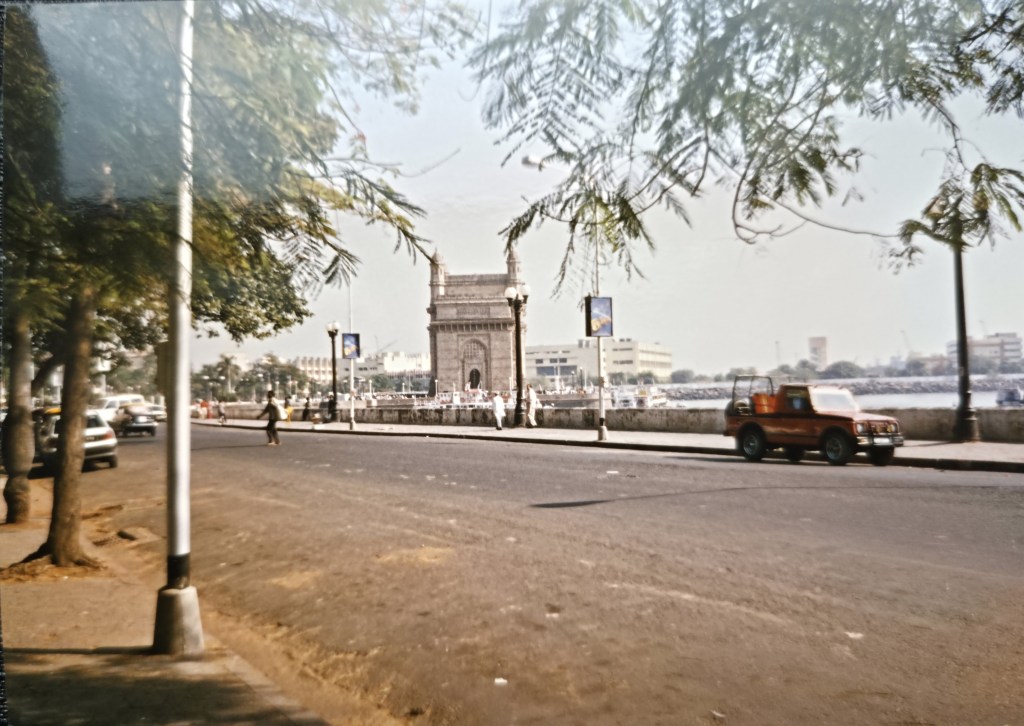
Travelling to Goa for the first time in the 1990s for about two months with a large group, eventually around fifteen men gathering in Arambol. Our group starts out in the south of Goa, in Calangute, after travelling down from Bombay. Image of the gate of India, Bombay in 1994.
Calangute is a horrible place to waste time staying. The beaches are awful, and the place the lads stay in is like an insectarium, with insects pouring out of the walls at night. My brother and Jay go straight out for cigarettes and a beer as soon as we arrive, even though we’d just survived an overloaded bus with wooden seats for fourteen hours. It was a cheap and nasty bus trip from Bombay over the most dangerous mountain roads I’d ever seen. There were bus graveyards at the bottom of the cliffs along the route.
The drivers chew betel quid, a psychoactive mixture of betel leaf, areca nut, slaked lime, and spices like cardamom or cloves. They drive as if they want to die on it. There are only three of us on the bus at this point and we’re the only foreigners. I stand up and ask the bus, “Does everyone want the bus to slow down on these mountain roads?” The whole bus nods instantly.
The cabin door is locked, so I knock. When no one opens it, I shove it open. There are always three or four drivers taking turns, but to my horror I see a brick on the accelerator and the driver is sitting cross-legged on his seat. All of them have red glazed eyes, red lips, and red teeth. They’re clearly addicted to betel quid and under orders to do the two-way trip as fast as possible.
I try to remove the brick and keep motioning for them to slow down. A woman shouts something in Hindi, they finally slow—five minutes later they’re back at full speed again. Alton Towers had nothing on this ride.
A few hours later my brother and Jay return to the room and explain they got into a fight with ex-pat squaddies because the squaddies didn’t like Jay’s dreadlocks. The squaddies lose the fight.
In the morning, I wake up determined to find these men and make sure they got the message to leave us alone. I follow the main dirt road to a beach shack and see an old school friend with a group of men, one with a busted leg. I sit near them, nodding to the lad from my town, and hear one man saying he’s going to find “those two blokes” and do them in.
I find him in five minutes. None of his injured friends follow. He gets up and heads towards his Enfield bike. I follow. Before he can mount it, I tell him, “Look no further, I’m who you’re looking for.” He keeps circling the bike, avoiding me. I warn him it won’t end well for him if he causes any more trouble. He runs inside, comes back out with a large knife, and says, “I’m ready now.”
I slowly walk away down the sand path. He follows on his Enfield but keeps a safe distance, which tells me he doesn’t want a real fight. I lead him to our digs; he waits about fifty feet away. I tell my brother and Jay. We all agree to tell him to meet on the beach at sunset if he wants to sort it out. He agrees. We then throw our rucksacks into a rickshaw and head north to Arambol. I hadn’t gone to India to fight.
The bridge to Arambol is still being built, so the rickshaw takes us only as far as the ferry. On the other side, we take another rickshaw and arrive in Arambol early evening. I go straight out to eat and see the beach. My brother crashes out, so Jay and I head to the beach.
On that first night, we see a light in the distance on the beach. We walk towards it, guessing it’s a fire. It is. A small group is gathered around it. Nights can get cold on the beach, so we stay there, talk with strangers, and watch the sunrise. With no electricity around and no pollution like back home, I see the stars properly for the first time. It is incredible. The weight of life falls away. I remember thinking: this was created. That sky, those stars, that scale—no chance accident.
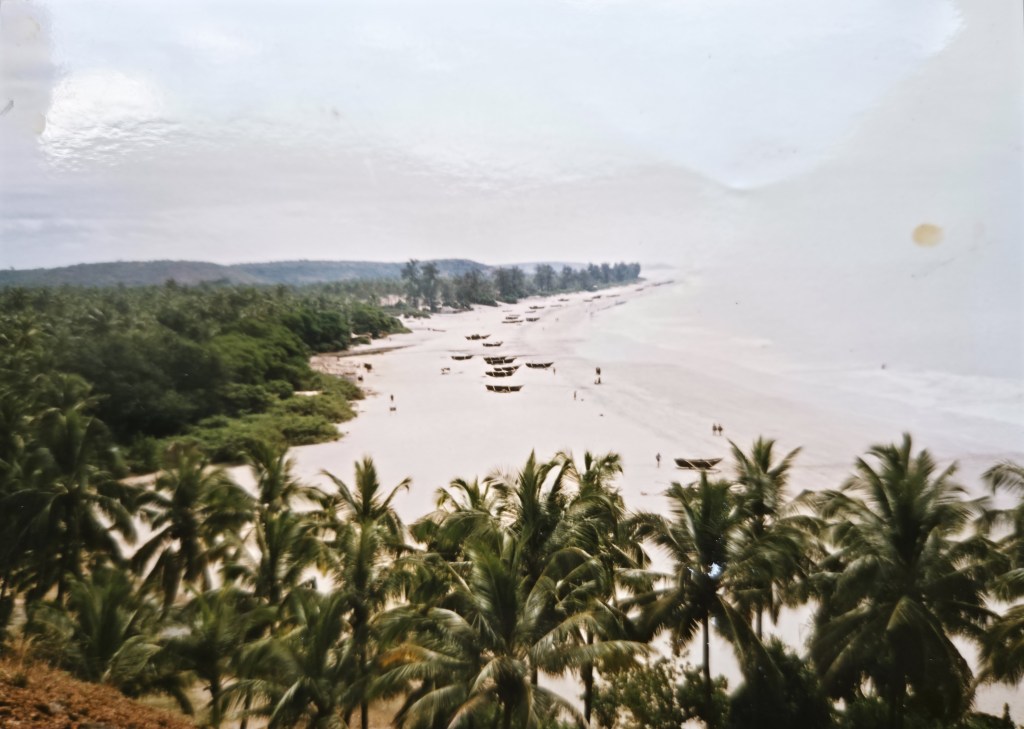
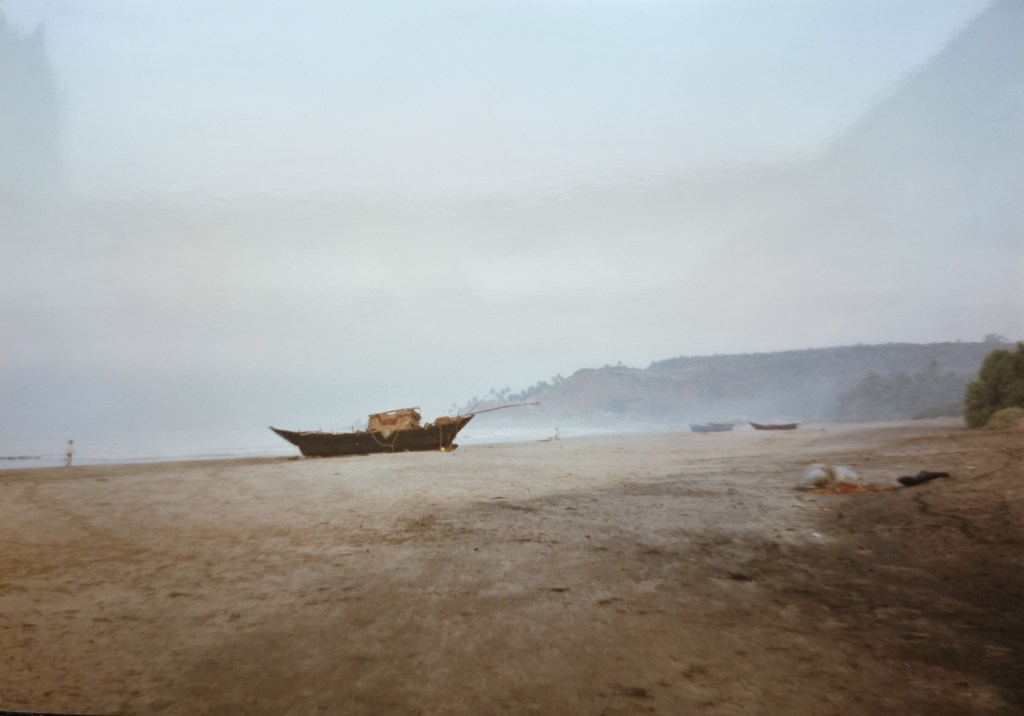
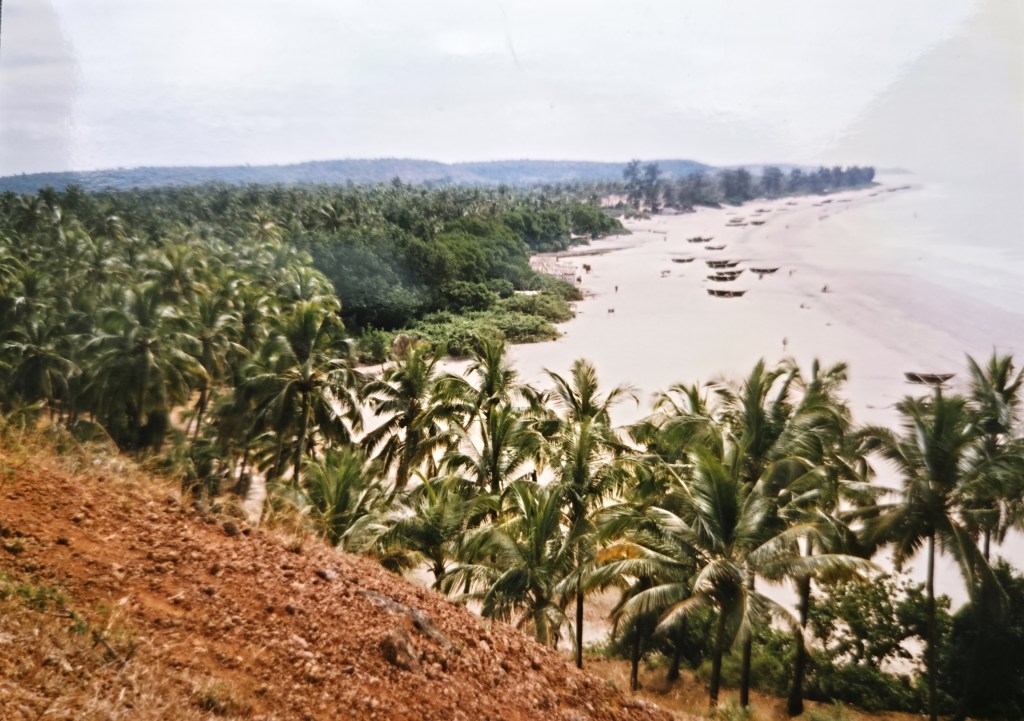
After a day and night, I realise this beach is the closest to untouched I’ve seen in India. The only thing spoiling it is us being there. The only things on the beach are three fishing boats.
It doesn’t take long before the rose-tinted glasses slip. The seawater isn’t clear. Sewage from the village runs through an open sandy channel into the ocean. I only notice it after a few days watching locals casually step over it. My perfect beach wasn’t as perfect as it first looked.
Daily Life and Accommodation in Arambol.
Most days are spent in a beach shack. Because there are fifteen of us drinking every day, whichever shack we choose ends up doing extremely well financially. Beer is unbelievably cheap—usually 15–17 pence a bottle. One shack is run by a man from London with Jamaican parents who’s been in Arambol for about twenty years, long before many westerners.
In 1994, £1 buys about 5–6 shack beers. By 1998, the same pound buys seven beers. It’s not because beer got cheaper; it’s the rupee collapsing. Western pocket money suddenly goes a long way, accelerating the tourist influx and changing the village economy.
I rent a room mainly to store my rucksack—with my first Good News Bible inside—and to have somewhere quiet if needed, but I rarely sleep there. One place has a cockerel perched outside my door that wakes everyone at dawn.
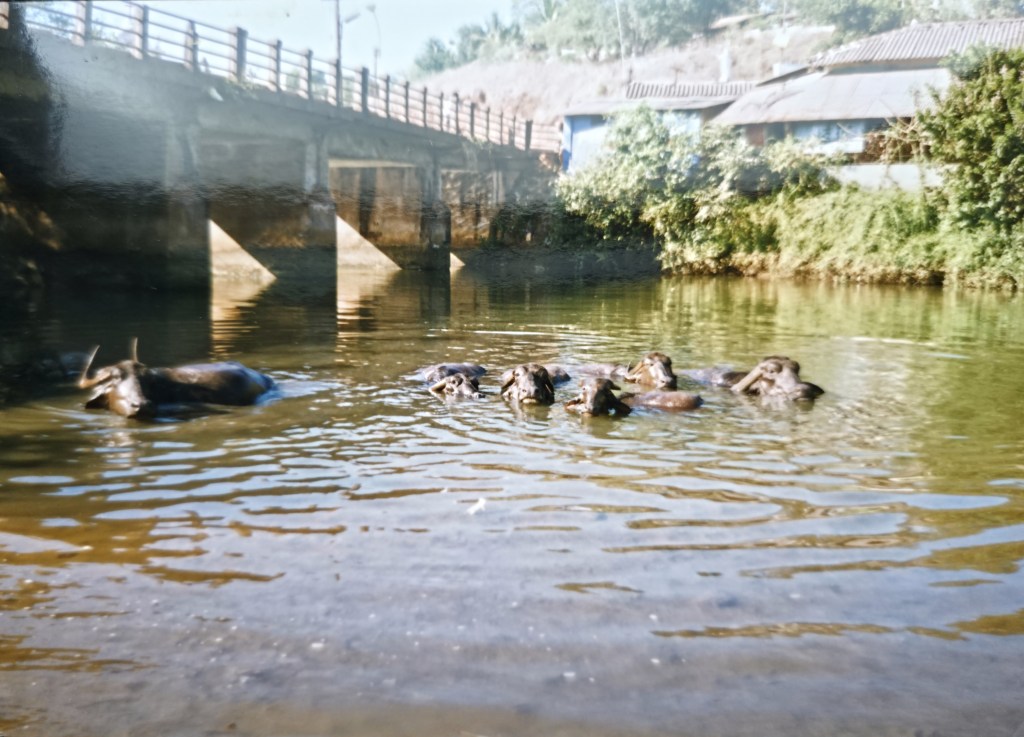
Mostly I sleep in beach shacks after long nights of drinking. I move regularly between beach and village. I find a local barber with a shack that has no windows, just holes in the walls; he shaves my head and face, places hot towels on me, and I fall asleep in the chair. A large water buffalo often sticks its head through the hole in the wall and wakes me by licking my face. This becomes a ritual—the buffalo, the shave, the hot towels, and me drifting off.
We also play football with the villagers. They play what I call “killer football.” Rough, aggressive, and fast. They love it when we give back as good as we get.
Fenny Episode.
About four weeks in, Jay asks if I’ve tried fenny. I thought it was made from cashews; he says the stuff here is coconut-based. I ask the London/Jamaican bar owner where to get it. He tells me to walk 200 yards up the beach to a closed shack where a man will be asleep.
I find him sleeping on the floor. I whisper “Fenny.” He gets up silently, dips a clear plastic tube into an old barrel, and offers me a choice: a 2-litre jug or a 5-litre jug. I point to the 5-litre. He fills it. When I ask, “How much?” he shakes his head. I give him about 70 rupees—more than enough. He smiles and goes back to sleep.
Back at the shack, no one else wants any, so I drink it slowly myself. Sitting, I feel fine. But when I stand to go to the toilet, I realise I’m “drunk from the legs up”—mind clear, legs completely drunk.
Village Habits and the Dawn Chorus.
From the shack I notice a morning pattern: villagers coming down to the sea to defecate and urinate. Heavy coughing, spitting, farting, cockerels crowing—the combined noise is like a strange “morning chorus.”
Fishing With the Village.
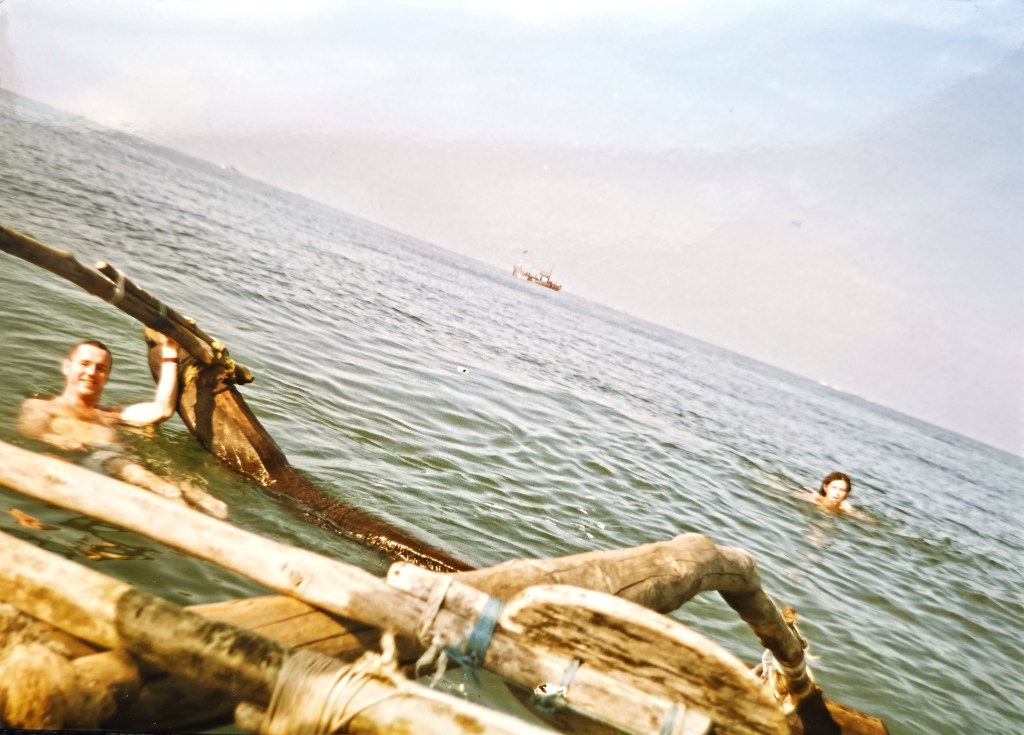
Over time I get to know the fishermen. I help push boats out in the mornings. Eventually they invite me in the boats for the early fishing runs. I love it—deep water, away from the toilet runoff. I never swim in the surf again, only out at sea.
I become close with one fisherman and his son. I go to their home early; he’s always still asleep. “Goa pace,” he tells me. We fish morning and evening. In the mornings we go far out; the water is slightly cleaner, and I dive into swim even though visibility is terrible. In the evenings we set nets near shore.
One morning swim nearly ends in disaster. A huge swarm of box jellyfish drifts towards me. The fisherman and his son are shouting and waving urgently. At first, I wave back—then I realise I’m being warned. I swim back to the boat as fast as I can. From inside the boat, I see the swarm glide through where I had been.
Arambol Beach, Goa, as it truly was in the 1990s.
In the evenings villagers gather to pull the nets in and share the catch. I join often and am always given fresh fish.
Moving to an Unfinished Shack.
At one point I live with a family—the Gunga family—but the place feels “too nice.” I want something simpler. I find a half-finished shack made of timber poles, palm-leaf thatching, and cow-dung flooring.
It has no doors, no windows—just holes. Animals can wander in pigs, cows, snakes, dogs. I buy a rope and hook, lift my rucksack into the rafters to keep it off the floor, and sleep on a woven wooden roll-mat with a proper handmade Goa blanket for the cold nights. My companions are geckos on the walls eating mosquitoes. I could watch them for hours.
Porcupine and Dogs.
One morning a huge porcupine—about the size of a pig—runs through the village. Villagers kill it right outside my hut, strip the skin, pull the quills, share the meat, and give the dogs the rest.
By the end of tourist season villagers lure dogs to the beach and cull them. Dogs roam in packs during the season, then disappear. One night a pack of fifteen follows me aggressively. I picked up the biggest branch I can find, swing it, and warn them off.
The Banyan Tree.
I meet Jack, an Australian who travels Goa often. He tells me about a giant banyan tree, supposedly the third biggest in the world. We pack bread, water, and bananas and hike through forest and clay pools where we cover ourselves in drying white clay. Monkeys come down for food; we share some.
At the tree we find sadhus performing rituals around a central fire. I stay three days and nights. They wrap me in blankets and a traditional head scarf. I’m deeply tanned by then—dark as the locals from fishing. When I return down the mountain, my brother thinks I’m a local and nearly doesn’t recognise me. The sadhus give me their pipe to smoke a couple of times over the three days; the whole experience is calm, relaxing, almost otherworldly. I learn to play the didgeridoo there and bring one home from Goa.
Guitar on the Beach and the Fake Police.
One night I hear faint guitar music and follow it down the beach. A Swedish man is sitting alone, playing beautifully, a spliff in his mouth. I sit behind him, not wanting to disturb him. He notices, nods, and keeps playing. He tosses me the joint; I take a couple of drags and stub it out in the sand.
A noise behind us makes me turn. A group of twelve to fifteen Indian men in brightly coloured hand-knitted balaclavas approach—some with eye holes cut in completely the wrong place. They claim to be police. I recognise one as a villager. They accuse us of having hashish.
I tell them I’ll go get my fifteen friends so we can all pay them together. That ends it. They wander off. The guitarist smiles and keeps playing.
Photography, Temples, and Weddings.
Back then there are no mobile phones and hardly anyone carries a camera. I bring two disposable Kodaks and only take photos on days I deliberately go out looking for things to capture.
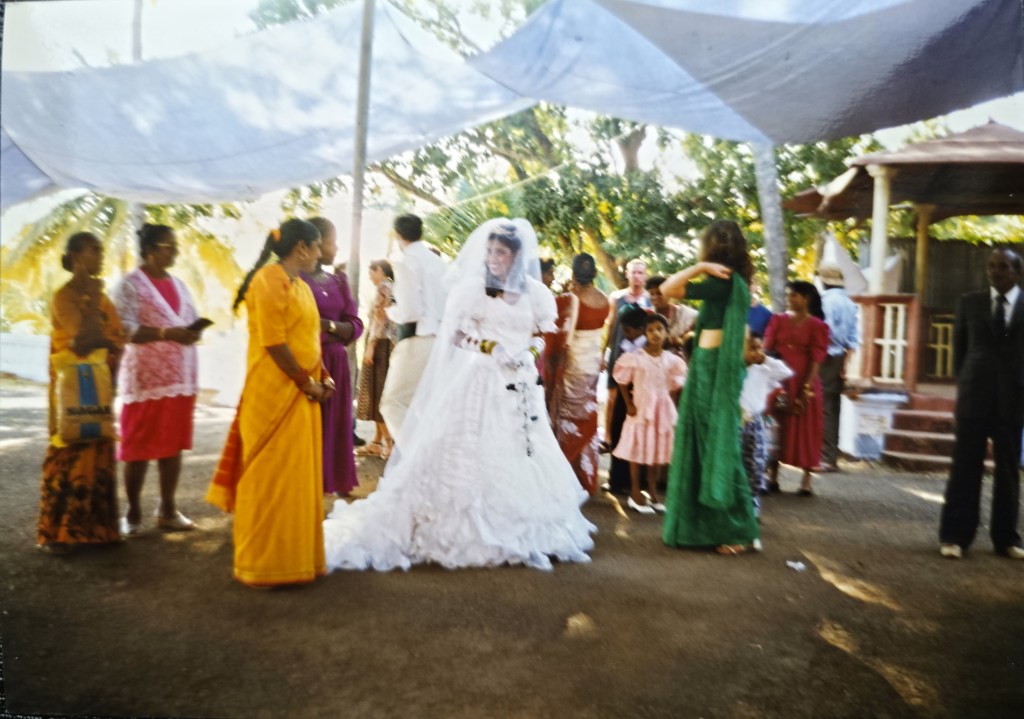
After six weeks in the village, three of us are invited to two weddings—a Hindu outdoor wedding and a Christian one in a small church. The contrast is obvious. Hindu: loud, vibrant, drums, colour everywhere. Christian: peaceful, restrained, but later everyone dances and sings.
Villagers ask why I dress like I have nothing yet spend so much in the village. I explain the woman who washes my clothes beats them on a rock with glycerine soap and destroys anything nice. Because of the heat I mostly wear simple Indian clothes and a single pair of jeans I cut down.
To attend the weddings, we buy new clothes. I keep photos of the Christian church and its Catholic imagery—crucifixion scenes, Mary and the infant Jesus.
When I get home, I develop the photos and show them to my brother’s friends who live close to North London. They look at them and say, “These are boring. Where are all the partying photos?” I tell them I was interested in capturing the place—not posing for drunken snapshots.
Just before the end of November 1999, I’m with a group of friends from my local area – some I’ve known for decades, others for ten or five years. I’m telling stories about Goa at Christmas from the earlier trips: the shacks, the beaches, the madness, the quiet.
By the end of the evening someone says, “Why don’t we go for the millennium?” That’s it. Decision made. “Let’s do it.”
We each book flights separately. I give people the details of the broker who usually books mine; some go through him; others sort themselves out. Alan and Gemma, a couple in the group, book their own flights. One friend, Lyn, chooses the absolute cheapest route, going via Russia and somewhere else, taking a much more complicated path to Goa.
By this time the Goa airport is built and up and running. Everyone arrives before me. I land about four days later than the rest, bringing a ridiculous amount of duty-free whisky, vodka, and cigars. No stopover in Saudi this time, so nobody confiscates anything.
2000 – Six-Bedroom House and a Changing Village.
For most of my friends, this is their first time in India and in Goa. They haven’t seen Bombay or anywhere else – just straight into this little corner of Goa that I’ve been coming back to for years.
On my first trip in the 1990s I’d gone through Bombay and eaten my first meal in a big hotel that would later be known for a terrorist attack. This time, I leave the airport in a rickshaw with my mate Lance. On the way he casually drops it into the conversation:
“We’ve rented a six-bedroom house.”
I laugh and say, “I didn’t know there were houses like that in Goa.”
Turns out it’s the only one like it in the village. It belongs to a local family I’ve met before over the years. It’s made of brick, with a proper slate roof. There’s an indoor shower and a separate bathroom with a Western toilet. Water is switched on to fill a tank bolted high up on the outside wall, and the whole system runs by gravity.
For Goa, in that little fishing village, this is the West arriving. It feels like the beginning of the end of its old peace and quiet.
Each person gets about a one-minute shower to wash and get ready in the evenings. The routine is simple: you wet the bar of soap, lather your whole body with a tiny bucket – the kind kids use for sandcastles – and then you’ve got one minute under the shower head to rinse off the lot before the water pressure dies. I don’t like it. I preferred the old way, pouring water over my head from the village well, staying closer to the life of the locals.
There are seven of us in total staying there. Alan and Gemma share one room; the rest of us spread out over the others. It’s comfortable, too comfortable. Eventually I decide the rent is too much and move back out into a shack again. The old pattern returns I go back to sleeping in simpler places while the others enjoy the “luxury” house.
Hammock Makers and Undercover Police – Millennium 1999-2000.
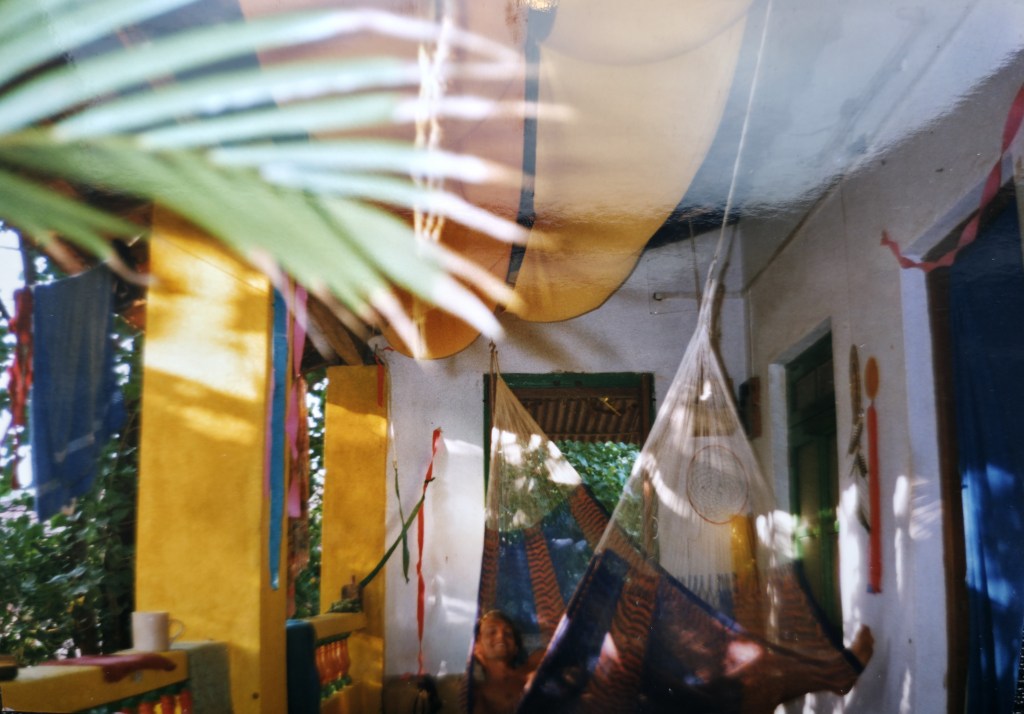
Over the years I become friends with a couple who make and sell very good quality hammocks. They always seem to be in Goa, year in, year out. They know the village, the locals, and the different layers of police – including the plainclothes officers.
They invite me to their place for homemade food; I go often, and one day I invite them down to the beach with the promise of drinks and food on me all day.
By sunset the beach is busy. People are smoking strong cannabis derivatives – “cream,” “gum,” and other forms that are closer to oil and crystal than the usual stuff. It’s powerful and hallucinogenic. Plainclothes police mingle with the tourists.
The hammock-maker’s wife gets up and starts walking around the beach, casually picking up small sticks. Each time she passes a plainclothes officer, she plants a little stick in the sand next to them. After quietly marking them all, she comes back and announces to everyone, “Wherever you see a stick, that’s a policeman.”
Bold, funny, and very accurate.
By this point the game has shifted. It’s no longer just fake “police” trying to extort a bit of money. Now the real police are operating undercover with quotas to hit – a certain number of arrests, a certain amount of bribe money. The money moves up the chain, and everyone takes their cut.
If you’re caught with even a small amount of cannabis, you’re looking at a possible ten-year sentence in an Indian or Goan prison. Many tourists pay bribes to avoid that. If the police are short on their monthly numbers, they sometimes pick people at random on the beach, leading to court cases, jail terms, and people being stripped of their money and sent home in disgrace.
Beach Shack Christmas and the Pig Meal.
On one of my trips back – about two years after the first time in Arambol – I buy an open ticket that lets me stay for up to six months. The shack where my friends and I had spent weeks on my first trip has done so well that the original owner has moved on to other business. His brother has taken it over and tried to “modernise” it with breeze blocks and Western touches.
We don’t like it. It feels wrong. So, we walk further up the beach and find a very basic timber-frame shack run by a young lad in shorts and flip-flops. He’s there every morning when we arrive, serves us beer all day and all night, cooks on a single ring stove behind a curtain, and somehow manages to get us whatever we ask for.
Around Christmas he tells us, “Christmas dinner is on us. You won’t have to pay.”
When the food arrives, it’s a brown broth with bones and no meat – from a village pig. We know what the pigs have been eating. They’re the village waste system, living under the shack toilets and eating human excrement as it falls. Looking into the bowl and seeing mostly bones, none of us can bring ourselves to eat it.
We don’t want to offend them, so we say it’s “too spicy” and ask if we can have something else. They bring vegetarian food. We decide to stick to vegetarian food and fish in India and leave the pig meat alone.
My first close encounter with the pig system had been at about three in the morning after a day and night of laughing and drinking. I was using a shack toilet – a simple hole in the floor – when a large pig’s snout suddenly appeared through it, eating as I continued. I remember joking with the pig and asking if it wanted wine with its meal.
New Year 2000 – Three Days of Parties.
By the time New Year’s Eve 1999 rolls round, the whole group and I have been on a heavy week-long drinking session. On New Year’s Eve itself we head to a party in a bamboo forest. The music is tribal and repetitive. After about three hours, it all sounds the same to me. Everyone is doing the trance-step dance, locked into their own world.
We mostly drink, watch everything, and chat with people.
As usual, a bit of trouble tries to find us when someone starts on one of my friends. I tell the bloke to leave us alone; he does, and that’s that.
Sometime in the early hours I fall asleep at the bamboo party. Instead of taking me home, my brother and friends carry me to another party. I wake up in daylight at a beach party on Day Two. We get some sleep on the beach during the day, then party again through the night.
On Day Three I wake up at yet another party in a completely different place. Everyone I came with has gone back. I have no idea where I am in Goa.
Then I spot one of the African lads I know from Arambol – someone I’ve become friendly with over the years. I walk over, offer him a beer, and ask, “Where are we?” I explain that I started in a bamboo forest three days ago and have been transported from party to party while asleep.
He laughs loudly, tells me where we are, and where the taxis are hiding. I find a taxi, get back “home” to my shack, and sleep there properly for the first time in days. By now I’ve moved out of the expensive house because I think the rent is too high. I sleep off three to five days of near-continuous drinking.
Parties, Israeli Soldiers, and A Broken Man.
By 2000 there are motorbikes everywhere – big 350cc Indian-built versions of old British Enfields. Packs of young Israelis who have finished their national service roar into Goa on them, usually in big groups. They arrive loud, fast, and ready to blow off steam.
I see and hear about far too many casualties. Chemists treat tourists as test subjects for new drugs – acid, ecstasy, all kinds of experimental blends. Some people never fully come back.
One night our group goes down to the beach for a big fire party. I show people how to build a proper beach fire that will last all night: dig a big hole, buy wood from locals over several days, and pack the fire with dry sand so it burns low and isn’t so visible to the police.
A large group of Israeli ex-soldiers sit around the fire with us. One of them gives me a hard, aggressive look, then gets up, walks behind me, and slaps me on the back of the head. I decide to let it go.
Ten minutes later he does it again, harder, on the top of my head.
I stand up and address the rest of the group, asking who he’s with. I tell them they know he’s out of order and it’s on them to control him, so I don’t have to. Then I sit back down.
A short while later, he comes round again and kicks me in the lower back. That’s it. I tell my friends we’re leaving, and we walk about a hundred metres to another shack where people know me from previous years. The same London/Jamaican bar owner is there and tells me that once the Siolim–Chopdem bridge is finished in 2002, he plans to leave because direct road access will turn the beach into a crowded, sunbed-lined circus.
We’re sitting on floor mats in his shack when the same Israeli soldier walks back in with five others. He kicks me in the back again while I’m seated. I jump up. He drops into a martial arts stance. I tell him he’s going to need it. I quickly get him in a throat hold and throw him over two of the little table bays. He lands in the sand, not on anything solid, and his mates drag him out.
A very large American man, who looks ex-military to me, stands up and says, “We don’t want trouble here. Trouble started when you came in.” I tell him I didn’t start it and explain that the soldiers followed us. I say the man is struggling and looks completely gone, probably from too many experimental drugs.
The American says, “I want you out.”
I reply, “If you think you can get me out, you can try.”
The shack owner, the London/Jamaican man, speaks quietly to him, and the American sits back down. The situation deflates.
The next morning the American and I are the first two in the shack. We end up talking, get on really well, and spend two days and nights drinking together and laughing. The aggressive Israeli’s parents fly out to Goa to collect their son. He has become a casualty – mentally and spiritually – and is beyond his friends’ control.
They ask to meet me and thank me for not hurting him. I tell them there’s no need to thank me and wish them well in getting him home safely. They arrange for him to fly back to Israel. Over that period, I see and hear too many horror stories of drug casualties in Goa, people broken in body and mind.
Bible, Seeking Years, and a Later Realisation.
Before I ever became a Christian, I was already a seeker. I always travelled with a Bible – my first Bible, a Good News Bible with an orange cover and simple line drawings. A pastor had once recommended it as a good starter Bible. I can’t remember exactly how young I was when I first got it, but by the time of my Goa years it was worn from use.
Wherever I stayed in Goa – shacks, huts, fishermen’s homes, village houses – that Bible was always next to my roll-out mat. Sometimes the places had no doors or windows, sometimes the doors were left open all night. But the Bible stayed by my mat.
I travelled light. My rucksack held very little apart from that Bible and a few essentials.
By 2000 and earlier, I noticed that everywhere we went locals seemed to recognise the bikes we’d hired. We’d ride little mopeds, 125 Hondas, or Enfields that we’d rented from village families. We’d travel to beaches far away from the main crowd or to places like the Anjuna flea market, and someone would say, “You hired that from my cousin,” then ask how much we paid. We’d laugh about how close-knit the village networks were.
Years later, on 28 November 2025, it hit me: it’s very possible the whole village knew I slept with a Bible by my mat. Goa has Christian communities. Villagers talk about visitors, especially ones who keep coming back year after year. A foreigner who drinks like the rest, lives a simple tourist way, but always has a Bible beside his bed – that would have been noticed, that’s what we witnessed with the locals. It was a part of community safeguarding.
Looking back, I can see those Goa years as part of a long-term “seeking” and God’s call across decades – even though I hadn’t gone there to study religion. I thought I was chasing sun, sea, and parties. Something else was going on.
From Goa to the Gospel.
During one break at Arambol around 2000, after six weeks of sun, sand, sea, and parties, I opened my rucksack and took out my Good News Bible again. I’d seen stone and wooden idols being worshipped. I’d seen the mash-up of Hinduism and Catholic Christianity left over from centuries of Portuguese rule. I’d seen people bowing down to gods they themselves had carved.
Something in me, which had been building for years, refused to accept that the beauty of the world, the universe, and the rare glimpses of real love we see were all an accident. I wanted to search. I wanted to know the truth.
That was the beginning of the journey where Christ found me – lost in a world that worshipped false idols: money, material things, stone gods, wooden gods, even papier-mâché gods paraded at festivals in Bombay.
I’ve travelled through many countries in my life, and everywhere I went I saw the same thing — people worshipping idols. Not carved statues only, but the things we all lift up above God. In India, the idols were literal and handmade, shaped from wood, stone, plaster, or metal. Back home in Britain, the idols weren’t statues at all, but money, status, possessions, comfort, and the need to look successful. Different forms, same root. We all create something to replace the God we don’t want to face. Seeing that contrast so clearly was part of what led me to look deeper into the Gospel.
Back in Blighty, some years later, I watched YouTube videos of Arambol Beach and felt sick. It was unrecognisable. A total freak show. Huge crowds. No fishing boats. Rows of sunbeds like a Spanish resort. One friend of mine kept going out there for six months every year, renting a house or shack, then working six months in metal framework back in the UK. He gave me updates about the changes – the arrival of the Russians, the area nicknamed “Little Russia,” and the rest of it.
For me, after 2000, it was over. I stopped going. The fishing village I’d known had gone.








Leave a comment